

 GMA Brandtalk
 Tracking
 Archives

Etched in history: Who is the judge who took on 2009 Maguindanao massacre case
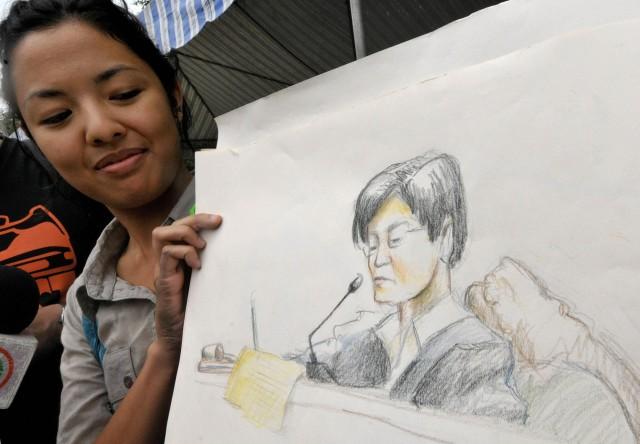
Judge Jocelyn Solis-Reyes would have been wise to inhibit from the 2009 Maguindanao massacre case when it landed on her lap, rather than risk the lives and safety of her loved ones, including her own.
Yet, the presiding judge of the Quezon City Regional Trial Court (RTC) Branch 221 bravely took on the high-stakes case. A decade later, after handing down guilty verdicts to the masterminds of the gruesome murder of 58 people, her name is now etched in the annals of history.
The verdict
On Thursday, over 10 years since the haunting massacre, Solis-Reyes convicted members of the powerful Ampatuan clan of 57 counts of murder and sentenced them to reclusion perpetua without parole.
Among those convicted were former Datu Unsay mayor Andal Ampatuan Jr., former Autonomous Region in Muslim Mindanao governor Zaldy Ampatuan, Anwar Ampatuan Sr., Anwar "Ipi" Ampatuan Jr., and Anwar Sajid "Ulo" Ampatuan.
The multiple murder and eventually historic case stemmed from the gruesome killings on November 23, 2009 of journalists, and relatives and supporters of then gubernatorial candidate Esmael "Toto" Mangudadatu who was seeking to challenge the Ampatuans’ hold over Maguindanao.
The victims were ordered to go up a hill where they were brutally shot to death and then buried along with their vehicles.
The massacre has been dubbed the single most brutal attack on journalists worldwide and the Philippines’ worst case of election-related violence.
Much has been said about the trial possibly dragging on for between 20 years (as one prosecutor estimated) and 200 years (as one lawmaker had said).
But Solis-Reyes earlier told GMA News Online that she, herself, wanted the trial to be over, and that she was doing everything in her capacity to expedite the multiple murder trial, without compromising any of the parties' rights.
Re-raffled case
Quezon City RTC Judge Luisito Cortez was originally assigned to handle the case. However, Cortez inhibited due to security concerns.
Then Chief Justice Reynato Puno re-raffled the case, which landed on the lap of Solis-Reyes.
The Philippine National Police offered a security detail to Solis-Reyes, but the judge refused.
A change of plans
In an interview with The Varsitarian, the official student publication of her alma mater University of Santo Tomas, Solis-Reyes revealed that she had initially planned on becoming a journalist.
After obtaining a degree in journalism from Lyceum of the Philippines, Solis-Reyes said she was nudged by her mother to take up law.
She passed the Bar in 1987 after graduating from the UST Faculty of Civil Law.
Solis-Reyes launched her career in law as a public attorney from 1992 to 1995.
She then served as a public prosecutor between 1995 and 2000 until she was appointed as a presiding judge of municipal trial courts.
Solis-Reyes was appointed presiding judge of Quezon City RTC Branch 221 in 2004.
In the years following 2004, Solis-Reyes would find herself sifting through volumes of documents for a case with almost 200 accused and later on pen a landmark ruling for half of those that would become her legacy as a judge. — MDM, GMA News

