

 GMA Brandtalk
 Tracking
 Archives

Treaty vs. nuclear weapons won't affect gov't bid in exploring nuclear energy in Philippines
The pending Senate concurrence to the ratification of the Treaty on the Prohibition of Nuclear Weapons (TPNW) would not prevent the Philippines from exploring nuclear energy, an official of the Department of Foreign Affairs (DFA) said Thursday.
"This does not affect our current nuclear energy program. What is prohibited is the acts enumerated in Article 1 and this does not affect the inalienable rights of the state to pursue, research, and development in the peaceful uses of nuclear energy," DFA Director Marge Malang said in a Senate hearing on foreign relations.
Among the prohibitions stated in Article 1 of the treaty are the development, testing, production, manufacturing, acquiring, possessing, and stockpiling of nuclear weapons or other nuclear explosive devices.
States who ratified the pact are also prohibited to use or threaten to use nuclear weapons and nuclear explosive devices.
Allowing any stationing, installation or deployment of these weapons in its territory or at any place under its jurisdiction or control is likewise against the treaty.
President Rodrigo Duterte formed the Nuclear Energy Program Inter-Agency Committee last July to study the possibility of tapping nuclear energy as the Philippines seeks to ensure steady power supply to meet the demands of a growing population and its economy.
The study, led by the Department of Energy, focused on the assessment of the viability of introducing nuclear power into the State's energy mix, taking into consideration the economic, security, and environmental implications, and engagement of the public and relevant stakeholders; among others.
In a statement, Senator Francis Tolentino said the Philippines will be able to strengthen its claim over the South China Sea should it become a State Party to the treaty.
The senator said that a state party has an obligation to declare whether there are any nuclear weapons or nuclear explosive devices in its territory or in any place under its jurisdiction.
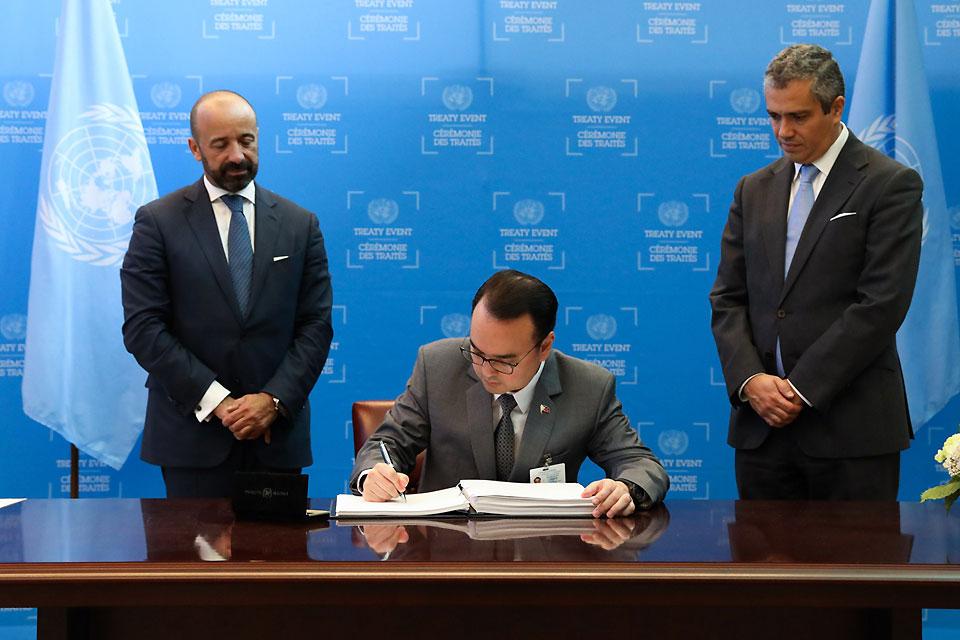
The Treaty on the Prohibition of Nuclear Weapons, signed by the Philippines in September 2017, would strengthen the legal and political norms on the use of nuclear weapons, increase the stigma against its use, and place greater pressure on nuclear weapon states, according to the DFA.
China, France, Russia, UK, and US are the five nuclear weapon states mentioned during the hearing.
The Senate committee on foreign relations, led by Senator Aquilino "Koko" Pimentel III, endorsed the treaty to the plenary for the concurrence of the Senate to the ratification of President Rodrigo Duterte.
The instrument of ratification was sent by the President to the Senate on November 18, 2020.
According to the 1987 Constitution, "no treaty or international agreement shall be valid and effective unless concurred in by at least two-thirds of all the Members of the Senate."—With a report from Joahna Lei Casilao/AOL, GMA News

