

 GMA Brandtalk
 Tracking
 Archives

Australia unveils maritime package for Philippines, vows commitment to SCS presence
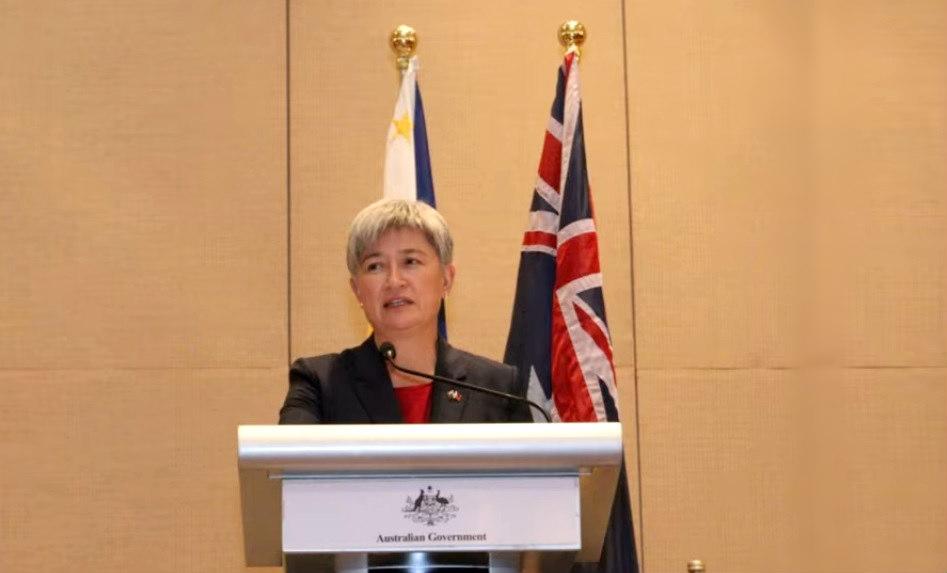
Australia on Thursday unveiled a maritime security and cooperation package for the Philippines to improve the country’s domain awareness amid simmering tensions with China in the South China Sea, as it vowed to strengthen its presence in the region, including in the disputed waters.
Australian Foreign Minister Penny Wong, currently in Manila for an official visit, said initiatives include technical assistance and capacity building for the Philippine Coast Guard; provision of equipment, including drones; and skills and technology to improve maritime domain awareness and marine protection.
It will also provide assistance to mitigate the environmental impacts of the recent oil spill in Mindoro and support for women’s leadership in maritime security.
“The Philippines is a long-standing important security partner for us,” Wong said at a joint press conference with counterpart Foreign Secretary Enrique Manalo.
She is the fourth high-level Australian official to visit the Philippines since January of this year.
“We are committed to continuing Australia’s long-standing presence in the region, including in the West Philippine Sea, South China Sea,” Wong said.
On Tuesday, Wong met with Philippine Coast Guard officials, who shared their current experiences while patrolling the West Philippine Sea, where several incidents of harassment by Chinese vessels were reported against Filipino fishermen and government ships.
In that meeting, Wong said both sides reiterated the importance of rule of law, particularly adherence to the United Convention on the Law of the Sea (UNCLOS), which sets a comprehensive regime of law and order in the world's oceans and seas.
Australia, Wong said, is open to participating in joint maritime patrols in the West Philippine Sea, noting that such cooperation is crucial in maintaining freedom of navigation and overflight in the waters where a bulk of global trade passes through.
China, which considers the sea disputes a purely Asian issue is opposed to any foreign intervention, particularly from the US.
The US, long-time defense treaty ally of the Philippines, and China are at odds over the long-seething territorial row in the strategic waters, where Beijing has turned several former reefs into artificial islands with military facilities, runways and surface-to-air missiles.
Analysts said America's continuing presence in the South China Sea will ensure "balance of power" in the region.
Manalo said various modes of cooperation are currently being explored by the Philippines with Australia, Japan and the United States.
“We are certainly planning to take forward these discussions in the very near future,” he said.
Manalo and Wong, in their joint statement, agreed on “the importance of securing a region that is open, stable and prosperous, where sovereignty is respected and where States operate in accordance with
agreed rules and norms.”
Wong also expressed Australia’s strong support for the 2016 Arbitral Tribunal ruling, which declared China’s massive claim in the South China Sea as having no basis under international law.
Having nearly eight decades of bilateral relations, Manalo and Wong discussed the progress and renewed the commitment between the two countries to elevate the relationship to a Strategic Partnership—a higher level of cooperation that includes defense and security.
Manalo and Wong also agreed to enhance trade and investment
cooperation, including exploring possible cooperation on critical minerals, and to continue exploring opportunities to improve two-way tourism.
To strengthen people-to-people connections, a Work and Holiday Visa
Arrangement is being negotiated between the two countries, their joint statement said.
Wong also said that Australia’s Official Development Assistance to the
Philippines would increase to an estimated AUD89.9 million for 2023-2024 to support programs including cooperation on shared priorities including inclusive economic growth, education, training and scholarships, disaster and climate resilience, and peace and
stability in Mindanao.
This amount is in addition to an AUD10.95 million commitment to support the Philippines to establish a new immunization information system and a strengthened laboratory network and surveillance system, addressing disruptions to routine immunization during the pandemic. — BM, GMA Integrated News

