

 GMA Brandtalk
 Tracking
 Archives

Sweden defense chief denounces dangerous acts vs PH in WPS
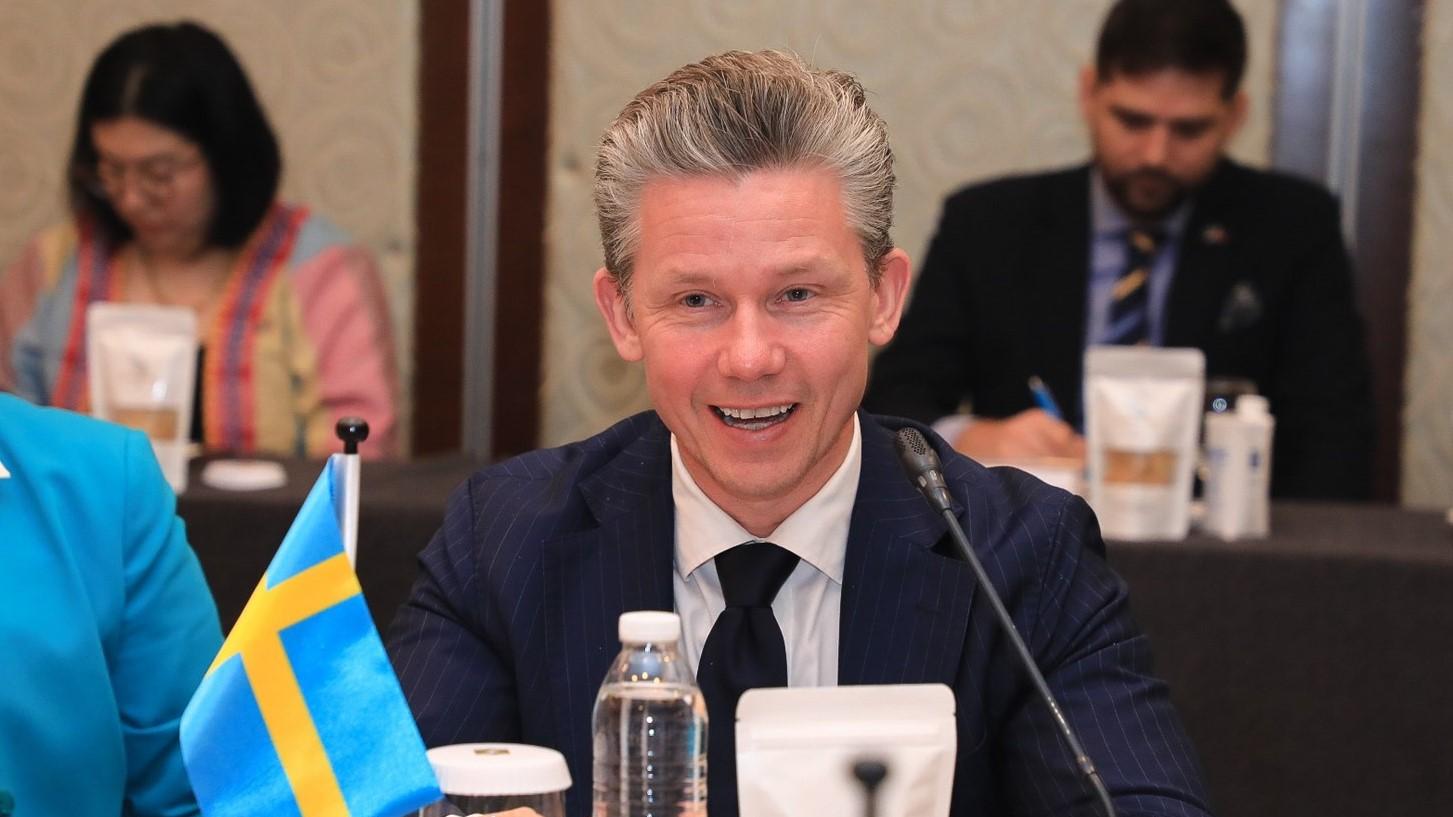
Sweden's defense minister Pal Jonson has denounced the series of dangerous maneuvers against Philippine vessels in the South China Sea, saying such acts put human lives at risk and undermine regional peace and security.
Speaking before Sweden's National Day reception Thursday night, Jonson, who was in Manila for an official visit where he met Philippine counterpart Gilberto Teodoro and other officials to bolster bilateral defense and security ties, said such actions are a threat to global security, stressing that safety at sea "must be respected at all times."
Jonson did not mention China by name but recent aggressive Chinese actions in the South China Sea prompted serious concerns and condemnations from several countries after China's coast guard vessels blasted water cannons and lasers to prevent Philippine government ships from conducting resupply missions from a shoal that Beijing claims as its own.
Incidents of collision between Chinese and Filipino vessels and several injuries from the Philippine side have also been reported.
China has also been blocking Philippine vessels and fishermen and installed barriers at the Scarborough Shoal, which lies within Manila's exclusive economic zone under a United Nations (UN) maritime convention.
"Let me express my deep concern on the repeated dangerous maneuvers against Philippines vessels that have been taking place in West Philippine Sea and the South China Sea," Jonson said, using Manila's name for the disputed waters which falls within its exclusive economic zone (EEZ) as mandated by a United Nations law.
"These acts put human lives at risk, they undermine regional stability and international law, and they threaten the security in the region and beyond. These are not only threats to your national security but the threats to our common global security," Jonson added.
Sweden's position adds an important voice aside from several countries led by the United States, Japan, and Australia to the Philippines' stance that the territorial disputes should be resolved peacefully within the framework of the United Nations Convention on the Law of the Sea or UNCLOS.
"Sweden stands firm behind the call of the European Union and others for restraint and full respect for international law to ensure peaceful resolution of differences and a reduction of tensions in the region," he said.
Jonson added, "The UN Charter, UNCLOS, and the arbitration of 2016, as well as other relevant international rules and regulations related to the safety of life at sea, should be respected at all times."
A vital trading and shipping lane, the South China Sea, dotted with rocks, shoals and reefs where rich oil and mineral deposits were found, are claimed in part or in whole by the Philippines, China, Vietnam, Malaysia, Brunei, and Taiwan.
China's vast territorial claims in the waters have sparked tensions and violent confrontations with smaller claimants, like the Philippines and Vietnam.
The Philippines largely won a landmark case against China's massive claim in the South China Sea before an arbitration tribunal in The Hague, Netherlands in 2016, but Beijing refused to participate in the arbitration process and recognize the ruling.
Sweden recently became a member of the North Atlantic Treaty Organization (NATO) on March 7 this year, ending its national and international identity as a neutral and non-aligned state.
Jonson said Sweden, which will soon launch its Indo-Pacific Strategy, is eyeing "deeper and more comprehensive" security and military cooperation "than it's ever been" with the Philippines and other like-minded allies and is considering playing a more active role in the region. He said that he recently met with his counterparts from the US, Japan, and Australia.
Sweden, he added, is looking into joining regional exercises and sending its military in higher education training. Closer people to people relationship, trade and investment are also key priorities, he said.
The Philippines and Sweden in June 2023 signed an Acquisition of Defense Material agreement that allows cooperation on areas of logistics, technology research and development, defense industry development, and exchange of related information.
"We want to be a long-term partner of the Philippines in the area of security and defense," Jonson said, noting that "safe sea lanes of communication and freedom of navigation is a core interest for Sweden." — VDV, GMA Integrated News

