

 GMA Brandtalk
 Tracking
 Archives

License of bus driver in tragic SCTEX crash revoked
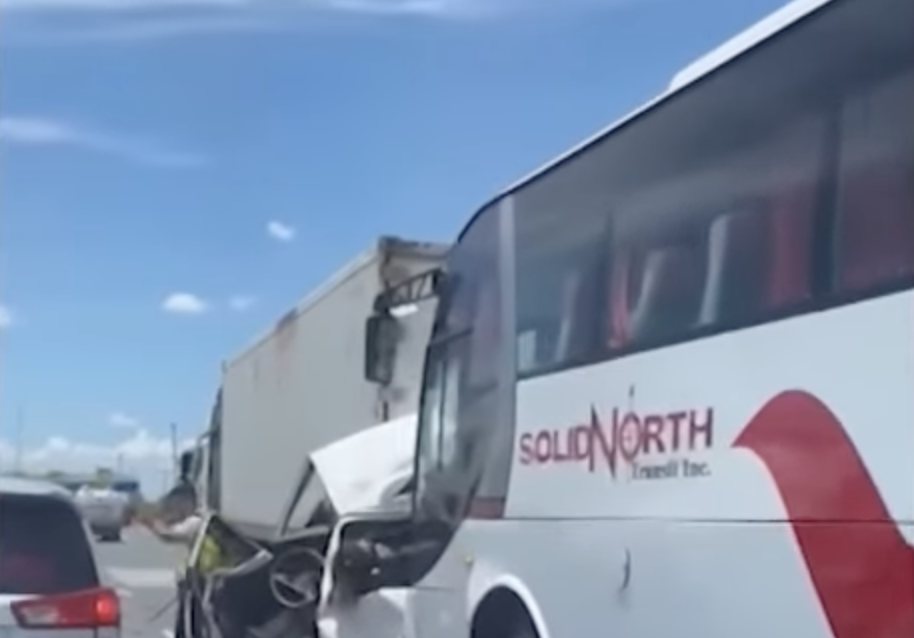
The Land Transportation Office (LTO) announced Monday that it has revoked the driver’s license of the bus driver involved in the fatal multiple-vehicle collision at Subic-Clark-Tarlac Expressway (SCTEX) last week.
“We already revoked with perpetual disqualification the license of the driver. When he refused to take the drug test, that was already the signal for us [that] under the law, we can revoke already the license and then perpetual disqualification,” LTO chief Assistant Secretary Vigor Mendoza II said in a press conference.
Transportation Secretary Vince Dizon also announced that they will push through with the filing of criminal and civil cases against the Pangasinan Solid North Transit Incorporated, whose bus was involved in the crash that killed 10 individuals and injured at least 30 others.
“This means that we will demand compensation over and above ‘yung usual TPL (Third-Party Liability) insurance. Hindi ito TPL lang, ‘yung compensation na sinasabi ko, hindi ito limitado doon sa makukuha nung mga biktima galing sa TPL ng Solid North,” Dizon explained.
(This means that we will demand compensation over and above the usual TPL insurance. This is not just TPL, the compensation I’m talking about is not limited to what the victims will get from Solid North’s TPL.)
Meanwhile, Land Transportation Franchising and Regulatory Board (LTFRB) chairman Teofilo Guadiz III said that all the 278 Solid North buses will be required to undergo a motor vehicle inspection to ensure their roadworthiness.
He said the inspection will not be done manually, but by machines by the Private Motor Vehicle Inspection Centers (PMVIC) that are accredited by LTO.
The LTFRB chief also highlighted that all the drivers and conductors of Solid North will be mandated to undergo a drug testing that will be conducted by clinics duly authorized by the Department of Health.
To recall, operations of the Pangasinan Solid North Transit Inc. have been suspended for 30 days following the fatal incident, in compliance with a directive from the Department of Transportation (DOTr).
Guadiz said the LTFRB has tapped other provincial buses to take over the routes of the bus company to cater to passengers, especially considering the expected exodus for the upcoming national and local elections.
“I assure the riding public na meron pong supisyente at sapat po ang mga buses na lalabas po sa daan. Even as we speak today, may mga special permits na kaming ini-issue,” he added.
(I assure the riding public that there are sufficient buses that will ply the road. Even as we speak today, we are issuing special permits.)
Negative drug test result
The Tarlac City Police Station earlier disclosed that the bus driver involved in the accident tested negative for illegal drugs and alcohol.
Senator Ronald “Bato” dela Rosa, who previously served as Philippine National Police (PNP) chief, had urged the police force to insist on the conduct of a drug test on the bus driver, in accordance with Republic Act No. 10586 or the Anti-Drunk and Drugged Driving Act.
“The driver should not refuse and the PNP should insist to subject the said driver to a drug test under this existing law,” the reelectionist senator said.
Ang Probinsyano Party-list Representative Alfred Delos Santos, meanwhile, called for a road safety review and reforms following the SCTEX crash, as well as the other one at the Ninoy Aquino International Airport (NAIA) Terminal 1.
“Drivers are not supposed to be under hazardous working conditions like long working hours, fatigue, and sleep, this is not only for their protection but especially for their passengers and all motorists in general,” Delos Santos said.
Dizon on Monday announced that the government will now require all drivers of public utility vehicles (PUV) to undergo mandatory drug testing, following this series of recent road accidents which killed at least a dozen individuals.
He said he also asked the LTFRB and LTO to revise the maximum number of consecutive hours that PUV drivers can ply the road from the current 6 hours, down to 4 hours.
He also directed these attached agencies to make “real” road-worthiness assessments of PUVs, and enforce “very strict, enforceable, and regular” checks similar to the standards of other countries.—AOL, GMA Integrated News

