

 GMA Brandtalk
 Tracking
 Archives

China says US should stop using PH to make trouble as PH reiterates sovereignty
China on Friday urged the US to refrain from using the Philippines to create trouble as the Philippines reiterated its sovereignty over Pag-asa island and all of its cays.
In a press conference, Chinese Foreign Ministry spokesperson Mao Ning said: "We advise the U.S. side not to use the Philippines to stir up trouble in the South China Sea, and not to undermine peace and stability in the region."
GMA News Online (GNO) contacted the US Embassy but it said it has no comment about the statement from Beijing. The embassy referred GNO to the US State Department and the Philippines' Department of Foreign Affairs (DFA) instead.
GNO then contacted the DFA for comment but it has yet to receive a statement as of posting time.
Mao's statement came in light of an X post by US Ambassador to the Philippines MaryKay Carlson, who condemned China’s aggressive actions against Philippine research vessels.
“The China Coast Guard’s aggressive actions against a lawful [Philippine] civilian mission near Sandy Cay recklessly endangered lives and threaten regional stability. We stand with our [Filipino] allies in support of international law and a Free and Open Indo-Pacific,” Carlson said Thursday.
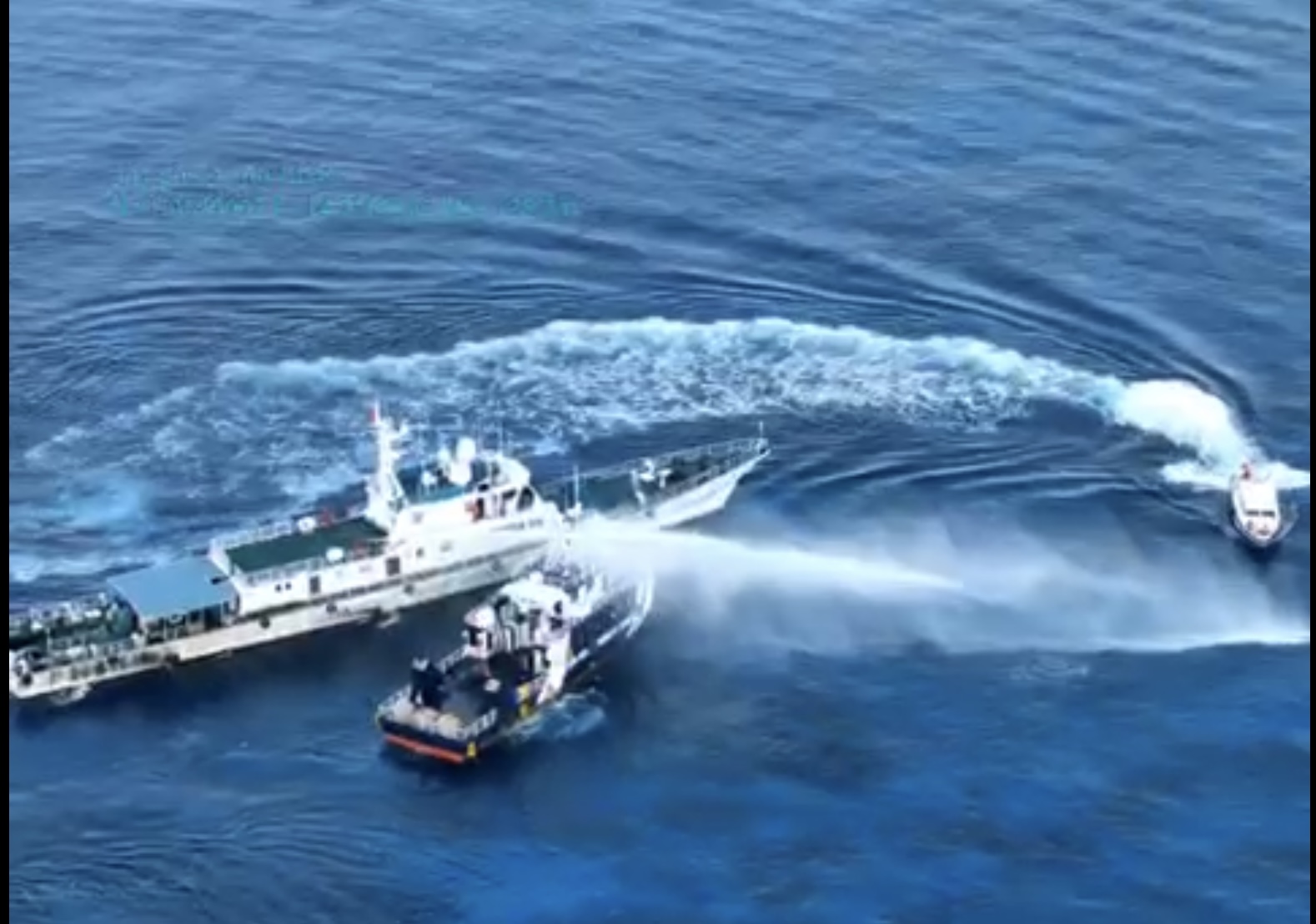
Earlier on Thursday, a China Coast Guard (CCG) ship reportedly fired water cannon and sideswiped a Philippine Bureau of Fisheries and Aquatic Resources (BFAR) vessel in Pag-asa Cay 2 (Sandy Cay) in the West Philippine Sea (WPS).
In a statement, BFAR said its BRP Datu Sanday and BRP Datu Pagbuaya were on a routine mission with a scientific team to collect sand samples in the area as part of a marine scientific research initiative.
BFAR said the Philippine scientific team was able to complete its operations in Pag-asa Cays 1, 2 and 3 despite the CCG and Chinese maritime militia vessels’ “aggressive, dangerous, and illegal” actions.
The bureau pointed out that the incident happened within the territorial sea of the Philippines in the area of Pag-asa Island and Pag-asa Cay 2, which are part of the Kalayaan Island Group in the WPS.
China however claimed that the Philippines was illegally sending people to Tiexian Jiao, its term for Sandy Cay, which it said was part of Nansha Qundao or the Spratly Islands.
The CCG on Thursday said it took "control measures" against Philippine ships and confirmed a collision occurred between the two sides' vessels.
“China Coast Guard has released a statement and on-site video footage on the incident. The facts speak for themselves… That severely infringes on China’s sovereignty, and violates the Declaration on the Conduct of Parties in the South China Sea,” Mao said.
China insisted that their actions were fully necessary, legitimate, and lawful.
“The Philippines needs to immediately stop its infringement activities and provocations. Otherwise, China will make a resolute response,” Mao said.
In response, the National Maritime Council (NMC) condemned the actions and reiterated that the Philippines had longstanding sovereignty and jurisdiction over Pag-asa island and all of its cays.
"These deliberate acts of interference and intimidation seriously violate the sovereignty of the Philippines and constitute a grave violation of international law, particularly the United Nations Convention on the Law of the Sea (UNCLOS), and the relevant domestic laws,” the NMC said in a statement on Friday.
Tensions continue as Beijing claims almost all of the South China Sea, a conduit for more than $3 trillion of annual shipborne commerce, including parts claimed by the Philippines, Vietnam, Indonesia, Malaysia, and Brunei.
Parts of the South China Sea that fall within Philippine territory have been renamed by the government as West Philippine Sea to reinforce the country’s claim.
The West Philippine Sea refers to the maritime areas on the western side of the Philippine archipelago including Luzon Sea and the waters around, within and adjacent to the Kalayaan Island Group and Bajo de Masinloc.
In 2016, the Permanent Court of Arbitration in the Hague ruled in favor of the Philippines over China's claims in the South China Sea, saying that it had "no legal basis."
China has refused to recognize the decision. —with a report from Reuters/KG, GMA Integrated News

