

 GMA Brandtalk
 Tracking
 Archives

Marcos: Accelerate adoption of SCS Code of Conduct to prevent miscalculation at sea
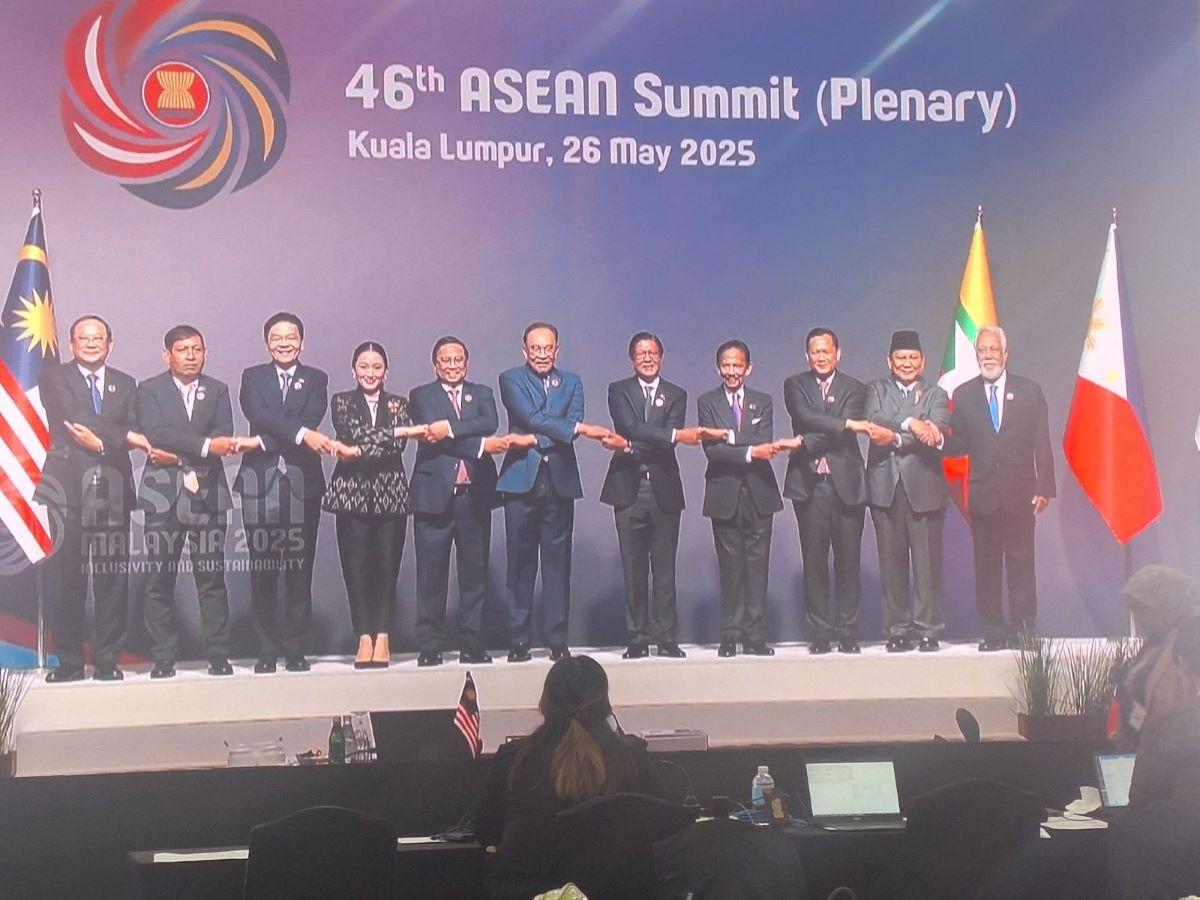
KUALA LUMPUR - President Ferdinand ''Bongbong'' Marcos Jr. emphasized Monday the need to hasten the adoption of the Code of Conduct on the South China Sea to prevent miscalculations at sea.
''We underscore the urgent need to accelerate the adoption of a legally binding Code of Conduct in the South China Sea,'' Marcos said this during his intervention at the ASEAN plenary.
Marcos said this is to safeguard maritime rights, promote stability, and prevent miscalculations at sea.
In his speech, he also pointed out the need to continue engaging partners, not just to expand networks, but to uphold and project ASEAN values, such as peace, inclusivity, and shared progress.
Marcos said the Philippines' strategies help define its path towards deeper stability and security. He added that the country would continue its efforts in ensuring that the regional bloc will be secure, peaceful, stable, and governed by law.
''Yet these objectives can only be realized by working together with our partners as we collectively navigate a constantly shifting global architecture. Sustainable growth requires that we invest in our people,'' he said.
To recall, member states of the regional bloc and China have agreed to complete a Code of Conduct on the South China Sea by next year despite contentious issues that have prevented its creation to push through, the Philippines' Department of Foreign Affairs (DFA) earlier said.
In August 2018, the ASEAN and China agreed to a single draft of the COC, with an agreement reached in November 2018 for both sides to finalize the document within three years, starting from 2019. No final document was agreed upon since then.
The proposed code aims to set rules to prevent the intensifying dispute in the South China Sea from spinning out of control and worsening into a major armed conflict that could involve the United States, an ally of the Philippines, and other Asian countries at odds with China.
China currently claims almost the entire South China Sea, including areas claimed by the Philippines, Vietnam, Indonesia, Malaysia, and Brunei.
While a ruling of the Permanent Court of Arbitration in The Hague sided with the Philippines and stated China’s claims over the South China Sea had “no legal basis” in 2016, China has not recognized said decision and continues its aggression in the region.
Philippine officials said the China Coast Guard (CCG) recently water cannoned and sideswiped the BRP Datu Sanday (MMOV 3002) twice, resulting in some damage to its port bow and smokestack.
The incident also put at risk the lives of its civilian personnel onboard.
It was the first time water cannons had been used against a Philippine Bureau of Fisheries and Aquatic Resources (BFAR) research vessel in the area of Sandy Cay, a strip of sandbars near the Philippine-occupied Pag-asa Island.
The Philippines refers to Sandy Cay as Pag-Asa Cay.—AOL, GMA Integrated News

