

 GMA Brandtalk
 Tracking
 Archives

Israel back to normal but will help OFW repatriation, says ambassador
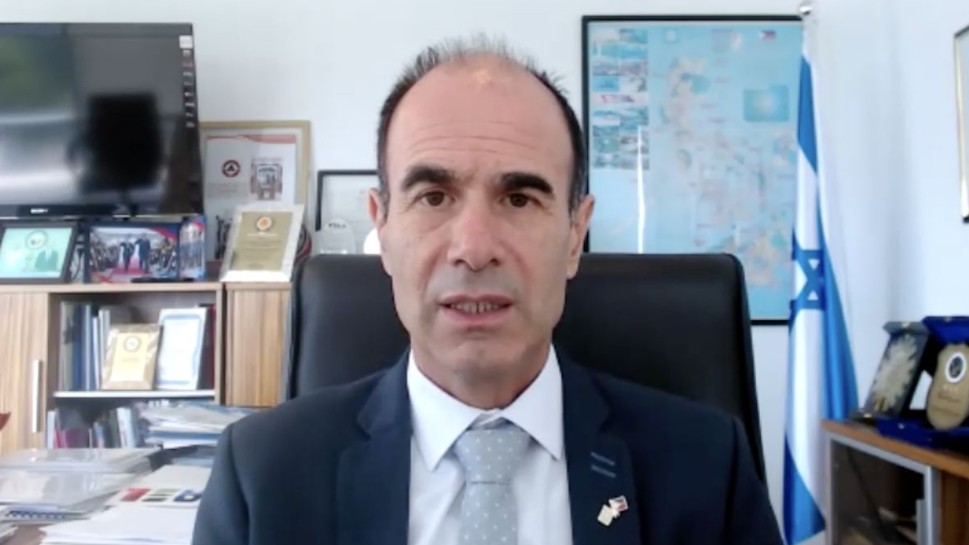
Israeli Ambassador to the Philippines Ilan Fluss said Wednesday the situation in Israel is back to normal but its government will continue to assist Filipinos who wish to be repatriated.
In an interview with GMA News Online on Wednesday, the ambassador confirmed the state of emergency in Israel has been lifted following a ceasefire between his country and Iran.
“Life in Israel is back to normal, which means for the [Overseas Filipino Workers] in Israel, it is safe to go out, to go do your shopping, to meet your friends, continuing with daily life as you did before,” Fluss said.
“I think it's also a very good and positive message, of course, to the families here, knowing that the loved ones in Israel are sort of back to normal life and don't have to go every night, like my family or our families in Israel who had to go once, twice, three times a day into the shelters and suffering from those missiles falling in different parts of the country,” he added.
Despite the improving condition in the region, Fluss maintained Israel will not stop any OFW who wished to return to the Philippines, and that repatriation efforts are being conducted in coordination with the Philippine Embassy, Overseas Workers Welfare Administration (OWWA), and the Department of Migrant Workers (DMW).
On the part of Israel, Fluss shared his country has aided repatriation efforts by coordinating crossing routes.
“It's a free country. Israel is not putting any obstacles in that way. There's no problem. They're entitled to whatever they are supposed to get,” he said.
Israel is also offering psychological assistance to OFWs who may have been affected by the conflict, and said his government is doing its best to care for Filipinos in need of medical attention.
The diplomat said OFWs who chose to be repatriated may return without a re-entry visa should they wish to return to Israel.
“They can simply come back. So this is again an Israeli government initiative in order to make people feel easier in leaving the country, but knowing that they can come back and they don't need to apply for re-entry visa,” he said.
The right to be a state
The ambassador denied claims from Palestine that it was Israel framing the war as religious, saying it is “disinformation and misinformation.”
Rather, he shared that Israel was simply fighting for its right to become a state.
“You know, the Palestinians are trying to put blame on Israel, on everything, and any bad word they can say, they will try. That's part of the, unfortunately, sort of disinformation and misinformation, and they're putting Israel in the image of being the bad guy,” he said.
“It's a very, very complicated issue. I never claimed that it's a religious conflict... And there's no desire to create war against other religions, where full democracy, that's not the issue. The issue here goes to a different place. It is recognition of the right of the state of Israel, which is the homeland for the Jews to exist,” he continued.
Fluss said that Israel’s goal to be recognized as its own state was behind their conflict with Iran and Hamas, which resulted in the deaths of about 1,200 persons during the October 7, 2023 attacks.
“We are seeing what is the kind of attacks and terrorism that they're spreading and who they are targeting, and why are they doing this? Because they don't want to see the Jewish state of Israel, the homeland of the Jews there. They want to annihilate the state of Israel,” Fluss said.
“We're always saying Israel has to be strong, because only when you're strong, you'll survive, because you are being targeted again and again… Thank God, we are strong. We are able not only to survive, but to thrive,” he added.
Fluss acknowledged that a part of Palestine’s territory was occupied by Israel, but noted Israel provided Palestinians in these areas with rights and autonomy. He also clarified that Gaza was not under occupation.
“Until then, they had no autonomy, they had no self-rule. And the idea was to try to move on with a peace process with the Palestinians. And this was the goal, in order to end us occupying some parts… As long as we don't have a partner to negotiate peace, there is no way forward from the Palestinian and from their point of view of resolving this conflict between us and the Palestinians. And we will continue, unfortunately, to struggle,” he said.
Fluss hopes for a future where Israel would be accepted as its own state, and asked Palestinians would find it in themselves in the future to acknowledge this.
A rise in anti-semitism
Meanwhile, the ambassador rejected accusations that Israel labeled its critics as anti-semitic.
While he noted there has been a recent increase in anti-semitic sentiments, he said that it was normal and legitimate to have arguments and political discussions as long as the right of a state to exist was not being denied.
“We are seeing a global raise of anti-Semitic sentiments, which is alarming. Globally, we're seeing an increase to 46% of the responders who expressed anti-Semitic sentiments. I said in the Philippines, and this is why I actually talked about it, we have seen also a rise in anti-Semitic sentiments… Not acts, not statements, but sentiments by the people who responded. And it went up in 10 years from 3% to 42%,” he shared.
“That's something that I think globally has to be raised… We have a history and centuries of persecution against the Jews. However, not every criticism of political issues and arguments are anti-Semitism. There is a global definition of anti-Semitism, and the Philippines has joined the global definition of anti-Semitism,” he added. —RF, GMA Integrated News

