

 GMA Brandtalk
 Tracking
 Archives

3 bodies exhumed in search of missing sabungeros —Remulla
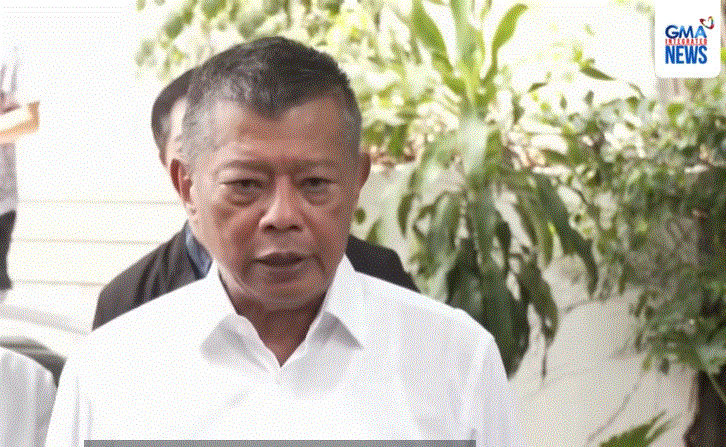
Authorities are now digging up at least three bodies in Batangas who may be connected to e-sabong or the drug war amid the ongoing search for the missing sabungeros, Justice Secretary Jesus Crispin Remulla said Wednesday.
In Ian Cruz’s report in “24 Oras,” authorities dug a portion of a public cemetery in the town of Laurel using a backhoe. It was at around 1 p.m. when they found what they believe are human bones.
Remulla said authorities are looking into locations that may have been used not only for e-sabong but also the drug war.
“There were some victims found in 2020 that were just buried by the police because nobody claimed them in the punerarya (funeral parlor). We’re exhuming them now as we speak because we have to find out who these people are,” he said in an ambush interview.
“We’re setting up the DNA bank that we need to set up precisely because of those people who are missing. ‘Yung mga disappearances ng mga tao dapat ma-solve ‘yan,” he added.
According to the 24 Oras report, grave digger Magdaleno Salamatin recalled that he buried three bodies in the said portion of the public cemetery. But he noted that they were not buried on the same day as the remains were found in different places.
Salamatin also said that he buried the bodies three or four years ago and from what he knew, these were victims of salvage or summary execution.
“Hindi ko kilala, sir. Basta dine-deliver lang sa akin ‘yun. Inaabisa lang sa akin at nire-report lang sa akin na, ‘mag-ready ka at may salvage na ililibing tayo,” he said.
(I don’t know them. They were just delivered to me. They advised or reported to me to prepare because we needed to bury these ‘salvage’ victims.)
He added that the bodies were already decomposing when they were buried.
Asked if this means authorities are now investigating drug war killings, Remulla said their focus remains on the missing sabungeros.
However, he said that authorities have no choice but to include everything due to a supposed intersection in the two cases.
Remulla previously said that some people who may be involved in drug war killings may also be involved in the deaths related to e-sabong.
“Yung ano eh, yung actors eh, yung mga taong involved sa what we call enforced disappearances. parang nagkaka— nagkatugma na isang grupo ginamit pareho. They were part of the drug war and they were part of the disposition dito sa e-sabong,” he said.
(The thing is, the actors, the people involved in what we call enforced disappearances, it seems like— it matches that one group was used for both. They were part of the drug war and they were part of the disposition here in e-sabong.)
However, Remulla declined to comment on Vice President Sara Duterte's statement that former President Rodrigo Duterte found the alleged link between the drug war and the missing sabungeros preposterous.
“I have no comment on that. I have no response to that,” he said.
Last week, authorities started searching Taal Lake for the remains of the missing sabungeros. This came after whistleblower Julie “Dondon” Patidongan claimed that more than 100 sabungeros were abducted, killed, and then dumped at Taal Lake.
Earlier, members of the Japanese Embassy visited the Department of Justice.
Remulla said they relayed the Philippine government’s request for equipment and assistance with the DNA analysis.
“Although we have a very competent crime lab, a police crime lab, and an NBI crime lab capable of looking at DNA, we’re looking at the best possible persons who can help us also. Kasi, this is not an easy task. We need all the help we can get,” he said.
He said that the request is being processed.
On Tuesday, the Philippine National Police said authorities recovered what may be a human hip bone with a length of eight inches among the more than 90 bone fragments retrieved. —LDF/RF, GMA Integrated News

