

 GMA Brandtalk
 Tracking
 Archives

PSA: Only 70.8% of Filipinos aged 10–64 functionally literate
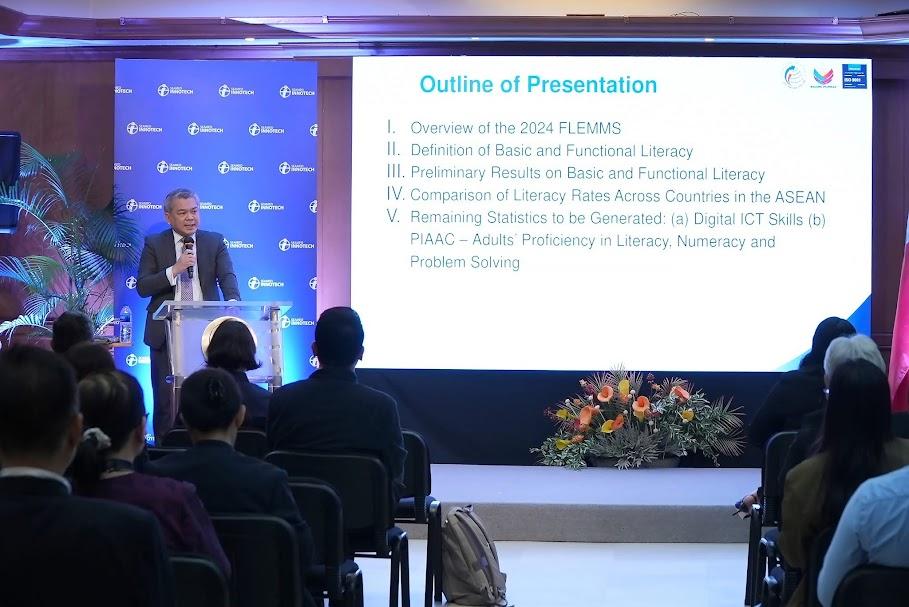
The Philippines is facing a comprehension crisis, according to newly released government data, with more than 1 in 5 Filipinos aged 10 to 64 having difficulty understanding what they read—despite being able to read, write, and compute.
This alarming gap was exposed in the 2024 Functional Literacy, Education, and Mass Media Survey (FLEMMS), unveiled Thursday, July 31, by the Philippine Statistics Authority (PSA).
According to National Statistician Claire Dennis Mapa, the basic literacy rate—the share of people who can read, write, and compute—is 93.1%, but only 70.8% are considered functionally literate, meaning they can also comprehend.
“For every nine individuals aged 10 to 64 who can read, write, and compute, two have difficulty with comprehension,” Mapa said during his presentation at SEAMEO INNOTECH in Quezon City.
The 22.3-point gap reveals a troubling reality behind seemingly strong literacy numbers—what some observers now call a hidden learning crisis.
New definitions reveal deeper truths
This year marks a turning point in the way literacy is measured in the country. The PSA, in consultation with DepEd and EdCom II, revised its definitions:
Basic literacy now includes numeracy alongside reading and writing.
Functional literacy adds the crucial skill of comprehension, tested directly for the first time.
Previously, even those who merely finished high school were automatically counted as functionally literate. But PSA analysis of 2019 data showed that 2% of high school completers could not comprehend what they read—prompting the agency to remove automatic classifications and instead assess every individual aged 5 and up.
“There’s no more automatic assignment. Everybody is tested now,” Mapa said.
A national problem with local faces
Mapa emphasized that the updated FLEMMS is now more granular, with results available down to the provincial and highly urbanized city level—the most detailed literacy survey yet.
Key findings show staggering disparities:
- Tawi-Tawi posted a functional literacy rate of just 33.2%, meaning only 1 in 3 residents aged 10–64 there can read, write, compute and comprehend.
- BARMM had the highest illiteracy rate at 14.4%.
- Zamboanga Peninsula (Region IX) had the lowest functional literacy among regions at 59.3%.
In contrast, Benguet led provinces at 87.9%, while San Juan City topped all highly urbanized cities with 94.5%.
Women ahead, seniors behind
Women consistently outperformed men across literacy metrics:
- 74.1% of women aged 10–64 are functionally literate, compared to 67.6% of men.
- Age matters: The 20–24 age group had the highest functional literacy (78.3%), while seniors aged 60–64 had the lowest at 57.8%.
Mapa said these patterns reflect both generational access to education and the growing impact of digital information environments, which are now being captured in new modules on ICT skills and problem solving.
Education doesn’t guarantee comprehension
The survey reinforced the strong link between educational attainment and literacy:
- 93.2% of post-baccalaureate individuals were functionally literate.
- Only 10.8% of those with no schooling passed the functional literacy test.
Still, Mapa cautioned against equating diplomas with understanding.
“Completing high school does not necessarily mean you understand what you read,” he said, aligning with EdCom II findings and the World Bank’s 2022 learning poverty estimate that 91% of Filipino 10-year-olds could not read and comprehend a simple story.
Mapa clarified that while methodologies differ, both reports signal the same problem — that school completion is no longer a reliable measure of learning.
Philippines still competitive in ASEAN—barely
The PSA also compared the country’s performance against ASEAN peers. Using the standard “can read and write” definition:
The Philippines scored 94.6%, slightly behind Malaysia (95.7%) and Indonesia (96.7%).
But unlike most countries that rely on proxy answers (from a household head), the Philippines tested individuals directly—a more rigorous method.
“We directly tested over half a million individuals, five years old and above,” Mapa said, noting that this sets the Philippine data apart from most ASEAN states.
More data to come: digital literacy, adult competencies
The PSA announced that further results from FLEMMS will be released in the coming months, including:
A new Digital Literacy module, measuring skills in data handling, content creation, online safety, and collaboration.
The Philippines’ first participation in the OECD-aligned Programme for the International Assessment of Adult Competencies (PIAAC), covering 11,000 households.
From national data to local action
Mapa said PSA’s goal is not only to inform national policymakers, but also to empower local governments by providing literacy data tailored to their cities and provinces.
“We want LGUs to own the data—this is your province’s result, your city’s challenge. What actions should your local government take?” he said.
The next FLEMMS is scheduled for 2027, a shorter three-year interval to help track progress before the end of the current administration. — BM, GMA Integrated News

