

 GMA Brandtalk
 Tracking
 Archives

DBM submits proposed 2026 P6.793T nat’l budget to House
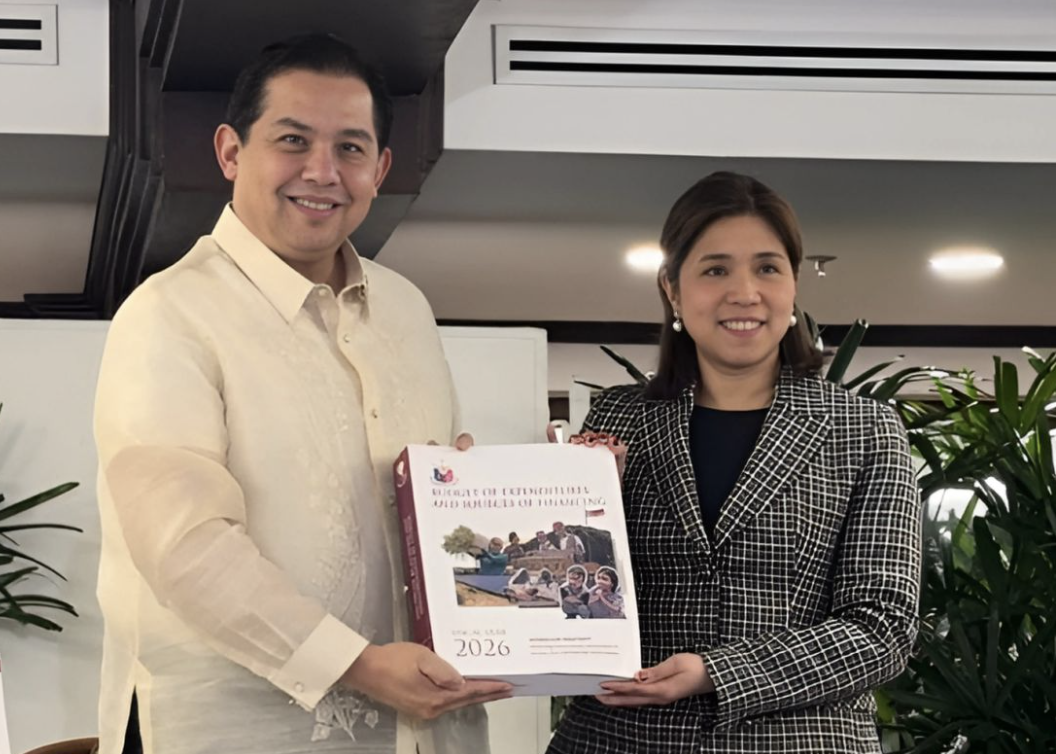
The Department of Budget and Management (DBM) on Wednesday submitted the P6.793-trillion National Expenditure Program (NEP) to the House of Representatives.
The legislative body, holding the “power of the purse,” is now set to start deliberating on the proposed budget allocations set by the executive branch for 2026 after the submission of the DBM.
The Budget Department’s submission came a day after the 2026 NEP was presented to President Ferdinand “Bongbong” Marcos Jr.
The NEP, the national government’s spending plan for the next fiscal year, serves as the basis for the General Appropriations Bill (GAB) —once approved by Congress— which upon signing into law by the President becomes the General Appropriations Act (GAA).
Marcos approved the proposed national budget for next year last month.
The proposed budget was equivalent to 22.0 % of gross domestic product and higher by 7.4% from the fiscal year 2025 budget of P6.326 trillion.
“While this is 7.4% higher than this year’s P6.326 trillion national budget, the Economic Team carefully considered the available fiscal space and worked diligently to tighten the budget,” Budget Secretary Amenah Pangandaman said in her remarks during the ceremonial turnover of the 2026 NEP.
Next year’s proposed expenditure plan resulted from about P10.101 trillion budget proposals which was trimmed down due to limited fiscal space and the fiscal consolidation strategy as it targets gradually reducing the national government’s deficit from 5.5% of GDP in 2025 to 4.3% by 2028.
“Only those within the available fiscal space were considered. This ensures that even as we strengthen the economy and strive to achieve the nation’s full potential, we remain committed to reducing the budget deficit,” Pangandaman said.
Philippine Development Plan
The Budget chief further explained that the DBM evaluated all budget submissions in consideration with its alignment with Philippine Development Plan 2023-2028, shovel-readiness, agencies’ absorptive capacity, fiscal space, and highest impact.
“For 2026, the largest allocation will go to Social Services— covering education, health, and social protection—with P2.314 trillion or 34.1% of the total budget, followed by Economic Services at P1.868 trillion or 27.5%,” Pangandaman said.
In particular, she said that P1.224 trillion or 16.6% of the total proposed budget was earmarked for basic and higher education next year.
For the healthcare sector, the budget was set at P320.5 billion, up 23.6% from this year, which includes subsidies for PhilHealth to cover insurance of indirect contributors and medical assistance to indigent and financially challenged patients.
“We are also increasing the budgets of DOH hospitals in Metro Manila by 20.2% and DOH regional hospitals by 26.1%. This also includes funding for the operational needs of BUCAS Centers, bringing affordable, quality healthcare closer to every community,” Pangandaman said.
Under the 2026 NEP, the DBM approved a P239.2-billion budget for the Department of Agriculture (DA).
“To support our farmers, we will triple the budget for the Rice Competitiveness Enhancement Fund (RCEF) [at P30 billion] and increase the budget for the National Rice Program by 38% [to P29.9 billion]. In addition, we will establish a National Agricultural Food Hub [P2.1 billion], which will serve as a major distribution and marketing center,” she said.
“We will also continue the Rice for All Program [P10 billion, providing affordable rice through KADIWA Centers and local markets—benefiting over 15 million households,” she added.
For the administration’s infrastructure initiative, Build Better More Program, the DBM has set aside P1.556 trillion for 2026, equivalent to 5% of GDP.
“We will also dedicate P87.33 billion to accelerate the digital transformation of government services,” the Budget chief said.
“Among our other priorities: We will boost income-earning abilities with a P55.2 billion allocation for labor and employment,” Pangandaman said.
The Budget chief added that the government “will protect our sovereignty and territorial integrity with a P299.3 billion allocation for the Department of National Defense.”
“For peace and order, the Department of the Interior and Local Government will receive P287.5 billion, while the Judiciary will get P67.9 billion to enhance the administration of justice,” she said.
The national government is also increasing the National Tax Allotment of local government units (LGUs) by 15.1% to P1.191 trillion in 2026 and boosting the annual block grant for the Bangsamoro Autonomous Region in Muslim Mindanao (BARMM) by 10.8% to P104.57 billion.
Reforms
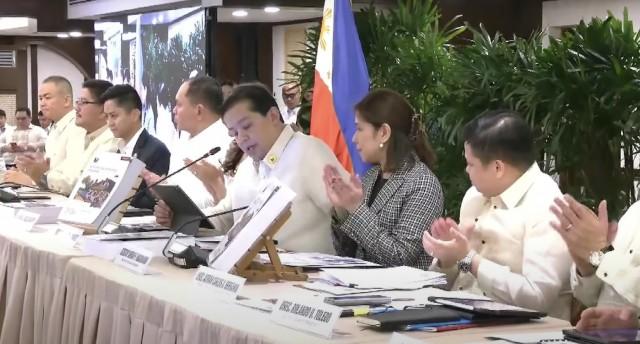
During the turnover, Speaker Ferdinand Martin Romualdez said that at least five significant reforms will be enforced by the House of Representatives in the scrutiny and enactment of the budget for fiscal year 2026.
The House will remove the “small committee” that collated institutional amendments, according to Romualdez.
It will also open the Bicameral Conference Committee on the budget to the public and the media and civil society, people’s organizations, and the private sector will also be invited to join budget hearings.
Romualdez pointed out that the reforms seek to ensure full transparency and to involve the public through people’s organizations, noting that the budget is the people’s money.
“A budget is not just a spending plan—it is a mirror of our priorities and a measure of our accountability to the people. And because this is the people’s money, the process of crafting it must be transparent, inclusive, and worthy of public trust,” Romualdez said.
The NEP is more than numbers on paper, according to Romualdez, saying that it is the government’s plan ''to make the vision of a Bagong Pilipinas real—roads that connect communities, markets where food is affordable, schools that open doors to opportunity, hospitals that save lives, and safe, secure communities for every Filipino.''
Romualdez further said the chamber would strengthen oversight—requiring timely reports from agencies and enabling real-time tracking of major projects.
Romualdez said the reforms are not meant to slow the process but they are meant to make it ''better, stronger, and more trusted.'' —with reports from Anna Felicia Bajo/ VAL, GMA Integrated News

