

 GMA Brandtalk
 Tracking
 Archives

Marcos inks Judicial Fiscal Autonomy Act

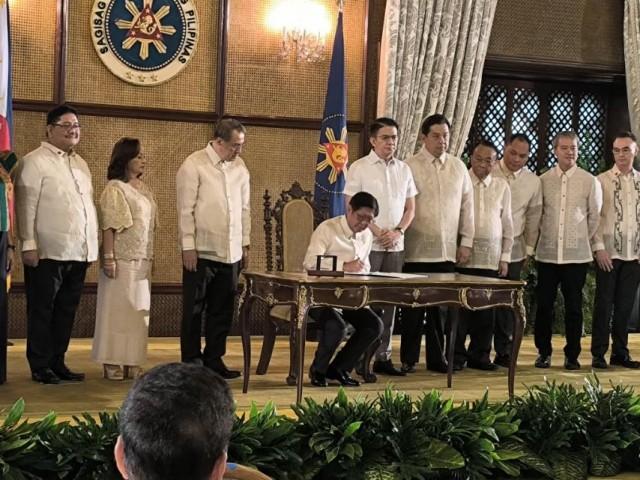
President Ferdinand “Bongbong” Marcos Jr. on Thursday signed into law the measure defining the scope and extent of the judiciary’s fiscal autonomy.
The ceremonial signing was held at the Malacañang Palace. In his speech, Marcos stressed that the government is putting safeguards in place so that the judiciary can work more efficiently and more independently.
"Our Constitution already mandates: The Judiciary shall enjoy fiscal autonomy. Appropriations for the Judiciary may not be reduced by the legislature below the amount appropriated for the previous year, and, after approval, shall be automatically and regularly released,'' Marcos said.
"And this is why we continue to help the Judiciary become secure in its resources and perform its duty to serve our people without any delay," he added.
Section 2 of “The Judiciary Fiscal Autonomy Act” indicates the policy of the State to affirm and strengthen the Constitutional mandate and powers of the Judiciary as a co-equal branch of government.
To this end, the State affirms and strengthens the fiscal autonomy of the Judiciary enshrined in the Constitution, which declares that the appropriations for the Judiciary may not be reduced below the amount appropriated for the previous year and, after approval by Congress, shall be automatically and regularly released.
Under the law, the Supreme Court shall submit to the Department of Budget and Management (DBM) the annual budget proposal for the Judiciary, detailing its budget of expenditures and sources of financing (BESP), and reflecting total revenues and expenses.
The law further indicated that the original budget proposal prepared by the Supreme Court shall be included as an attachment to the National Expenditure Program (NEP); Provided, that the DBM may submit its comments and recommendations thereon.
The law authorized the Chief Justice to augment any item for the Judiciary in the general appropriations law savings in other items appropriated for the Judiciary.
Through an en banc resolution, the Chief Justice may modify the allotment within the same activity or project: (1) from one allotment class to another, except capital outlays; or (2) from one operating unit to another.
Under the law, the DBM shall automatically release to the High Tribunal, without need for any request, the monthly cash requirements of the Judiciary or one-twelfth (1/12) of the total budgetary support.
These releases shall not be conditioned on approved work and financial plans or any other financial report, according to the law.
For its part, the Supreme Court shall submit quarterly accomplishment and financial reports to the President and to Congress.
The President said this is how the government does checks and balances.
''This is how democracy works—by respecting the role each branch plays, while exercising our duty to ensure that no branch acts beyond what the Constitution allows,'' Marcos said.
The Supreme Court welcomed the signing of the law, saying that this will allow the High Tribunal to submit its original budget proposal directly to Congress and ensure that its monthly cash requirements will be released.
All revenues and expenditures of the Judiciary, including those from the newly established Judiciary Trust Fund, will remain subject to post-audit by the Commission on Audit.
Marcos ensured that his administration is committed to respecting the autonomy and authority of the Supreme Court as it discharges its constitutional duty to interpret the highest law of the land.
''This commitment thus calls on us to stay true to our Constitution, to champion integrity and fairness, and implement laws with prudence and foresight,'' he said. —VAL, GMA Integrated News

