

 GMA Brandtalk
 Tracking
 Archives

PCG slams China's claim of PH 'dangerous maneuvers' in Bajo de Masinloc
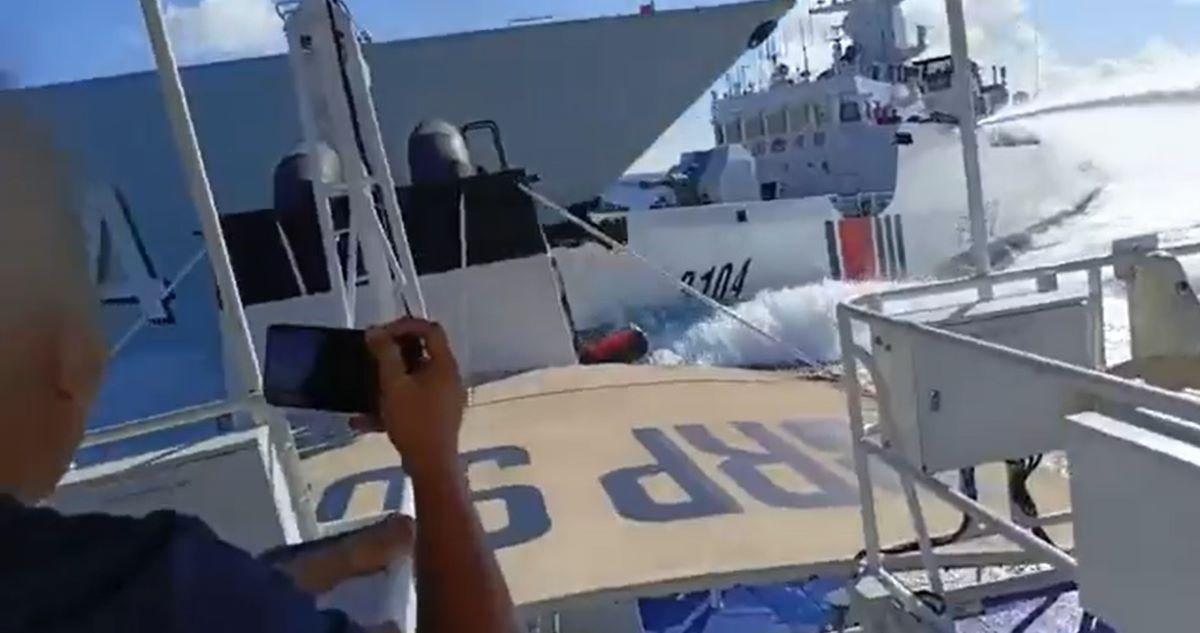
The Philippine Coast Guard (PCG) on Saturday lashed back at China for claiming that it was the Philippine side which made "dangerous maneuvers" near Scarborough Shoal or Bajo de Masinloc, an incident which Manila said resulted in a collision between two Chinese ships.
At a news forum in Quezon City, PCG spokesperson for the West Philippine Sea Commodore Jay Tarriela said, "It is not the PCG or the Philippine government that escalates the tension in the WPS (West Philippine Sea)."
"The reason why tension is rising is because of their dangerous actions and illegal presence within our own EEZ (exclusive economic zone). If there is one country that escalates the tension in the entire SCS (South China Sea), not just in the WPS, that is the People's Republic of China because they are deploying their CCG (Chinese Coast Guard) vessels and even PLA (People's Liberation) Navy warships and this is the source of the tension," Tarriela said.
"For the PCG, we are not doing anything that provokes any country in the region. Well, first of all, we are not encroaching in our own waters. We do not recognize the illegal claim of the PRC (People's Republic of China). I say it is illegal because this was already resolved by the 2016 Arbitral Award," he added.
The Coast Guard spokesperson made the remark after Chinese Ministry of Defense spokesperson Jian Bin alleged that on August 11, Philippine ships "illegally intruded into the territorial waters of China's Huangyan Dao."
"The China Coast Guard vessels took measures in accordance with law to track, monitor, block and dispel these Philippine vessels," said Jian.
"During the incident, a PCG vessel made dangerous maneuvers such as high-speed changing and sharp turns to cross the bow of Chinese vessels, which created a complex and close quarters situation at sea," the Chinese official said.
Jian, however, did not mention the collision between CCG and PLA Navy vessels in his statement.
Last Monday, Tarriela said a collision took place between a CCG vessel and PLA Navy ship off Bajo de Masinloc after the CCG 3104 vessel, which was chasing BRP Suluan at high speed, performed a risky maneuver which led to its impact with PLA Navy warship 164.
Following the incident, BRP Suluan's flagpole was bent after it was hit by the PLA Navy ship.
The PCG and the Bureau of Fisheries and Aquatic Resources (BFAR) were on a mission to distribute aid to local fishermen in Bajo de Masinloc (Scarborough Shoal) as part of the Kadiwa program.
Despite the incident, the PCG had said it immediately offered support, including assistance with man-overboard recovery and medical aid for any injured CCG crew members.
Jiang, however, said that the PCG's maneuvers "severely violated China's sovereignty, rights and interests, seriously endangered the safety of the Chinese personnel, and seriously undermined peace and stability in the South China Sea."
"We urge the Philippine side to stop its infringements and provocations immediately. The Chinese side reserves the right to take necessary countermeasures to resolutely safeguard territorial sovereignty and maritime rights and interests of the country," the Chinese official said.
Unfortunate, but...
Following the incident, the Philippine government said it bears no responsibility for the collision between CCG and PLA Navy ships near the contested shoal.
The Philippine Department of Foreign Affairs (DFA) said the collision was an "unfortunate outcome, but not one caused by our actions."
Further, the Philippines, through the DFA, reiterated its demand to China "for compensation for the damage caused to vessels and equipment last June 17 2024, as well as the return of its firearms and equipment, and the personal effects of its personnel that were illegally seized on that date."
Tarriela, likewise, said the Philippine side will not pay any damages to the Chinese side since it was their vessels that collided.
"It's actually their recklessness and their dangerous maneuvers that resulted in the collision, but kidding aside, we are not going to pay any accountability for it, for such an incident. It's their own doing, it is their illegal actions that resulted in such a collision," the PCG official said.
Grounded PH drones
Meanwhile, Tarriela said the PCG was unable to fly its drone on the day of its mission with BFAR in Bajo de Masinloc.
"It's because we believe that the Chinese were blocking our drones from taking off… This is the first time that I will be disclosing to the public that we were not able to launch our drones. It's because we are suspecting that the Chinese have jammed the signal for us to bring our drones out to take videos and photos," he said.
"Well obviously the intent of the PRC in jamming the signal of our drones is because they know our intention was to get photos and videos, and they also know this information will also be released to the public," he added.
GMA News Online has requested comment from the Chinese Embassy in Manila regarding Tarriela's statement about the drones, but it has yet to respond as of posting time.
Tarriela said the Philippine side has not yet received official reports or official information from the Chinese side regarding any death or injury caused by the collision.
China claims almost the entire South China Sea, a conduit for more than $3 trillion in annual ship commerce. Its territorial claims overlap with those of the Philippines, Vietnam, Malaysia, and Brunei.
Beijing's heavily contested territorial claims in the SCS have led to multiple maritime incidents involving the Philippines over the years.
Meanwhile, Manila refers to parts of the waters within its exclusive economic zone as the West Philippine Sea.
In 2016, an international arbitration tribunal in the Hague ruled that China's claims over the South China Sea had no legal basis, a decision Beijing does not recognize. — VDV, GMA Integrated News

