

 GMA Brandtalk
 Tracking
 Archives

Senate kept ‘blind sided’ on PH-US tariff deal, says Zubiri
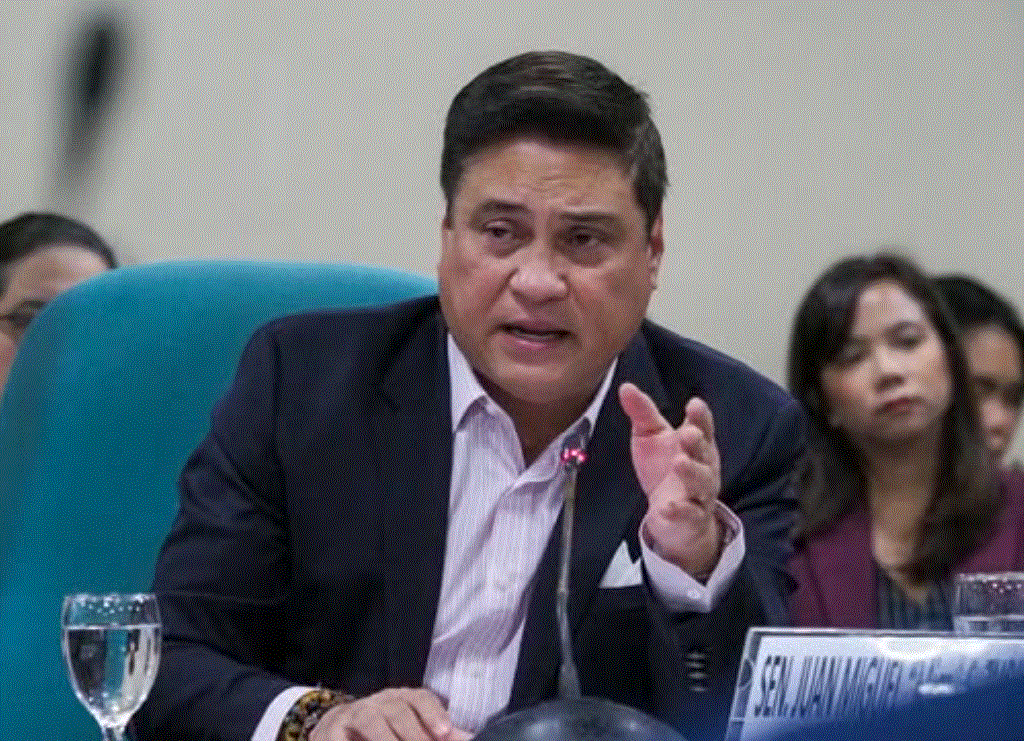
Senator Juan Miguel Zubiri on Thursday lamented that the Executive branch kept the Senate in the dark regarding the country’s trade deal with the United States, particularly the imposition of a 19% tariff rate on Philippine goods.
“I must say that I’m a bit disappointed that our executive officials have kept us in the dark on these tariff agreements with the US. Not a single official from the executive has approached us in the Senate or volunteered to brief us on the status or the outcome of the trade negotiations with the US. That’s why we called for this hearing,” said Zubiri, who chairs the Senate Committee on Economic Affairs, in a joint hearing with the Committee on Foreign Relations.
Zubiri added that the matter of tariffs is “in the realm of congressional powers.”
“Let us remind the executive officials here that tariffs are not the sole domain of the executive. It is the delegated authority to the President by Congress and therefore it is primarily in the realm of congressional powers,” he said.
“So do not keep us blind sided with the final outcome of the ongoing negotiations - that is our request. In previous administrations, there was healthier coordination between the Congress and the executive,” Zubiri also said.
US President Donald Trump in July announced a new 19% tariff rate for goods from the Philippines following a visit from Philippine President Ferdinand Marcos Jr. This is just a small cut from the initial 20% rate set by Trump, but both figures are still bigger than the 17% rate set in April.
According to the Presidential Communications Office, the Philippines holds the second lowest tariff rate in Southeast Asia, following Singapore with only a 10% tariff rate.
But Philippine Ambassador to Washington Jose Manuel Romualdez clarified that the 19% tariff on Philippine goods is still subject to negotiations.
Likewise, the Department of Trade and Industry (DTI) explained that there is no agreement yet regarding the imposition of the 19% tariff rate.
“To date, as to the question whether or not yung agreement na sinasabi with the US can be considered an executive agreement or treaty, ang sagot po doon ay wala pa tayong agreement therefore hindi pa natin masasabi yung nature ng agreement na ‘yun,” said DTI Undersecretary Allan Gepty, noting the said rate is a “unilateral imposition” by the US.
(To date, as for the question of whether the said agreement with the US can be considered an executive agreement or a treaty, the answer is that we still don't have an agreement, so we cannot yet say the nature of that agreement.)
‘Little brown brother’
Further, Zubiri pointed out that the imposition of a 19% tariff rate by the US seemed to disregard the fact that Manila is a strategic partner and treaty ally of Washington.
“Hindi ba importante na isa tayong treaty ally ng Estados Unidos? Iilan lang naman tayo di ba? Japan, Korea, Philippines, Australia, yung quad. We’re strategic partners and treaty allies. Kasi if you look at the treaty allies with the United States, pinakamataas sa kanila 15%. Yung Australia yata 10%. Tapos tayo para tayong bukas loob sa kanila, pwede sila pumasok dito, they have EDCA sites,” he said.
(Isn't it important that we are a treaty ally of the United States? There are only a few of us, right? Japan, Korea, Philippines, Australia, the quad. We're strategic partners and treaty allies. Because if you look at the treaty allies with the United States, the highest tariff for them is 15%. Australia, I think, is 10%. And then for us, we're like we're open to them, they can come in here, they have EDCA sites.)
“We’re not here to fight the Americans, we are here to be partners with them. Sana naman yung reciprocity din that they gave to their treaty allies will be the same to us at hindi tayo malulugi, or else we’re going to be their ‘little brown brother.’”
(We're not here to fight the Americans, we are here to be partners with them. Hopefully, the reciprocity that they gave to their treaty allies will be the same for us so that we will not lose out, or else we're going to be their 'little brown brother.')
Meanwhile, Senate Committee on Foreign Relations chairperson Imee Marcos shared the same sentiments.
“All the other treaty allies got a maximum 15%, we got 19%. 19% seems inviolable. So therefore, our being a treaty ally was not considered,” she said.
In response, the DTI official said that the Philippines being a treaty ally is being highlighted in the negotiations. Gepty added that the Philippine government won’t allow itself to be at a disadvantage when it enters a deal.
“On the US tariffs po, tama po kayo your honor. In fact, we’re an ally of the United States, treaty ally at isa sa mga hina-highlight natin sa negotiation. Sabi nga namin is that hindi lang trade ang relations natin with the US, in fact, all aspects,” he said.
(Regarding the US tariffs, you are correct, your honor. In fact, we are an ally of the United States, a treaty ally, and that is one of the things we are highlighting in the negotiation. As we said, our relationship with the US is not just about trade, in fact, it's about all aspects.)
“We know the predicament of our stakeholders at hindi tayo papayag na malulugi tayo dito, especially na sinasabi natin na ally tayo. So hindi po tayo papayag sa isang agreement na dehado tayo. That would not happen,” Gepty said.
(We know the predicament of our stakeholders and we will not allow ourselves to be at a disadvantage here, especially since we are saying that we are an ally. So we will not agree to a deal where we are at a disadvantage. That would not happen.)
President Marcos earlier said that the reduced tariff for Philippine goods is a “significant achievement.”
The President also clarified that not all goods entering the Philippines from the United States will get a zero tariff.
But other lawmakers have raised concerns about the trade deal, noting that the 19-0 disparity is too huge a margin to be considered fair.—LDF, GMA Integrated News

