

 GMA Brandtalk
 Tracking
 Archives

PH formally accedes to legally binding UN marine protection treaty
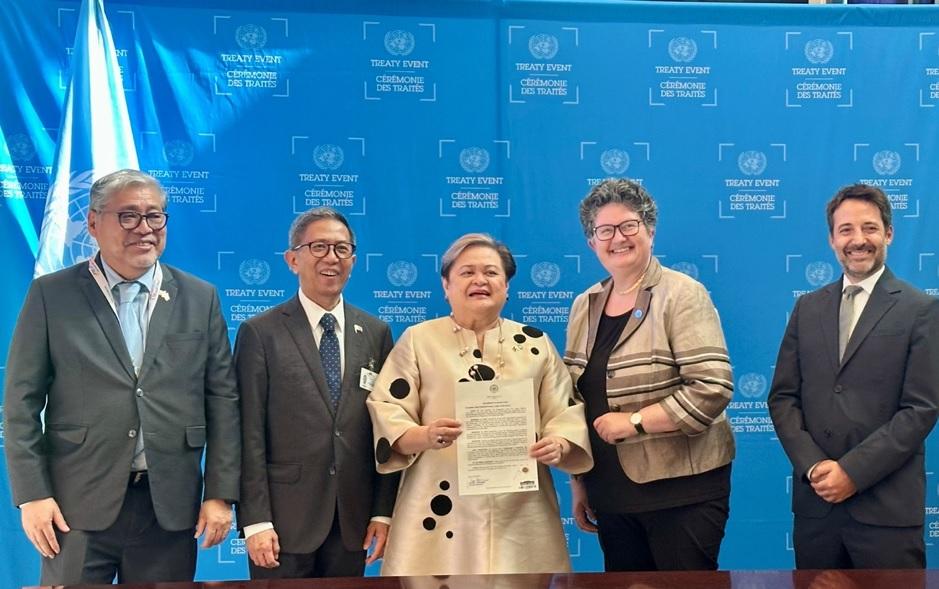
The Philippines has formally deposited to the United Nations its instrument of ratification on an agreement that binds countries to protect marine life, as well as stop overfishing and destruction and degradation in oceans and international waters.
This move completes the country’s ratification process after President Ferdinand "Bongbong" Marcos Jr. ratified on June 18, 2024 the BBNJ accord or the UN Convention on the Law of the Sea on the Conservation and Sustainable Use of Marine Biological Diversity of Areas beyond National Jurisdiction. The Senate granted its concurrence to the ratification through a unanimous vote on Sept. 17, 2025.
Foreign Affairs Secretary Theresa Lazaro called the agreement, also known as the “High Seas Treaty,” a “milestone” in addressing “biological diversity loss and the degradation of ocean ecosystems”
Lazaro personally handed over the Philippine ratification documents during a ceremony held at the UN Headquarters in New York City, where world leaders and top diplomats are currently gathered for a week-long meeting.
“It is a crucial multilateral framework for an archipelagic state like the Philippines that is located in the world’s center of marine biodiversity, and bounded by the high seas in the Pacific and in the South China Sea. It further implements and reinforces the UNCLOS,” Lazaro said. UNCLOS stands for United Nations Convention on the Law of the Sea.
The new treaty, which was negotiated for two decades, secured this week the 60 needed accessions for it to come into force. The BBNJ agreement builds on the UNCLOS, regarded as the “constitution for the seas.”
It is the first legally binding international treaty safeguarding marine environment in the High Seas, which covers two-thirds of the world’s ocean.
The Philippines had blamed China for maritime destruction in some features in the South China Sea for its massive land reclamation activities and for the loss of endangered giant clams in the Scarborough Shoal, which is within Philippine territory, but being claimed by Beijing as its own.
Manila won a landmark case in 2016 against Beijing before an international arbitral tribunal in The Hague, Netherlands, which invalidated China’s historical claim over nearly the entire waters. It threatened to file a second case against China for alleged damage to marine environment in some areas of the South China Sea that is within the Philippines’ exclusive economic zone.
Lazaro said the agreement “holds particular significance for the Philippines given its proximity to wide swathes of high seas in the Pacific and pockets of high seas in the South China Sea” as affirmed by the 2016 South China Sea ruling.
“We advocated for the special recognition for archipelagic states—and together with other states, the common heritage of humankind, the fair and equitable sharing of benefits, as well as capacity building and marine technology transfer, particularly for developing states,” she said.
The BBNJ is expected to deliver tangible benefits to the Philippines, Lazaro added.
As the first comprehensive, cross-sectoral ocean treaty in decades, it helps ensure the health of the ocean and sustain fisheries, securing food and livelihood for millions of coastal families, she explained.
Area-based protections in the high seas could enhance fish stocks that spill over into the waters under the Philippines’ jurisdiction, securing catch for small fishers and helping stabilize market prices for consumers, Lazaro said.
Through its capacity-building and marine technology transfer pillar, Filipino scientists, she added, can gain access to training, scientific data, and technology, strengthening marine scientific research and enabling access to benefits derived from marine genetic resources in areas beyond national jurisdiction.
BBNJ will come into full effect on Jan. 17, 2026, meaning all states that have ratified it must ensure it is enshrined within their own national laws. — BM, GMA Integrated News

