

 GMA Brandtalk
 Tracking
 Archives

US slams China over vessel clash with PH near Pag-asa Island
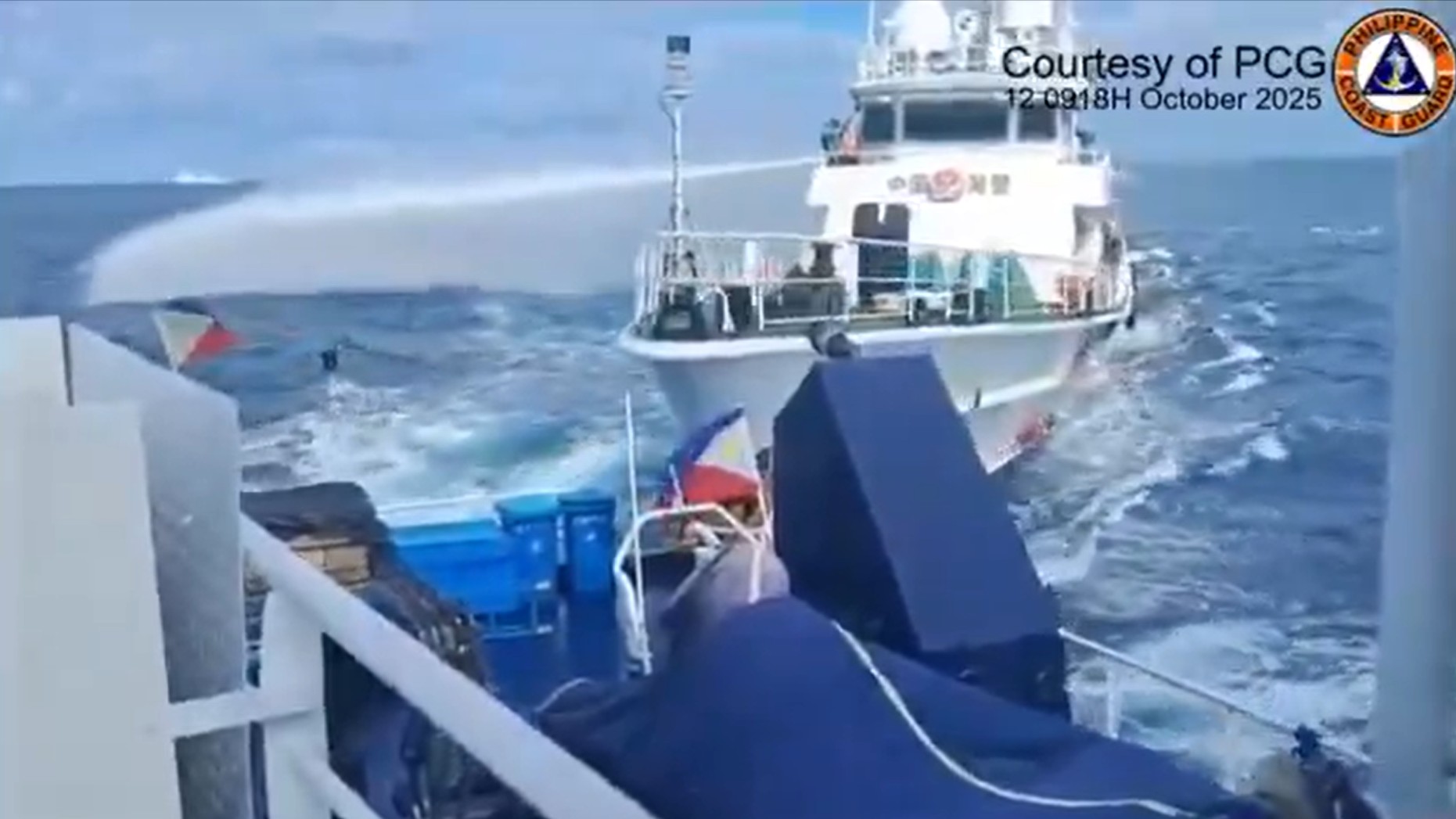
WASHINGTON/BEIJING — The United States said on Monday it stood by its Philippine ally and emphasized their mutual defense treaty after vessels from China and the Philippines clashed amid heightened tensions in the disputed South China Sea.
Earlier, China's Foreign Ministry urged Manila not to challenge Beijing's efforts to "safeguard its territorial sovereignty and maritime rights and interests" after Sunday's incident in the Spratly Islands, in which the Philippines said China deployed water cannon and rammed a Filipino vessel.
"The United States condemns China's October 12 ramming and water cannoning of a Philippine Bureau of Fisheries and Aquatic Resources vessel close to Thitu Island in the South China Sea," the US State Department said in a statement.
"We stand with our Philippine allies as they confront China's dangerous actions which undermine regional stability," the department added.
It said "China's weeping territorial and maritime claims" in the South China Sea and its "increasingly coercive actions" not only undermine the stability in the region but "fly in the face of its prior commitments to resolve disputes peacefully."
"The United States reaffirms Article IV of the 1951 United States-Philippines Mutual Defense Treaty extends to armed attacks on Philippine armed forces, public vessels, or aircraft – including those of its Coast Guard – anywhere in the South China Sea," the department added.
The recent harassment by China near Pag-asa Island is the closest such incident to the Philippine archipelago, as it occurred not only within the country’s exclusive economic zone – but also within its territorial waters, the Philippine Coast Guard (PCG) said on Monday.
According to Jonathan Andal’s Monday report on “24 Oras,” the harassment occurred on Sunday at 1.8 nautical miles or 3 kilometers away from Pag-asa Island – or the distance from the Luneta Park in Manila to the Cultural Center of the Philippines in Pasay City.
“This is the closest that the Chinese Coast Guard has harassed and bullied a BFAR (Bureau of Fisheries and Aquatic Resources) vessel. It only has a distance of 1.6 to 1.8 nautical miles,” said Commodore Jay Tarriela, PCG spokesperson for West Philippine Sea.
More than 20 Chinese vessels approached and surrounded Pag-asa Island. Five of the vessels were China Coast Guard ships and 15 were Chinese maritime militia, with one warship and helicopter of the Chinese Liberation Army.
Six BFAR vessels were then delivering aid to fishermen in the waters off Pag-asa Island. Three BFAR vessels were hit by the water cannons of the Chinese ships.
These are the BRP Datu Bankaw, BRP Datu Sanday, and the BRP Datu Pagbuaya, which was the most damaged among the three, as its stern was also rammed by a CCG ship.
China and the Philippines have confronted each other repeatedly in recent years in the South China Sea, a strategic trade route that facilitates more than $3 trillion in annual ship-borne commerce, and which China claims most of.
Tensions have heightened recently and Lin Jian, a spokesperson for China's foreign ministry, told a regular press briefing the Philippines should immediately stop "violations and provocations."
In 2016, however, the Philippines scored a victory against China in a landmark ruling by the Permanent Court of Arbitration. The PCA ruled that "there was no legal basis for China to claim historic rights to resources within the sea areas falling within the nine-dash line."
"[Although] two Chinese navigators and fishermen, as well as those of other States, had historically made use of the islands in the South China Sea, there was no evidence that China had historically exercised exclusive control over the waters or their resources," it added.
China has repeatedly said the PCA ruling is "illegal" and "invalid".
President Ferdinand "Bongbong" Marcos Jr. stood his ground that the West Philippine Sea (WPS) belongs to the Filipinos amid China's aggression in the resource-rich region.
West Philippine Sea is the name the Philippines uses to refer to portions of the South China Sea that fall within its exclusive economic zone and its jurisdiction.
Last year, during the former Biden administration, two senior Republican US senators called for a list of options developed by the Pentagon and State Department to support the Philippines against Beijing in the South China Sea, saying that limiting responses to verbal assurances of the applicability of Article IV undermines the credibility and value of these commitments. —GMA Integrated News with Reuters

