

 GMA Brandtalk
 Tracking
 Archives

Witness protection applicants should return ill-gotten wealth - lawyer
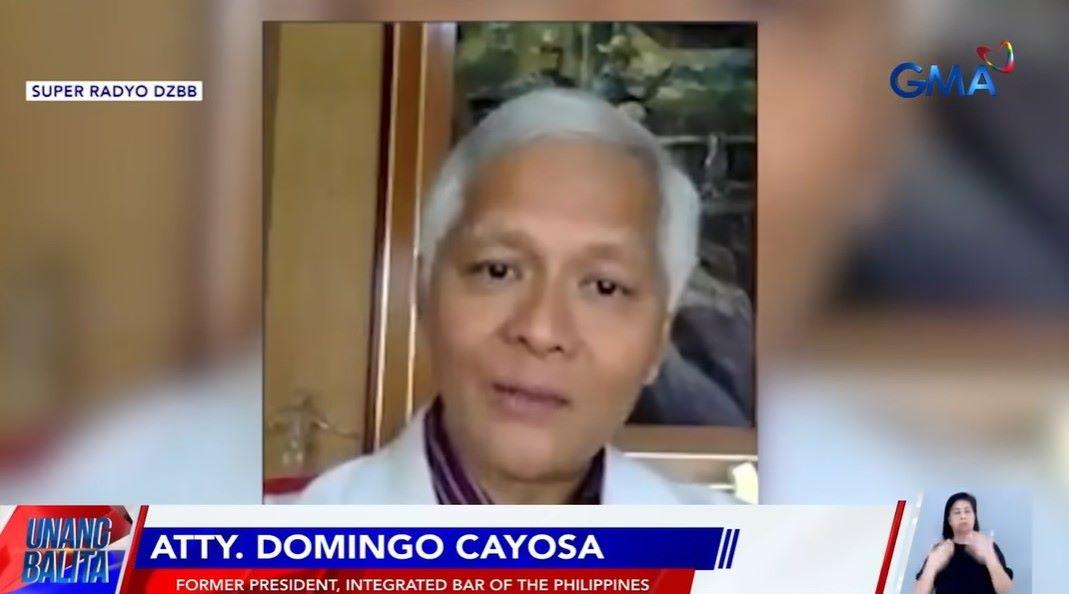
A law expert on Saturday said that restitution, or the return of ill-gotten wealth by a person applying for the Witness Protection Program (WPP), is lawful.
Interviewed on Dobol B TV, Atty. Domingo Cayosa said that under the WPP, an applicant has to sign a memorandum of agreement where certain conditions required by the government are specified.
“Nakalahad sa batas mismo at sa Implementing Rules and Regulations na anumang mga kondisyon na sa tingin ng gobyerno ay karapat dapat,” said Cayosa, a former president of the Integrated Bar of the Philippines (IBP).
(It is stated in the law itself and in the Implementing Rules and Regulations that whatever conditions the government deems appropriate are included.)
“Kasama na rin sa MOA, nakalagay sa batas din ‘yan, ‘to comply with legal obligations and civil [judgments] against him.’ So pagbabalik ng anong ninakaw mo kahit wala pang kaso, hindi ka pa nahatulan, malinaw naman yan na legal obligation,” Cayosa added.
(It's also included in the MOA, and it's also stated in the law, 'to comply with legal obligations and civil [judgments] against him.' So returning what was stolen even with the absence of a case, even if you have not yet been convicted, is clearly a legal obligation.)
Cayosa said it is not only “common sense” but also “a settled principle” in law for a person to return a property that he or she does not own.
Senator Rodante Marcoleta earlier this week once again questioned the Department of Justice (DOJ) for insisting that contractors Sarah and Curlee Discaya should return illegally acquired wealth, if any, to the state coffers before they can be entered into the WPP.
During the Senate Committee on Finance’s deliberations into the proposed P43.65-billion budget of the DOJ and its attached agencies for fiscal year 2026, Marcoleta claimed that agency is “imagining something that is not within the law.”
Section 10 of Republic Act 6981, or the Witness Protection, Security and Benefit Act, states that any person who has participated in the commission of a crime and desires to be a witness for the State can apply and possibly qualify to be admitted into the WPP if the following circumstances are present:
- the offense in which his testimony will be used is a grave felony as defined under the Revised Penal Code or its equivalent under special laws;
- there is absolute necessity for his testimony;
- there is no other direct evidence available for the proper prosecution of the offense committed:
- his testimony can be substantially corroborated on its material points;
- he does not appear to be most guilty; and
- he has not at any time been convicted of any crime involving moral turpitude
DOJ officer-in-charge Fredderick Vida, meanwhile, said that he agrees with the position of former Justice Secretary now Ombudsman Jesus Crispin Remulla, that restitution is one of the conditions to qualify for the WPP.
Justice Undersecretary Jesse Andres also maintained that there is no inconsistency in what the DOJ is doing, citing Section 5 (f) of the law, which states that before a person is provided protection, he shall first execute a memorandum of agreement which shall set forth his responsibilities, including complying with legal obligations and civil judgments against him. —Jamil Santos/VBL, GMA Integrated News

