

 GMA Brandtalk
 Tracking
 Archives

Teodoro hits China’s ‘blackmailing’ claim amid tension in West Philippine Sea
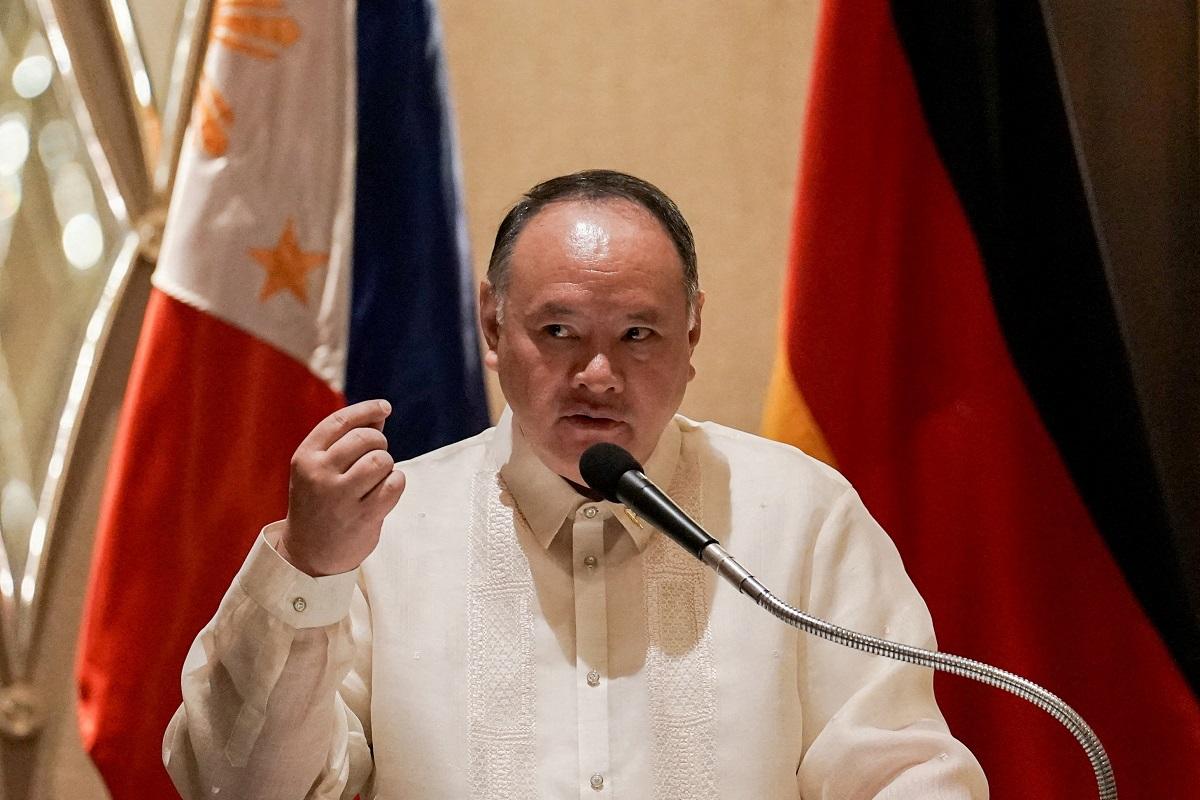
Department of National Defense Secretary Gilberto Teodoro Jr. on Sunday slammed the recent claim of an official of China’s Defense Ministry that the Philippines is “blackmailing” the Chinese government amid the dispute over the West Philippine Sea.
"Would you talk to or would you offer to talk to somebody who slammed your country that way? Of course not,” said Teodoro in a chance interview with reporters following the signing of the Status of Visiting Forces Agreement with Canada.
Earlier, Zhang Xiaogang, spokesperson for China’s Ministry of National Defense, said Beijing “would never allow any provocation and trouble-making to work, nor would we leave any room for blackmailing the big by the small.”
China was reacting to the Philippine Coast Guard’s (PCG) recent maritime domain awareness operation over Bajo de Masinloc. The PCG said its MDA flight encountered “aggressive interference by forces from the People’s Republic of China.”
The disputed Bajo de Masinloc, also known as Scarborough Shoal or Panatag Shoal, is located 124 nautical miles off Masinloc, Zambales.
It is considered within the Philippines’ 200-nautical-mile exclusive economic zone (EEZ), based on the 1982 United Nations Convention on the Law of the Sea (UNCLOS).
In 2016, an international arbitration tribunal in The Hague ruled in favor of the Philippines over China’s claims in the vast waterway, but China has refused to recognize the decision.
Meanwhile, the Armed Forces of the Philippines, the Australian Defence Force, the New Zealand Defence Force, and the United States Navy recently conducted a joint maritime defense exercise in the West Philippine Sea.
This drew the ire of China’s military, which accused the Philippines of being a “troublemaker.”
In response, Teodoro said China’s statement is “indicative of the regard of China for international law.”
“If China makes that statement that you invite an outsider in the open sea area, then it is indicative of how it views international law. So are they saying that they own the area or if they have an exclusive jurisdiction and sovereignty over the high seas? If they say that, then you have your answer on how they regard the international law, which is precisely why these activities have to continue, to uphold the international law,” Teodoro said.
“So if China feels that it is an intrusion on an area, which under international law is a common area, then we refute that,” he added. — JMA, GMA Integrated News

