

 GMA Brandtalk
 Tracking
 Archives

Security alliances crucial to deter aggression in South China Sea — envoys
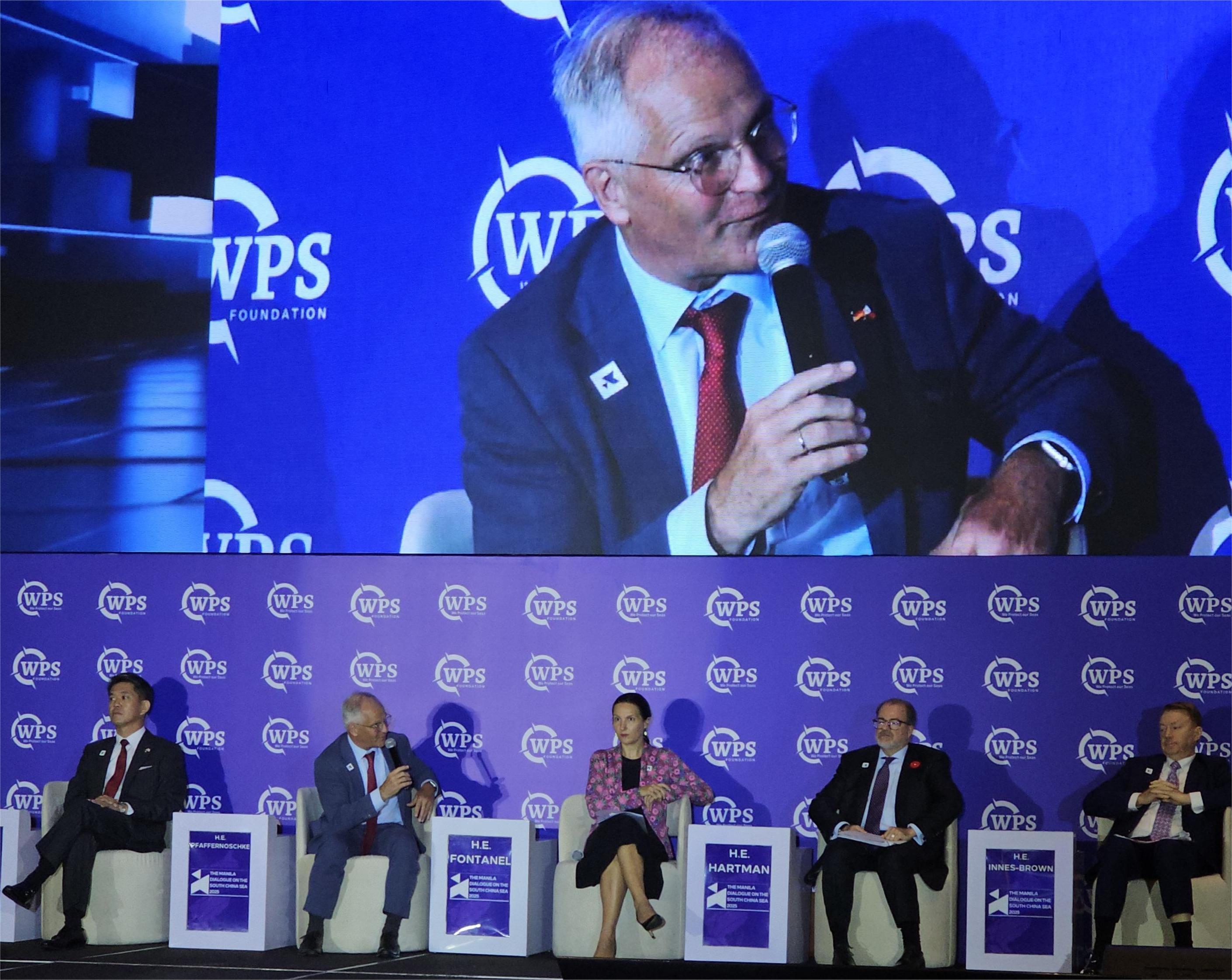
Building security alliances and strengthening of defense capabilities among like-minded states are crucial in deterring aggression in the South China, foreign envoys said on Thursday, as they assured the Philippines that “we are with you” in its fight for a rules-based order in the disputed waters.
"It's very important for each and every one of us to act to uphold the principles of free and open rules-based maritime domain,” they said as any disturbances in the South China Sea affect all countries and disrupt global trade and security.
“This region in the world is of paramount importance to us that we could not collectively allow disruption on grand scale to continue to take place,” Canada’s Ambassador David Hartman said at the Manila Dialogue, which tackled current challenges in the South China Sea.
While pursuing diplomacy, the envoys said like-minded partners should continue building their defensive capability and increase joint military drills and maritime patrols.
Manila’s treaty ally, the United States, Canada, Australia, Japan and New Zealand have participated in several joint patrols and drills called Maritime Cooperative Activity with the Armed Forces of the Philippines in the South China Sea since last year.
China has opposed the MCAs, describing the Philippines as a “troublemaker,” which collaborates with outside countries to undertake actions that threatens regional stability.
German Ambassador Andreas Pfaffernoschke, however, said these activities must continue.
“I think this is the way to follow - building coalitions, training of military exchange of information, participation in exercises. I think this is the way also to go to the future,” Pfaffernoschke said.
“What has been done and has been achieved, particularly over the last two, three years, is already very impressive. The building up of political coalitions, the negotiation of SOVFAs, of defense arrangements, and agreements with a large number of countries,” he said of the recent security cooperation agreements the Philippines signed with several countries, including Germany.
He added: “Building coalitions and making clear to China, let's call China, China, there is a large number of countries, which is helping the Philippines to push through with protecting and safeguarding the rules-based international order.”
French Ambassador Marie Fontanel said France has a “strong interest” in freedom of navigation and peace and stability in the South China Sea.
Finalizing a code of conduct, she added, has acquired urgency due to heightened tensions in the waters between China and its smaller Southeast Asian neighbors with competing claims to the waters, like the Philippines, Vietnam and Malaysia. Other claimants include Brunei and Taiwan.
“It is precisely all the more important to finalize this code of conduct,” Fontanel said. “Disputes should be resolved peacefully through dialogue and according to international law.”
Bill Hayton, associate fellow of London’s Chatham House Asia Pacific Program, said Manila’s transparency initiative “has been very effective” in exposing to the world China’s violations and increasingly aggressive acts.
However, he said “the power of embarrassment hasn't really worked against China.”
“There are limits to what transparency can do,” Hayton told GMA News Online.
“If a state is willing to suffer reputational costs, if it doesn't really care what other countries think about, which therefore kind of means that the only deterrence is actually going to be physical deterrence is going to be armed force.”
Japanese Ambassador Endo Kazuya said it is very important for regional allies to increase coordination and “to show our shared determination to maintain a stable, rules-based maritime order in the Indo-Pacific.”
Frequent bilateral and multilateral maritime cooperative activities are also prime examples on how like-minded nations show their collective commitment to ensure unfettered access to the South China Sea.
China claims the South China Sea virtually in its entirety and has deployed much larger fleets of coast guard, navy and suspected maritime militia ships in the past years to assert that extensive claim against smaller claimant states.
An international arbitration decision in 2016 has invalidate China's territorial claims, but Beijing does not recognize the ruling.
President Ferdinand Marcos Jr. has expanded defense ties with the US and non-traditional allies in Europe, Japan, Australia, Canada and New Zealand to strengthen the country's external defense, including in the West Philippine Sea, that part of the South China Sea that is nearest to the Philippine archipelago.
Australian Ambassador Marc Innes-Brown said Australia, a country largely dependent on trade, is investing in defense partnerships in Southeast Asia, citing “commonality of interest and a commonality of desire to expand security cooperation” in the region.
In the past two years, Chinese Coast Guard, Navy and suspected maritime militia ships have used high-pressure water cannons and dangerous sea maneuvers against Philippine ships or vessels, which China has accused of encroaching into what it claims as its territorial waters.
German Ambassador Pfaffernoschke assured that the Philippines can count on its international partners in raising global awareness on China’s assertive behavior in the South China Sea and in telling the world “what is at stake.”
“We are with you, we support the rules based international efforts and we help as ambassadors in this country to build these coalitions and that can also be done extensively outside of Manila,” Pfaffernoschke said. — RSJ, GMA Integrated News

