

 GMA Brandtalk
 Tracking
 Archives

EDCOM2 vows crackdown vs ‘graduate degrees for sale’
The Second Congressional Commission on Education (EDCOM 2) has raised alarm over the proliferation of fraudulent and low-quality graduate programs for teachers, warning that “diploma mills” and academic corruption are eroding the integrity of the country’s education system.
Dr. Karol Mark Yee, EDCOM 2 executive director, cited a recent study by the commission and Ateneo de Manila University, which found that more than half of all graduate programs in the Philippines are in teacher education.
Many of these programs, however, reportedly suffer from poor quality, misaligned curricula, or even fraudulent practices.
“We found reports of teachers paying for panel approvals, paying for their thesis, or finishing a PhD in six months when it should take three to five years,” Yee said in an interview on Wednesday.
“May mga schools na hindi man lang nila kailangan attend-an, ga-graduate sila. Students graduate, get their diploma, but learn nothing,” he said.
(Some schools don’t even require attendance; students graduate, get their diploma, but learn nothing.)
“It’s a paper chase—and it’s hurting our children’s learning,” he added.
‘Degrees for sale,’ misplaced incentives
Yee said many teachers pursue graduate degrees not for professional mastery but simply to secure promotions under the Department of Education’s (DepEd) current ranking system.
This, he explained, often leads to a mismatch between what teachers study and what they actually teach.
“You have science teachers taking master’s in educational leadership, not in science. Eh hindi naman siya magpi-principal, magti-teacher siya (They won’t become principals; they’ll remain teachers),” he said.
“That creates a mismatch in content knowledge,” Yee added.
The EDCOM 2 revealed that the spread of low-quality programs has also been accompanied by exploitative and unethical practices.
“May mga nagpapalibre daw ‘yung school ng mga tour, nagpa-party, nagpapakain, tapos bibigyan na sila ng degree. Mga PhD na natatapos in six months to one year, na dapat three to five years,” he said.
(Some schools offer free tours, parties, or meals—and then award degrees. PhDs are finished in six months to a year what should have taken them three to five years to complete.)
“Mahirap ‘yun eh, kasi kung walang quality ‘yung graduate programs natin, nagbabayad ‘yung mga teachers, nagbabayad ‘yung mga estudyante,” Yee said.
(That’s problematic because if our graduate programs lack quality, teachers and students end up paying for programs from which they gain nothing.)
200 non-performing universities still operating
Citing EDCOM 2 data, Yee said the crisis is widespread and not limited to certain regions.
“To be honest, marami naman everywhere. We have 1,470 teacher education institutions nationwide, with over 400 offering master’s or doctoral programs,” he said.
“Yet around 200 universities recorded a zero passing rate in the licensure exams for teachers—but are still operating.”
He said this has pushed EDCOM 2 to call for tighter regulation and unified quality assurance mechanisms among education and professional agencies.
“Kailangan ayusin talaga ‘yung sistema eh. Tapos ang problema namin, pagpunta ‘yung mga bata minsan, hindi nila alam na ganoon pala ‘yung sitwasyon,” Yee said.
(The system really needs fixing. The problem is, students sometimes don’t realize the situation.)
“Mag-aaral sila, ga-graduate sila, pupunta sila sa PRC, hindi pala recognized ‘yung school, hindi sila makapag-licensure,” he said.
(They study, graduate, go to the PRC, only to learn later that their school isn’t recognized—they can’t get licensed.)
Unified quality assurance
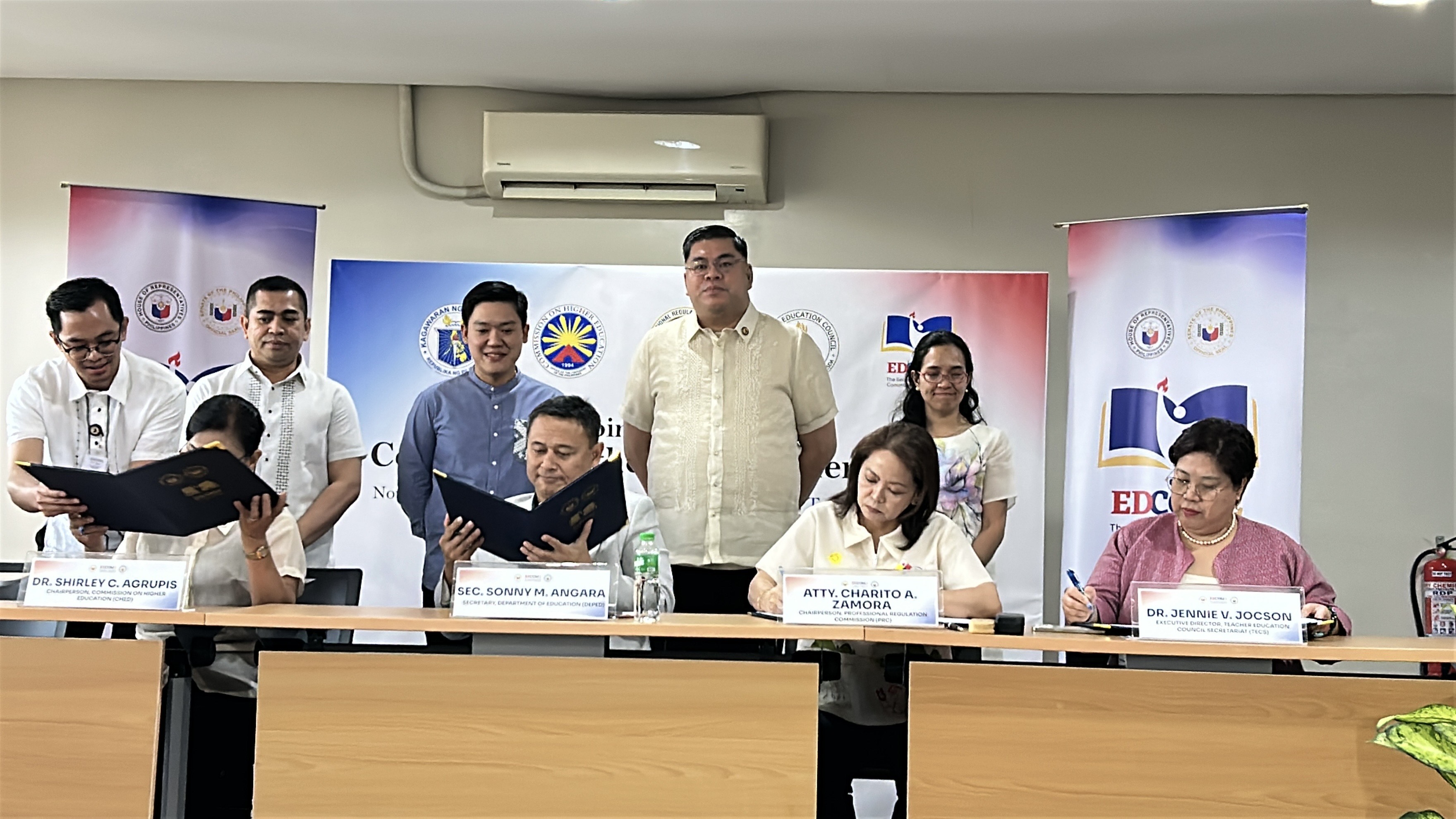
On Tuesday, the Department of Education (DepEd), Commission on Higher Education (CHED), and the Professional Regulation Commission (PRC) signed a Joint Memorandum Circular (JMC) establishing a unified quality assurance system for all higher education programs—especially in teacher education.
Witnessed by EDCOM 2 and the Teacher Education Council (TEC), the JMC mandates that only programs with a Certificate of Program Compliance (COPC) or Government Recognition (GR) will be honored for licensure, government employment, and promotion.
“This joint circular institutionalizes shared responsibility for quality. We are protecting students and ensuring that every degree issued in this country carries integrity and recognition,” said CHED Chairperson Dr. Shirley Agrupis.
PRC Chairperson Charito Zamora said the move would “close the loopholes” that have allowed graduates of unaccredited programs to take licensure exams.
“Those who studied in unrecognized programs will no longer be able to take the licensure examinations unless granted a special authority during the transition period,” Zamora said.
DepEd Secretary Sonny Angara said the registry will also be linked to DepEd’s promotion system to ensure that only recognized degrees count toward teachers’ career advancement.
“We want transparency and fairness. Teachers should know which programs truly matter for their profession,” Angara said.
(Gusto namin ng transparency at fairness. Dapat malaman ng mga guro kung aling programa ang tunay na mahalaga sa kanilang propesyon.)—MCG, GMA Integrated News

