

 GMA Brandtalk
 Tracking
 Archives

SWS Mega Manila survey: 84% say there's ‘a lot’ of corruption
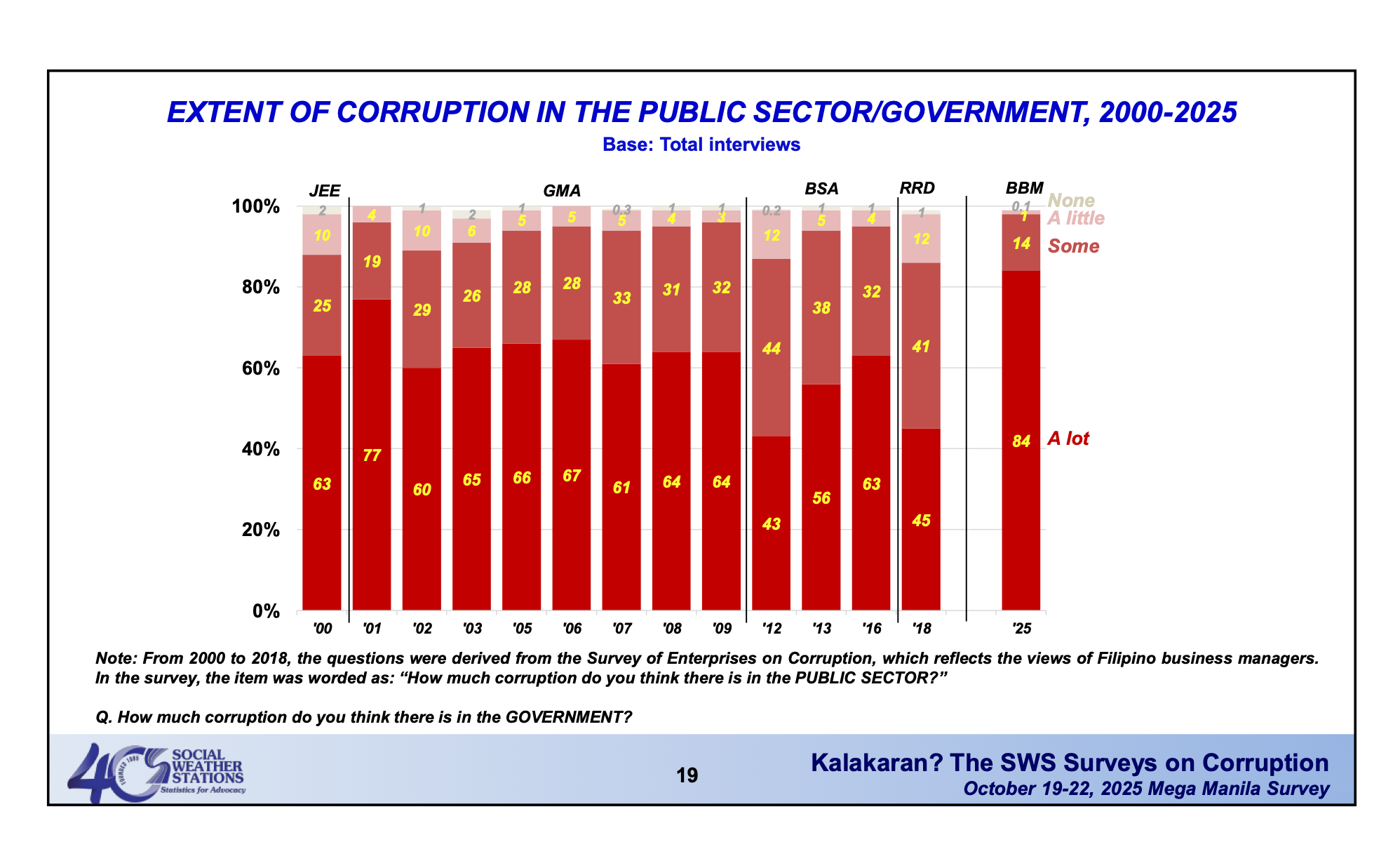
Eighty-four percent of respondents in the National Capital Region, Bulacan, Cavite, Laguna, and Rizal believe there is "a lot" of corruption in the government, data from the latest SWS Surveys on Corruption showed.
The research institution presented the findings on Thursday at a briefing that showcased results from the October 19–22, 2025 Mega Manila survey alongside long-term corruption perception data dating back to 2000.
The survey was conducted among 600 respondents in the National Capital Region, Bulacan, Cavite, Laguna, and Rizal. It has a margin of error of ±4.
Among other questions, the SWS asked the respondents, "How much corruption do you think there is in the government?" The results table indicated the choices were "none," "a little," "some," and "a lot."
The 84 percent that answered "a lot" marks the highest that the SWS recorded since 2000, with corruption perception surveys covering the administrations of Joseph Estrada, Gloria Macapagal Arroyo, Benigno Aquino III, Rodrigo Duterte, and Ferdinand "Bongbong" Marcos Jr.
The SWS said that from 2000 to 2018, the questions were derived from its Survey of Enterprises on Corruption, which reflected the views of Filipino business managers. In the surveys, the item was worded as: “How much corruption do you think there is in the public sector?"
The 2025 data represented the general adult population in Mega Manila.
Sharpest spike in 25 years
The historical data show that public perception of severe corruption fluctuated across administrations but never reached the 2025 level.
- Estrada (JEE): “A lot” of corruption measured 63%–77%
- Arroyo (GMA): stayed around 60%–67%
- Aquino (BSA): dropped to 43%–56%
- Duterte (RRD): declined further to 41%–45%
- Marcos Jr. (BBM): increased to 84%, the highest in the entire series
77% say corruption is more widespread now
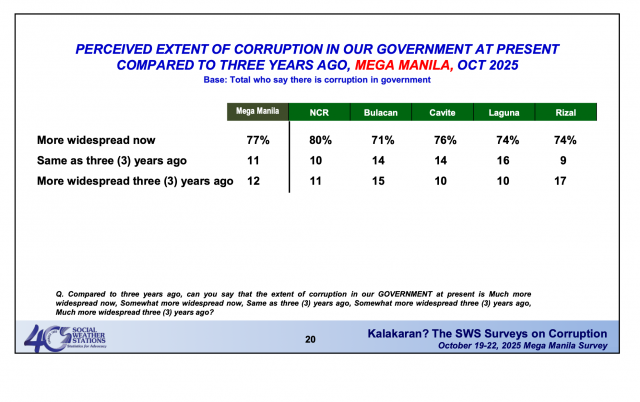
The survey also found that 77% of Mega Manila respondents believe corruption is more widespread now compared to three years ago.
This sentiment is consistent across all surveyed provinces:
- NCR: 80%
- Bulacan: 71%
- Cavite: 76%
- Laguna: 74%
- Rizal: 74%
Only 11% say corruption is the same as before, while 12% believe it was more widespread three years earlier.
These perceptions emerged amid ongoing congressional and media scrutiny of alleged irregularities in public infrastructure, including controversial flood control projects in Bulacan.
 National government seen as the center of corruption
SWS also reported that corruption is perceived to be most prevalent in the national government, with 83% of respondents identifying it as the primary level where corruption occurs. This echoes trends from previous surveys conducted in 2000, 2009, 2016, and 2018.
Other levels of government also registered high perceptions of corruption:
- City/Municipal government: 35%
- Barangay government: 25%
- Provincial government: 38%
This reflects a pattern where Filipinos consistently view corruption as concentrated at the top levels of the bureaucracy.
Cabinet officials seen as most involved
When asked which level of government employees are most associated with graft, the 2025 survey—using a single-response format—found:
- 73% pointed to Cabinet-level and top management officials (secretaries, undersecretaries, assistant secretaries).
- 15% cited middle-level managers (directors, department heads).
- Only 4% named supervisors, and 8% identified rank-and-file employees.
Earlier enterprise surveys (2012–2018), which allowed multiple responses, similarly placed top-level officials as the most frequently mentioned.
Government employees still seen as primary initiators of corruption
The survey also examined perceptions of who typically initiates corruption. In October 2025:
- 75% said government employees who ask for bribes are the primary initiators.
- 23% said the corruption starts with citizens who bribe.
- 2% were undecided.
The October 2025 Mega Manila survey interviewed 600 adults, with assigned samples in NCR, Bulacan, Cavite, Laguna, and Rizal.
The sampling margin of error is ±4% for Mega Manila. Historical data (2000–2018) came from the SWS Survey of Enterprises on Corruption, while earlier rounds were based on national surveys of adults. — BM, GMA Integrated News

