

 GMA Brandtalk
 Tracking
 Archives

Palawan's Iwahig 'prison without bars' promotes tourism and second chances
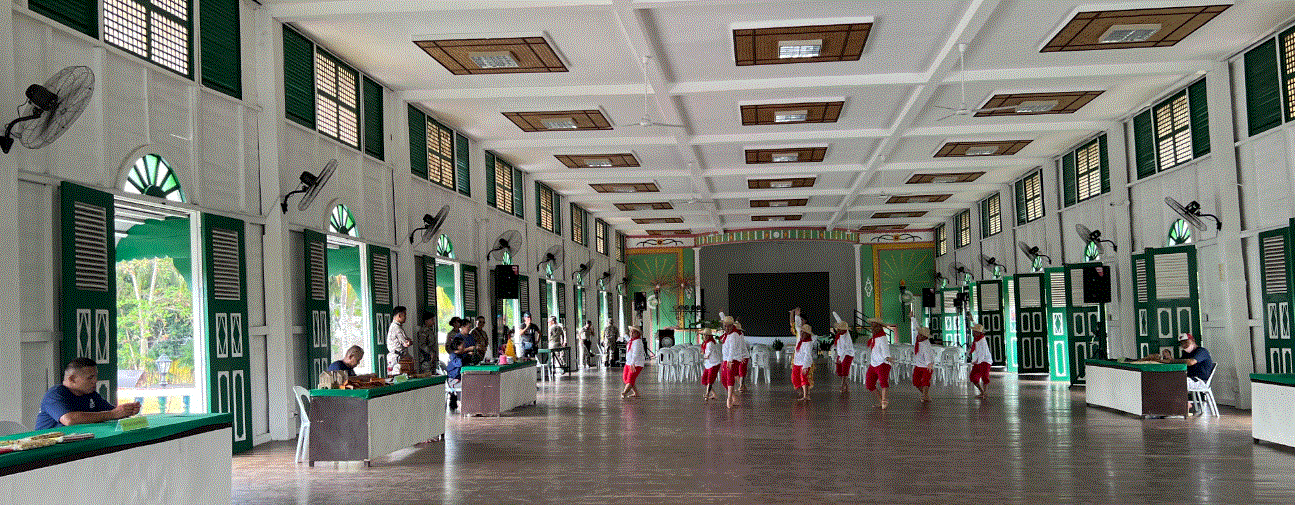
PALAWAN — The Iwahig Prison and Penal Farm (IPPF) in Palawan is boosting its efforts as a local tourist destination and where one can find second chances.
During the Palawan Regional Tourism Fair, IPPF said that they were pushing to promote their facility as a “place of healing and hope” and remove the idea that persons deprived of liberty (PDLs) had no chance of redemption.
“Nakakalungkot na parang deprived na nga sila, tapos yung tingin pa, yung stigma sa kanila na parang lalo na kapag term is ex-convict. Parang takot sila or ayaw nilang bigyan ng chance, hindi na bibigyan ng opportunity,” shared IPPF Media and Public Affairs acting chief C01 Ma. Eden Larawan.
(It’s sad that they’re already deprived, and people look at them with stigma, especially with the term ex-convict. People seem scared or won’t even give them a chance or an opportunity.)
“We are tagged as a ‘prison without walls.’ [We push tourism kasi] nakita namin yung advantage. Nakita namin na malaking tulong din talaga siya pagdating sa reformation,” she added.
(We are tagged as a ‘prison without walls.’ [We push tourism because] we can see the advantage. We saw that it was a really big help when it comes to reformation.)
Despite being one of the seven penal colonies of the Philippines under the Department of Justice (DOJ) and the Bureau of Corrections (BuCor), IPPF is the only open penal facility in the country with minimal protection and an open community for minimum security prisoners.
Larawan shared that they offered reformation programs to their PDLs to upskill them upon release.
She also noted that participation in programs added up to a prisoner’s Good Conduct Time Allowance (GCTA) that helped lessen their sentences and may eventually lead to release.
“We have seven reformation programs. We have the education and training. We have the sports and recreation wherein our PDLs are allowed to participate in physical activities, sports. We have the behavior and modification program, then we have the health and welfare… Through the work and livelihood program, we give them skills training through TESDA. They are [also] free to exercise their religion,” she shared.
“We believe that those activities we believe that they help our PDLs in reforming them. Because we believe, yes, nagkasala sila, nagkamali sila, pero there are second chances naman eh. (Because we believe, yes, they did something wrong, but there are second chances.) We believe in second chances,” she added.
Good progress, according to Larawan, made them think that it was a good idea to use tourism as an avenue to let the public know more about the “prison without bars.”
“Our mandate is to safeguard and reform our PDLs… Actually, we are not really into tourism because that's not our mandate. But we saw the importance that, oo nga, somehow with promoting our tourism here, our PDLs, we are also helping them, we are also reforming them,” Larawan shared.
Since it was announced as a heritage site by the city of Puerto Princesa in 2018, visits have spiked in the facility.
Visitors ranged from college students to foreigners to cruise ship passengers, all of whom are welcomed by the IPPF’s dancing inmates and allowed to interact and purchase items made by PDLs.
“Actually everyday, halos everyday may mga bisita tayo… Parami siya ng parami. At first talaga, parang hindi nila alam kung bakit sila nandito. Most of them, ang perception nila is nasa Iwahig yung mga most heinous crimes na mga PDLs. Ang perception nila is wala ng chance lumaya yung mga nandito. So kami, as part of our advocacy, [we are pushing for] awareness na [that’s not true],” Larawan said.
(We have visitors almost every day… They keep on coming. At first, it seems like they don’t even know why they’re even here. Most of them had the perception that Iwahig only had PDLs with the most heinous crimes. Their perception is that the people here had no chance of ever being released. So us, as part of our advocacy, [we are pushing for] awareness [that it’s not true].)
Larawan added that interacting with non-PDLs helped PDLs boost morale and become more social.
“When they have discussions with others, with the visitors, nagiging light yung kanilang morale. Yung parang pagtingin nila sa life nila, nagiging positive kasi may nakakausap sila ng mga ibang tao, nakakapagumusta-kumusta sila, something like that. So it's a good effort, magandang initiative din talaga siya na i-improve yung ating tourism dito sa Iwahig,” shared Larawan.
(When they have discussions with others, with the visitors, their morale becomes lighter. Their outlook in life tends to be more positive because they can talk to someone else, they can ask how it is outside, something like that. It’s a good effort, a good initiative to really improve tourism here in Iwahig.)
IPPF is now included in the city’s tourism packages with tours passing through every day.
Meanwhile, IPPF said that they continue to lobby for the improvement of the facility.
PDLs currently have a P75 food budget a day and receive a P75 salary for their work every month.
They are now in talks with the authorities to increase the food budget.
Larawan also shared that they have created Barrio Libertad, a community with around 10 families of PDLs who are about to be released, and are planning an eventual expansion of the Barrio.
IPPF was established in 1904 as a penal colony under the US colonization, and was converted into a prison and penal farm in 1972.
The facility currently has 4,100 PDLs from all around the country. —LDF, GMA Integrated News

