

 GMA Brandtalk
 Tracking
 Archives

Rodrigo Duterte's legal team appeals to ICC to order his immediate, unconditional release
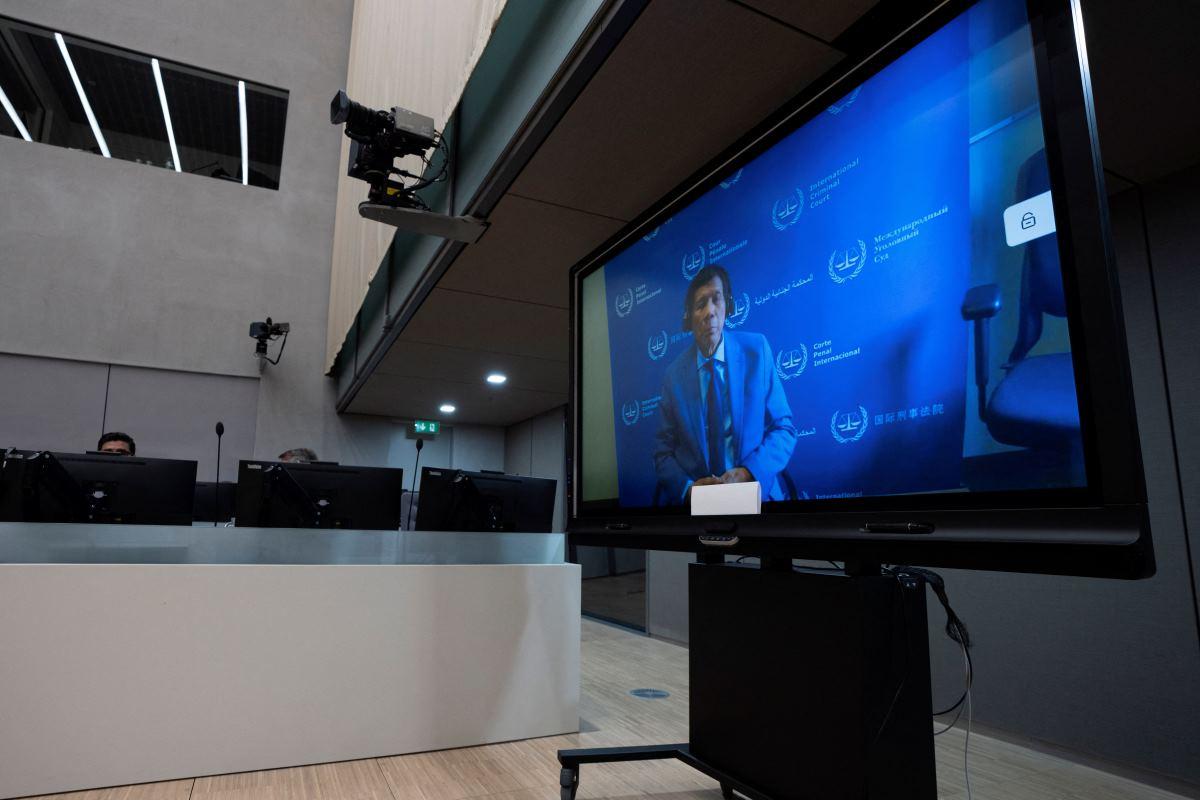
The defense team of former president Rodrigo Duterte has appealed to the International Criminal Court (ICC) to "order his immediate and unconditional release."
In a 21-page document uploaded on the ICC website on Nov. 14, the defense, in its appeal brief on jurisdiction, asked the ICC Appeals Chamber to "reverse its impugned decision" and "find that there exists no legal basis for the continuation of International Criminal Court proceedings against Mr Rodrigo Roa Duterte."
The defense said the Pre-Trial Chamber I erred in its decision on the defense's challenge to the jurisdiction of the court.
"In the Impugned Decision, the Pre-Trial Chamber agreed with the Defence in finding that Article 12(2) requires 'a State to be a Party to the Statute at the time that the Court exercises its jurisdiction,'" the defense team said.
However the Pre-Trial Chamber I ruled that the ICC still has jurisdiction even if a state has withdrawn from the ICC, interpreting Article 127(2) as lex specialis with respect to Article 12. The Oxford Public International Law explains lex specialis as: "if a particular matter is being regulated by a general norm and a more specific one, the special norm shall prevail over the general standard."
The defense however said that the ICC decision "is materially affected by three further errors of law and fact in finding that:
i) a preliminary examination is a ‘matter under consideration’;
ii) the reference to ‘the Court’ in Article 127(2) includes the Office of the Prosecutor; and
iii) the ‘object and purpose’ of the Rome Statute permits the opening of an investigation even after the effective withdrawal of the Republic of the Philippines (‘the Philippines’)."
Duterte's team said the chamber "formulated a novel doctrine for extending the exercise of jurisdiction beyond the effective date of a State Party’s withdrawal."
According to the Pre-Trial Chamber, “Article 127 […] was specifically enacted as lex specialis to set out the regime that would apply to the exceptional circumstance of a State that withdraws from the Statute, providing that the withdrawal of a State from the Statute ‘shall not […] prejudice in any way the continued consideration of any matter
which was already under consideration by the Court prior to the date on which the withdrawal became effective.’”
The defense said this finding is an error of law because:
1. the Pre-Trial Chamber did not explain in what way Article 127(2) constitutes lex specialis of Article 12;
2. there was a lack of discernible intent for the application of lex specialis;
3. there was misapplication of lex specialis particularly in the lack of normative conflict or absence of a need for clarification;
4. there was misapplication of lex specialis regardingg Part 2 of the Rome Statute.
"As a direct consequence of classifying Article 127(2) as lex specialis, the Pre-Trial Chamber found that, post-withdrawal, the jurisdictional provisions of Part 2 of the Statute will continue to apply to a State targeted by a preliminary examination as if that State were still a Party to the Statute," the defense said.
"While such a ruling throws the Prosecution a life-belt for its erroneous decision to seek an impermissibly belated investigation, the Impugned Decision, para. 82. ICC-01/21-01/25-319 14-11-2025 9/21 PT OA3 No. ICC-01/21-01/25 10/21 14 November 2025 upshot thereof has far-reaching and undesirable consequences. Given that Part 2 of the Rome Statute incorporates both the material and temporal jurisdiction of the Court, vesting Article 127(2) with the status of lex specialis would mean that the mere opening of a preliminary examination would be sufficient for the exercise of jurisdiction over alleged crimes committed even after the withdrawal of the State concerned. This is a claim unsupported by any authority, and, once again, is something never before argued by the Prosecutor," it added.
The defense further said that a preliminary examination is not a "matter under consideration" within the meaning of Article 127(2).
It added that "the Pre-Trial Chamber erred in law by finding that 'the object and purpose' of the Rome Statute permitted the opening of an investigation even after the Philippines' effective withdrawal."
The Philippines entered the Rome Statute on Nov. 1, 2011.
READ: TIMELINE: The Philippines and the ICC
The Prosecutor announced on February 8, 2018 the opening of preliminary examination into allegations that Duterte committed a crime against humanity in connection with his controversial war on drugs.
The Philippines withdrew from the Rome Statute effective March 17, 2019.
The Pre-Trial Chamber I authorized the investigation on Sept. 15, 2021.
The ICC Prosecutor has charged Duterte with 49 incidents of murder and attempted murder during his time as mayor of Davao City and as president of the Philippines, "although the actual scale of victimization during the charged period was significantly greater."
He is currently detained at the Hague Penitentiary Institution while awaiting trial. —KG, GMA Integrated News

