

 GMA Brandtalk
 Tracking
 Archives

3 Filipino fishermen hurt as China water cannons PH boats at Escoda Shoal
Three Filipino fishermen were injured Friday after Chinese coast guard and militia vessels used water cannons and acted aggressively against Filipino fishing boats near Escoda Shoal within the West Philippine Sea.
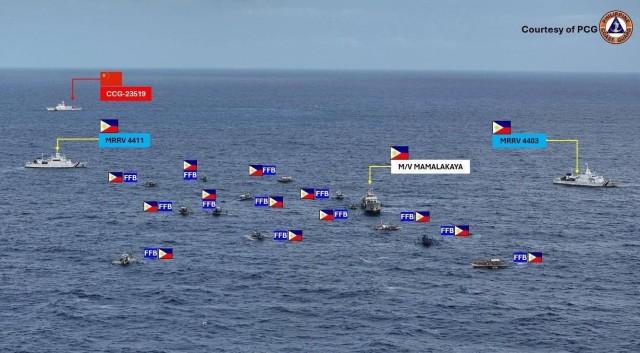
In a statement on Saturday, the Philippine Coast Guard (PCG) said some 20 Filipino fishing boats at the vicinity of Escoda Shoal were "targeted with water cannons and dangerous blocking maneuvers" by two China Coast Guard (CCG) vessels and accompanying Chinese militia ships.
The PCG released photos and videos of the incident showing water cannons pointed at outrigger boats and water reaching small vessels. Pictures were also provided of individuals receiving medical attention following the incident.
Two Filipino fishing boats, the PCG said, "suffered significant damage" from the high-pressure water cannon blasts.
Tatlong mangingisdang Pilipino, sugatan sa panibagong insidente ng pambobomba ng tubig ng barko ng China malapit sa Escoda Shoal sa West Philippine Sea
— DZBB Super Radyo (@dzbb) December 13, 2025
????@jaytaryela , @coastguardph pic.twitter.com/Diiy0RFPi1
"In a brazen escalation, small CCG Rigid Hull Inflatable Boats (RHIBs) deliberately cut the anchor lines of several FFBs, endangering the vessels and their crews amid strong currents and high waves," the PCG said.
"As a direct result of these aggressive actions, three Filipino fishermen sustained physical injuries, including bruises and open wounds," it added.
The PCG's response to assist the Filipino fishermen was met with resistance by their Chinese counterparts and militia ships, but ultimately prevailed in providing aid and security.
A total of three CCG vessels performed "repeated blocking and dangerous maneuvers," the statement read, as two PCG multi-role response vessels attempted to rendezvous with the Filipino fishermen.
"One particularly hazardous incident occurred when CCG-23519 approached within 35 yards of a PCG vessel during nighttime navigation," the PCG said.
"Despite these unprofessional and unlawful interferences, the PCG successfully reached the fishermen this morning and provided immediate medical attention to the injured, along with essential supplies," it added.
As of Saturday afternoon, the two PCG ships are staying close to the fishermen for their security and safety. Assistance provided to the fishermen include fuel, ice, and food provisions as they continue their fishing activities.
“The PCG calls on the Chinese Coast Guard to adhere to internationally recognized standards of conduct, prioritizing the preservation of life at sea over pretensions of law enforcement that jeopardize the lives of innocent fishermen,” the statement read.
In a message to media on Saturday, the Chinese Embassy in Manila cited separate statements from the Chinese People's Liberation Army (PLA) Southern Theater Command and the CCG "announcing that they had taken necessary measures to expel Philippine small aircraft and vessels that recently illegally intruded into the airspace of China's Huangyan Dao (Scarborough Shoal) and the waters off Xianbin Jiao (Sabina Shoal), respectively."
CCG spokesperson Liu Dejun said that they took “necessary control measures” like verbal warnings, and that the fishermen intruded into the area “under the pretext of fishing despite repeated dissuations and stern warnings.”
“Huangyan Dao is an integral part of China's territory… We sternly warn the Philippines to immediately cease its infringement and provocations,” said PLA Southern Theater Command Senior Colonel Tian Junli.
On Friday, China's coast guard said it had driven away multiple Philippine vessels and taken "control measures."
That statement, Philippine coast guard spokesperson Jay Tarriela said on Saturday, was an admission of wrongdoing.
"They admitted this evil wrongdoing to ordinary Filipino fishermen," Tarriela told Reuters by phone.
Located 75 nautical miles or about 140 kilometers off Palawan, Escoda Shoal is a coral reef formation with a central lagoon surrounded by discontinuous shallow sections. It is also called Sabina Shoal, which China refers to as Xianbin Reef.
EXPLAINER: What is the Sabina Shoal and why is it important?
Beijing claims almost all of the South China Sea, a conduit for more than $3 trillion of annual shipborne commerce, including parts claimed by the Philippines, Vietnam, Indonesia, Malaysia, and Brunei.
Parts of the South China Sea that fall within Philippine territory have been renamed by the government as West Philippine Sea to reinforce the country’s claim.
The West Philippine Sea refers to the maritime areas on the western side of the Philippine archipelago including Luzon Sea and the waters around, within and adjacent to the Kalayaan Island Group and Bajo de Masinloc.
In 2016, the Permanent Court of Arbitration in the Hague ruled in favor of the Philippines over China's claims in the South China Sea, saying that it had "no legal basis."
China has refused to recognize the decision. — with a report from Jiselle Anne C. Casucian and Reuters/ VDV/ VBL, GMA Integrated News

