

 GMA Brandtalk
 Tracking
 Archives

Top 5 public health issues in PH in 2025
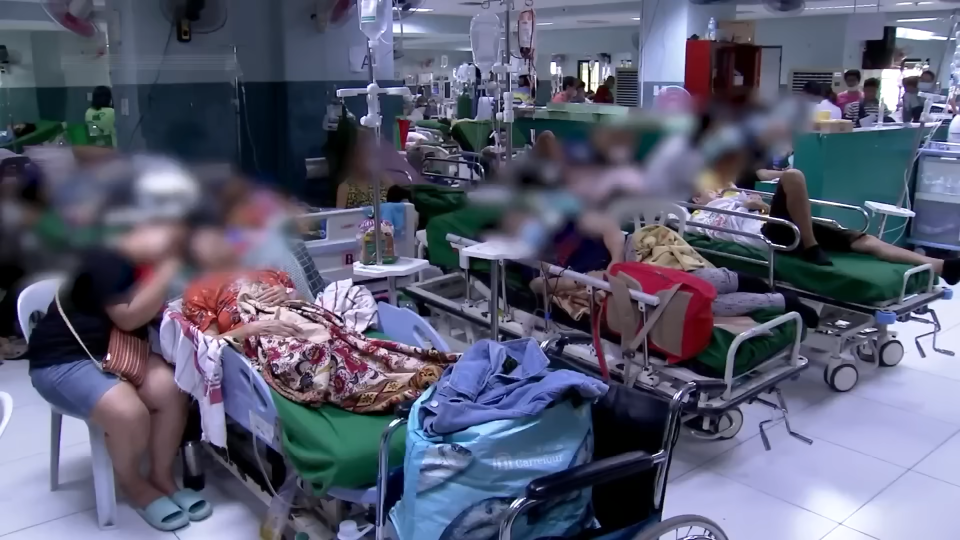
In 2025, many government agencies faced public scrutiny due to discrepancies and issues.
The Department of Health was not spared at it hurdled different challenges throughout the year, including major budget issues and public health concerns.
Here are five of the biggest public health news that the Philippines faced in 2025:
PhilHealth's excess funds
In 2024, PhilHealth had been ordered to return P89.9 billion worth of excess funds back to the Philippine treasury.
The return of the funding to the national treasury was ordered through a Department of Finance circular, and a transfer of P60 billion was successfully done until a temporary restraining order (TRO) was issued in October 2024.
In December 2025, the Supreme Court ordered the return of the P60-billion funding back to PhilHealth.
“Filipinos deserve better. We deserve to dream, not of the day when we and our families can finally walk into the hospital without fearing financial ruin, but of the beautiful life that can still be led after healing,” SC said in their decision.
“The Court will not sit idly by, not when the people look and cry to us for help, not when the Constitution charges us to be the singular indomitable bastion of our people’s rights. This Court will not be deaf to the pleas of our people. We will not be blind to their plight. And we certainly will not be callous to their agony,” it later added.
The decision was welcomed by lawmakers and the Health Department.
Earlier in the year, when asked about the rest of the P89.9 billion in PhilHealth funds remitted to the national treasury, Health Secretary Teodoro Herbosa said he had no idea where it went.
He mentioned that a portion of the fund that was protected by the TRO had been used to settle arrears in the health emergency allowance, but that he did not know about the rest of the budget that was handed to the treasury.
"I think that money could have gone, for example, to easing the burden and the cost, broadening the programs of PhilHealth for our people,” said Representative Chel Diokno.
Then Finance secretary Ralph Recto said the P60 billion fund went to the following:
- P27.45 billion to pay the allowances of COVID-19 frontliners
- P10 billion to the Social Programs for Health to provide medical assistance to poor Filipinos
- P3.37 billion for the establishment of three DOH facilities
- P4.1 billion to strengthen existing DOH facilities
- P1.6 billion to the Health Facilities Enhancement Program
- P13.00 billion to fund the government counterpart financing for foreign-assisted infrastructure and social determinants for health projects.
On December 22, complaints for plunder, graft, technical malversation, and grave misconduct were filed by health advocates against now Executive Secretary Ralph Recto and former Philippine Health Insurance Corporation president and chief executive officer Emmanuel Ledesma over the transfer of PhilHealth’s excess funds to the national treasury.
Guarantee letters under the MAIFIP program
The Department’s Medical Assistance for Indigent and Financially Incapacitated Patients (MAIFIP) program has long been the subject of public scrutiny due to its dependence on guarantee letters issued by politicians.
Critics believed the practice of giving guarantee letters is being used to perpetuate patronage politics.
MAIFIP is a financial aid program of the Department of Health targeted to provide assistance for the medical expenses of eligible applicants including indigent and financially incapable patients.
In November, a group of medical experts criticized high budget allocations for the MAIFIP program and low allocations for PhilHealth.
They noted that the higher MAIFIP budget forced patients to seek guarantee letters from politicians and agencies instead of the Health Department, causing a growing political control of medical aid.
The program then turned healthcare into a question of “who you voted for or will vote for.”
During the bicameral conference committee for 2026 budget, MAIFIP’s fund was raised to P51 billion, another move that drew more public criticism.
For its part, the DOH clarified that MAIFIP program was not at all dependent on guarantee letters and that funding will not pass through government officials.
The Palace echoed the same sentiments.
In July, some private hospitals considered a slowdown or even suspension in accepting guarantee letters due to DOH’s alleged failure to settle payment.
“Kasi nga medyo maraming nag-avail ng guarantee letter dito sa probinsya sa Batangas. So medyo naipon po siguro, and then, hindi po agad na-release 'yung funding, at isa pa, sabi nila doon sa region, kulang din sila sa tao na nagpo-proseso ng guarantee letter,” PHAPI president Dr. Jose De Grano said.
(Because many people availed of the guarantee letter here in the province of Batangas. So there was a backlog, and then the funding was not released immediately. And another thing, they said in the region, they also lack people to process the guarantee letter.)
The threatened suspension also caught the attention of some lawmakers like Mamamayang Liberal (ML) Party-list Representative Leila de Lima, who called for a probe into the unpaid claims.
“Ghost” Health Centers
Amid the probe into ghost flood control projects, the DOH in October exposed and criticized an “unfinished” health center in Marikina City.
DOH said that while P21.4 million have been released for the Phase 1 of the Conception Dos Super Health Center in Marikina City, what they found was an empty lot with foundations for the structure overgrown with vegetation.
The local government of Marikina, on the other hand, blamed DOH for not providing full funding for the project.
Herbosa also inspected a “partially-operational” health center in Antipolo that should have been operational since 2024.
It was during the inspection in Antipolo where Herbosa revealed that nearly 300 health centers remained inoperational or unfinished, but that it can be revived through public-private partnerships.
The DOH faced the Independent Commission on Infrastructure (ICI), where they reiterated that they found more inoperational health centers.
They were advised to continue their probe into ghost health centers.
“Ang nakikita namin na obstacle to operations ay minsan walang power, walang water. Sa arrangement namin, it is the LGU that will make sure it is connected to electrical, water lines and who will also hire the personnel na magpapatakbo ng health centers,” said Herbosa.
(The obstacle to operations are the lack of power and water. Based on our arrangement, it is the LGU that will make sure it is connected to electrical, water lines and hire the personnel who will run the health centers.)
Issues surrounding officials
In July, Health Undersecretary Dr. Maria Rosario Singh-Vergeire and two others stepped down from their posts.
While DOH Undersecretaries Achilles Gerard Bravo and Dr. Kenneth Ronquillo were said to have stepped down due to retirement, no comment was issued by the Secretary for Vergeire’s alleged resignation.
A month later, a statement was issued by 64 different health organizations criticizing the “removal” of Vergeire.
They said that she was replaced with officials who have limited public health backgrounds crucially needed for their roles.
“These actions risk undermining institutional stability, demoralizing other health professionals, and weakening the public trust we have collectively worked to build,” read the statement.
“Political transitions must not come at the cost of technical excellence or institutional memory—especially at a time when the country continues to face urgent health challenges, including the recent calamities affecting our communities,” the statement added.
On December 23, a graft complaint was filed against Herbosa, Assistant Secretary Albert Domingo, and Director Tina Marasigan for allegedly using the health agency’s radio program for their own benefit and publicity.
“The law does not prohibit health promotion. What it prohibits is a public officer using public funds to generate a platform from which he himself benefits," they said in their 24-page complaint.
"The question is, was the P98 million radio program genuinely for public health promotion, or was it a publicly financed vehicle for Respondent Herbosa’s own media exposure and personal branding?” the group added.
Herbosa had also been a subject of false reports on an alleged suspension due to issues surrounding DOH.
HIV, evolving local epidemic
In June, DOH reported that there was a 500% uptick in human immunodeficiency virus cases among the Filipino youth.
Herbosa went as far as to call the disease as a possible public health emergency.
"Five hundred percent increase po tayo ng HIV cases sa mga edad 15 hanggang 25. In fact, ang pinakabatang na-diagnose natin ay batang 12-anyos sa probinsiya ng Palawan," he said.
(There was a 500% increase in HIV cases among Filipinos aged 15 to 25. In fact, the youngest we diagnosed was a 12-year old child from Palawan.)
"Sa datos natin tayo na ang pinakamataas na new cases sa Western Pacific Region. Ang nakakatakot lang maraming new cases sa ating kabataan," he added.
(Based on our data, the Philippines has the highest number of new cases in the Western Pacific Region. What is disturbing is many of the new cases are young people.)
Herbosa said that from July to September 2025, they recorded 5,000 new cases of HIV with 30% of cases recorded on patients aged 18 and below.
In December, DOH called HIV an “evolving” Philippine epidemic as the number of cases continue to rise with 217,700 people living with HIV (PLHIV) in the country.
The agency said that more than 457,000 PLHIV could be recorded in the country by 2030 if it remains unmanaged.
“Globally, annual new infections and AIDS-related deaths are on a steady decline, including the Asia and the Pacific region. Unfortunately, this isn’t the case for us in the Philippines. The AIDS-epidemic model reveals that there is a 555% increase in new infections and 667% increase in AIDS-related deaths between 2010 and 2024,” said DOH Epidemiology Bureau Senior Health Program Officer Dr. Noel Palaypayon.
“This means that we have an evolving local concentrated epidemic that requires sustained and intensified interventions,” he continued.
DOH shared that currently, the country is still unable to meet UNAIDS’ 95-95-95 targets for the AIDS epidemic.
“As of October 2025, the current performance in terms of the 95-95-95 is at 60%-64%-59%... Our vision is to have 0 new infections, 0 aids-related deaths, and 0 stigma and discrimination by 2030, with the goal of reducing mortality, reducing new infections, and 0 catastrophic costs,” DOH HIV Program Manager Dr. John Derek Junio shared. —AOL, GMA Integrated News

