

 GMA Brandtalk
 Tracking
 Archives

AFP rejects Chinese media portrayal of Pinoy fisherfolk as West PH Sea aggressors
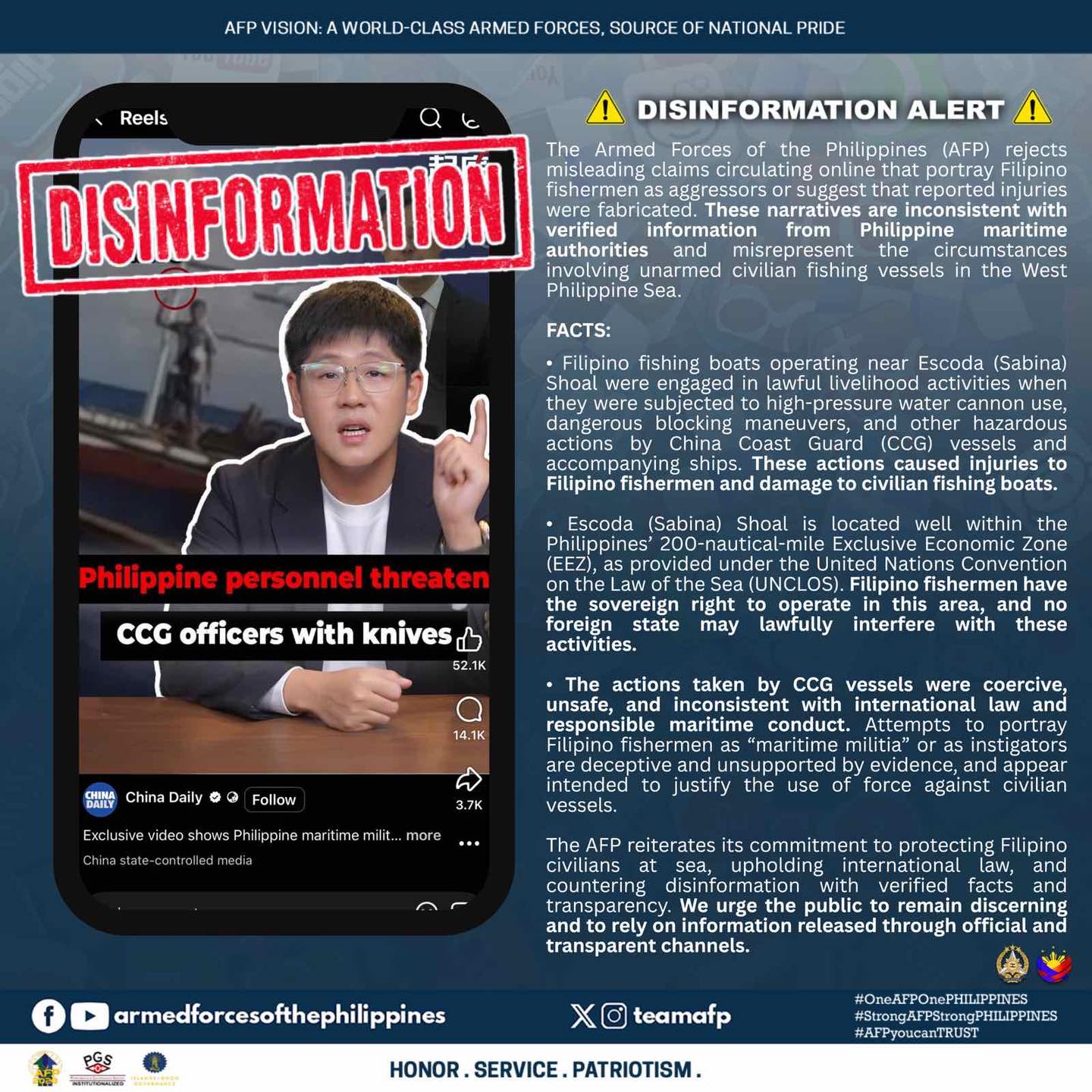
The Armed Forces of the Philippines (AFP) on Wednesday dismissed the portrayal of Filipino fishermen as aggressors in the West Philippine Sea (WPS) by Beijing-based media China Daily as misleading and deceptive.
“These narratives are inconsistent with verified information from Philippine maritime authorities and misrepresent the circumstances involving unarmed civilian fishing vessels in the WPS,” the military said in a statement.
The AFP also called out Chinese media for suggesting that the reported injuries sustained by Filipinos during China’s water cannon attack on Philippine boats in Escoda Shoal last December 12 were fabricated.
“Filipino fishing boats operating near Escoda (Sabina) Shoal were conducting lawful livelihood activities when they were subjected to high-pressure water cannon use, dangerous blocking maneuvers, and other hazardous actions by China Coast Guard (CCG) vessels and accompanying ships,” the AFP said.
“These actions resulted in injuries to Filipino fishermen and damage to civilian boats,” it added.
China Daily’s caption for a December 16 video posted on its Facebook page read: “Philippine maritime militia threatening China Coast Guard officers with knives.”
“On December 11, Philippine fishing boats intruded near China’s Huangyan Island, while small aircraft carrying journalists illegally entered Chinese airspace,” China Daily said in its caption.
“On December 12, additional Philippine vessels stirred up trouble by intruding into the lagoon of Xianbin Reef,” it added.
In response, the AFP said Escoda Shoal lies well within 200 nautical miles that comprises the Philippines’ exclusive economic zone (EEZ) under the United Nations Convention on the Law of the Sea (UNCLOS), where Filipino fishermen have sovereign rights to operate.
Escoda or Sabina Shoal is located 75 nautical miles or about 140 kilometers off Palawan.
The military said any interference by foreign vessels in the area is unlawful, while attempts to label fishermen as “maritime militia” or instigators are deceptive and unsupported by evidence.
“The AFP reiterates its commitment to protecting Filipino civilians at sea, upholding international law, and countering disinformation through verified facts and transparency,” the AFP said.
“The public is urged to remain discerning and rely only on information released through official and transparent channels,” it added.
Tensions continue as Beijing claims almost all of the South China Sea, a conduit for more than $3 trillion of annual shipborne commerce, including parts claimed by the Philippines, Vietnam, Indonesia, Malaysia, and Brunei.
Parts of the South China Sea that fall within Philippine territory have been renamed by the government as the West Philippine Sea to reinforce the country’s claim.
The West Philippine Sea refers to the maritime areas on the western side of the Philippine archipelago, including Luzon Sea and the waters around, within and adjacent to the Kalayaan Island Group and Bajo de Masinloc.
In 2016, the Permanent Court of Arbitration in The Hague ruled in favor of the Philippines over China’s claims in the South China Sea, saying Beijing had “no legal basis.” China has refused to recognize the decision. — JMA, GMA Integrated News

