

 GMA Brandtalk
 Tracking
 Archives

China not a 'benign, cuddly panda' in WPS disputes — PH envoy
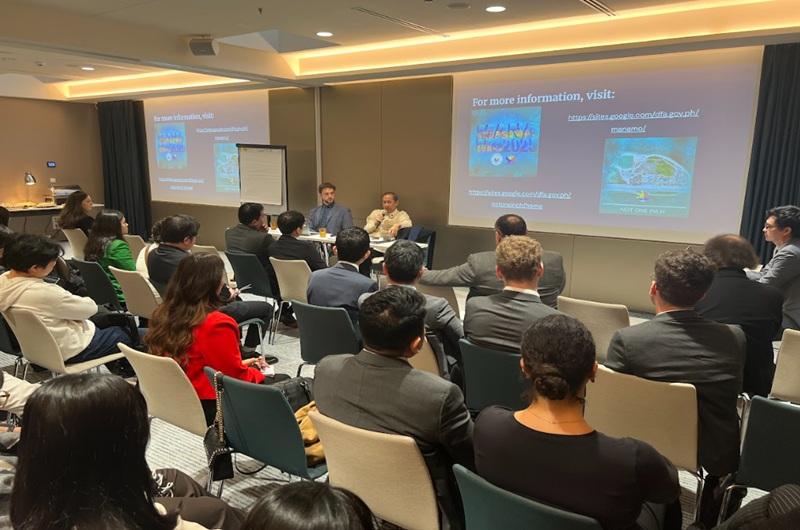
PRAGUE, Czech Republic – When it comes to the escalating territorial disputes in the West Philippine Sea, China “is not a benign, cuddly panda” but rather a “calculating and very well-coordinated security-conscious entity”, the Philippines’ envoy to the Czech Republic told diplomats, academics, and students in a recent lecture.
“Credits to their security analysts, advisors, and others — they are working in concert, really, to ensure that the country dominates in the near future,” Philippine Ambassador to the Czech Republic Eduardo Martin Meñez said in a discussion on the security in the Indo-Pacific region in Prague on December 17.
Meñez showed the audience footage of the incident near Escoda Shoal on December 12, when Chinese coast guard and militia vessels used water cannons against Filipino fishing boats, injuring three Filipino fishermen.
Saying the incident was “a great escalation” that exemplified a “persistent pattern of coercion” in the West Philippine Sea, Meñez invited his Czech and international audience to imagine a hypothetical incident in the Czech Republic’s Vltava River, which cuts through central Prague and has several islands with sports complexes and other tourist attractions.
“How would the [Czechs] feel if a large northern neighbor took control of your islands in the Vltava, prevented you from any beneficial rights from those islands, built military features, and harassed your tourists in your paddle boats? If you see it, you will understand how the Filipinos feel about this particular issue.”
GMA Integrated News is trying to get a statement from the Chinese government.
'Industrial cardiac arrest'
For Ambassador Meñez, any blockade or conflict in the South China Sea would trigger an “industrial cardiac arrest” that could affect countries as far away as the Czech Republic, which he called Europe’s “major industrial workshop”.
He argued that it would be in the Czech Republic’s economic interests and strategic investment to secure stability in the South China Sea, noting that a conflict there could affect its automotive industry.
Meñez cited International Monetary Fund (IMF) figures indicating the Czech automotive industry accounts for nearly 10% of the country’s gross domestic product and 20% of its national exports.
“The stability of the system is directly threatened by instability in the South China Sea, because it is a maritime superhighway carrying an estimated USD 3.4 trillion in annual global trade,” he added.
The ambassador also highlighted a “defense opportunity” for the Czech Republic to assist the Philippines in modernizing and strengthening its capabilities, particularly for patrolling the country’s maritime borders.
“A secure Philippines is a viable market and reliable partner for Czech high-tech exports as well,” he continued.
Key stress test
The lecture’s second speaker, security analyst David Gardaš from the Prague-based think tank Project Sinopsis, argued that the South China Sea is a “frontline arena for systemic rivalry”, and that escalating tensions there could become a “key stress test for rules-based maritime and legal order”.
“China is incrementally reshaping the status quo through sustained pressure and presence. We still have the legal norms, but they are rather weakly enforced,” Gardaš remarked, referring to the United Nations Convention on the Law of the Sea and the arbitration case that the Philippines won against China in 2016.
“[These norms] remain symbolically important, so they might need some heightened presence when it comes to private companies or collaboration between like-minded countries, and, possibly, the freedom of navigation operations. It all boils down to what we can do about these.”
Gardaš also detailed what he called China’s “vectors of power” in the South China Sea conflict, including the use of tourism as a soft power discourse, as well as turning artificial and militarized reefs into “outposts” with “electronic warfare systems”.
“China has many leverages that they can exploit over the countries in the region, be it economic interdependence. But China is diversifying very rapidly. They understand that this de-risking taking place in the European Union is something they themselves have to implement if they want to cut off some of the dependencies they have with democratic countries with differing views and different systems. They have several fields of infrastructure, energy, and mining projects that deepen some of the influence the CCP is using.”
Numbers game
Ambassador Meñez highlighted the Czech Republic’s support when the Permanent Court of Arbitration in The Hague ruled in favor of the Philippines over China's claims in the South China Sea in 2016.
“In essence, the ruling replaced political narratives with legal clarity and set firm boundaries for what states can and cannot claim in the South China Sea,” he said.
The countries recognizing the ruling, he added, have “respect for the rule of law and international law” in common.
Meñez also emphasized that while other countries may be affected by expansionist claims in the South China Sea, it remains a “numbers game” to compel China to abide by global norms.
“How many countries will recognize and support the rule of law, and what things should countries abide by? It is only through peer pressure, perhaps, that we can secure support for Filipino fishermen who have been disadvantaged by activities in the South China Sea. Because if more countries see that the Filipino fishermen are really at a losing end, maybe then countries will provide support for them,” Meñez said. — BAP, GMA Integrated News

