

 GMA Brandtalk
 Tracking
 Archives

PCG challenges China research ship off Cagayan province
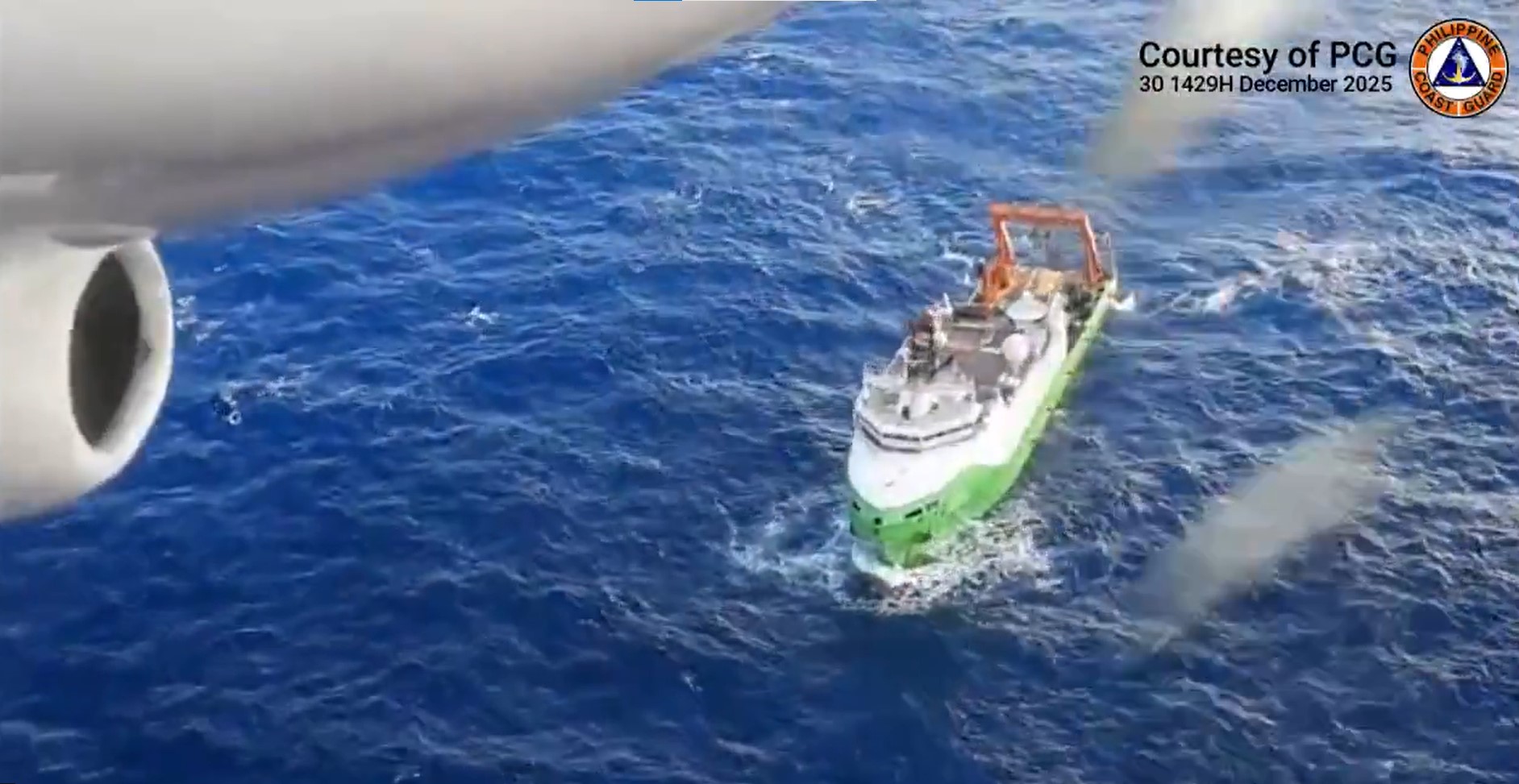
The Philippine Coast Guard (PCG) has monitored the presence of a Chinese research vessel off the coast of Cagayan province in northern Luzon, prompting it to challenge the ship's presence within the country's exclusive economic zone.
In a social media post late Tuesday night, PCG spokesperson for the West Philippine Sea (WPS) Jay Tarriela said Chinese Research Vessel (CRV) Tan Suo Er Hao was spotted about 19 nautical miles off the Cagayan coast.
PCG Commandant Admiral Ronnie Gil Gavan then ordered the deployment of a PCG Islander aircraft on Tuesday morning to conduct a Maritime Domain Awareness (MDA) flight to challenge the ship's presence.
According to the PCG, the operation also sought to verify if the vessel was conducting marine scientific research without prior clearance from the Philippine government.
Tarriela said such actions are in potential violation of the Philippine Maritime Zones Act and the United Nations Convention on the Law of the Sea (UNCLOS).
PCG Challenges Chinese Research Vessel Operating Near Cagayan Waters
— Jay Tarriela (@jaytaryela) December 30, 2025
The Philippine Coast Guard (PCG), utilizing the Canada’s Dark Vessel Detection program, detected the Chinese Research Vessel (CRV) Tan Suo Er Hao approaching within approximately 19 nautical miles off the coast… pic.twitter.com/8xUl9aZla6
The ship was spotted through Canada's Dark Vessel Detection technology.
During the MDA flight, the PCG aircraft sighted the Tan Suo Er Hao heading eastward 55.78 nautical miles east of Santa Ana, Cagayan.
Monitoring data showed that the vessel departed from Hainan province in China earlier this month and sailed through the western portion of the Philippine EEZ.
The PCG described the Tan Suo Er Hao as an 87.25-meter advanced deep-sea scientific research vessel operated by the Institute of Deep-sea Science and Engineering under the Chinese Academy of Sciences. It is designed to serve as a mothership, the PCG said, for manned and unmanned deep-sea submersibles and to support a wide range of deep-sea operations.
"The PCG pilot issued multiple radio challenges to the vessel, inquiring about its intentions and reminding it of the requirement for prior consent for marine scientific research in Philippine waters. The CRV Tan Suo Er Hao did not respond to any of the radio calls," Tarriela said.
The Chinese Embassy in Manila, however, insisted that the ship "was conducting normal navigation" as Beijing does not recognize the Philippine Maritime Zones Act.
It added that China disagrees with the Philippine Archipelagic Sea Lanes Act's designation of the Balintang Strait as the only strait for international passage in northern Philippines.
"China enjoys the right of passage through the archipelago maritime route in accordance with international law, including UNCLOS," the Chinese embassy said.
'Clear intrusion'
In March 2024, former United States Air Force official and ex-Defense Attaché Ray Powell reported that two Chinese research vessels were spotted "loitering" in the resource-rich Philippine Rise (earlier known as Benham Rise) on the eastern side of Northern Luzon.
President Ferdinand "Bongbong" Marcos Jr. called out the sightings, saying this was a clear intrusion of the country's territory.
"Once again, this is a clear intrusion into our Philippine maritime territory and it is, as usual, of great concern. And I see this as absolutely unnecessary because if it is truly a research vessel then we could have come to a very simple agreement that the research vessel will ply the waters and do the research that they need to do," said Marcos.
"However, there is a suspicion that they are not only research vessels so, again, this is a bit of an escalation of the tension that is present in the West Philippine Sea," he added.
Benham Rise, which sits off the Philippines' east coast, is a vast area declared by the United Nations in 2012 as part of the country's continental shelf. Manila in 2017 renamed it the Philippine Rise.
Last August, the PCG expressed alarm over the "significant increase" of Chinese research vessels within the Philippine EEZ.
In an interview with Super Radyo dzBB at the time, Tarriela had said four such vessels were spotted in July, including the Xiang Yang Hong 05 which was tracked some 37 nautical miles off Sta. Ana, Cagayan.
'Humanitarian' aid
In a related development, the Chinese embassy called out Tarriela for making "groundless accusations" regarding an incident involving a distressed Filipino fisherman in the West Philippine Sea on Christmas Day.
The embassy rebuffed Tarriela's statement that there was no communication between the Chinese naval ship and a PCG vessel. It claimed that on-site audio recordings of the incident had been released. China maintained that it provided "humanitarian" assistance, a claim that has earned a strong rebuke from the PCG.
Tarriela had said the PCG did not receive any prior information from the Chinese Navy regarding the location or condition of the fisherman.
The PCG official also belied the narrative the fisherman had been adrift for three days, asserting that the latter was safely moored to a Floating Aggregate Device (FAD) or payao, and was already awaiting to be picked up by a mother boat.
West Philippine Sea
Beijing claims almost all of the South China Sea, a conduit for more than $3 trillion of annual shipborne commerce, including parts claimed by the Philippines, Vietnam, Indonesia, Malaysia, and Brunei.
Parts of the South China Sea that fall within Philippine territory have been renamed by the government as West Philippine Sea to reinforce the country’s claim.
The West Philippine Sea refers to the maritime areas on the western side of the Philippine archipelago including Luzon Sea and the waters around, within and adjacent to the Kalayaan Island Group and Bajo de Masinloc.
In 2016, the Permanent Court of Arbitration in the Hague ruled in favor of the Philippines over China's claims in the South China Sea, saying that it had "no legal basis."
China has refused to recognize the decision. — VDV, GMA Integrated News

