

 GMA Brandtalk
 Tracking
 Archives

89% of Filipinos starting 2026 with hope – SWS
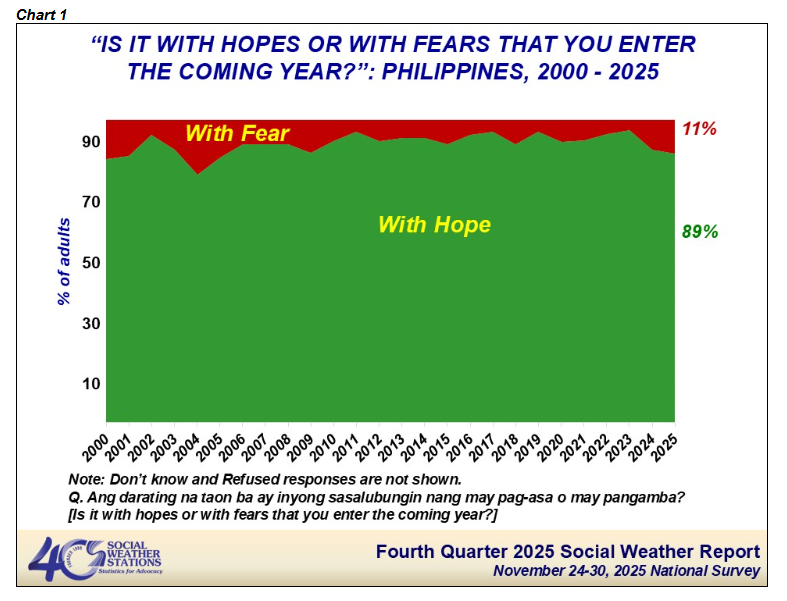
Eighty nine percent of adult Filipinos are looking forward to the New Year with hope instead of fear, the lowest level since 2009, a non-commissioned survey conducted by the Social Weather Stations (SWS) in November revealed.
This reflected a one-point decline from 90% in 2024 and a seven-point decrease from 96% in 2023, which marked the lowest level of optimism in 16 years since the 89% recorded in 2009.
Conversely, 11% will begin 2026 with fear, up by one point from 10% in 2024 and a seven-point rise from 3% in 2023. This is the highest since the 11% posted in 2009.
According to the SWS, Filipinos’ optimism for the New Year was at 87% when it was first surveyed by the poll body at the end of 2000.
The results were in the 80s at the end of 2000, 2001, 2004, 2005, 2009, and 2025. It was in the 90s at the end of 2002, 2003, 2006, 2007, 2008, and from 2010 to 2024.
The survey questions were phrased as: “Ang darating na taon ba ay inyong sasalubungin nang may pag-asa o may pangamba? (Is it with hopes or with fears that you enter the coming year?)”
The responses were: “Sasalubungin ang darating na taon nang may pag-asa; sasalubungin ang darating na taon nang may pangamba (Enter the coming year with hope; enter the coming year with fear).”
Happy Christmas 2025, hopeful 2026
The November 2025 survey also showed that 68% of adult Filipinos expected Christmas to be happy (“masaya”), 7% expected it to be sad (“malungkot”), and 25% expected it to be neither happy nor sad.
The percentage of those starting the New Year with hope instead of fear is higher among those who expected a happy Christmas (92%) than those who expected neither a happy nor a sad Christmas (83%), and those who expected a sad Christmas (79%).
“Hope for the coming New Year has always been higher among those who expected a happy Christmas than those who expected a sad Christmas,” the SWS said.
Hope slightly lower in Mindanao and Visayas
The same survey showed that hope for the coming New Year was highest in Balance Luzon at 92%, followed by Metro Manila at 90%, the Visayas at 85%, and Mindanao at 84% as of November 2025.
Compared to the end of 2024, hope for the coming New Year fell slightly in Mindanao, or down by five points from 89%. In the Visayas, this fell by two points from 87%. It remained at 92% in Balance Luzon, while it hardly changed from 91% in Metro Manila.
Hope lower in most educational levels except among junior high school graduates
The SWS poll found that those entering the New Year with hope tend to be higher among those with higher levels of education.
As of November 2025, hope for the coming New Year was higher among college graduates (91%), those with some senior high school education (93%), and junior high school graduates (90%). This is in comparison to elementary graduates (86%) and non-elementary graduates (81%) whose optimism about 2026 are lower.
In contrast to the end of 2024, hope for the New Year fell from 96% among college graduates and 89% among elementary graduates.
It remained at 93% among those with some senior high school education, while it hardly changed from 91% among junior high school graduates and 83% among non-elementary graduates.
Earlier, the SWS said 29% of Filipino adults reported that their quality of life improved in the past year (“gainers”), while 36% said their life worsened (“losers”).
Meanwhile, 44% of Filipino adults are looking forward to the improvement of their quality of life (“optimists”) in the next 12 months, the SWS said. The same poll noted that 38% of respondents felt their quality of life will stay the same, while 8% said theirs will worsen (“pessimists”).
Respondents’ socio-demographic characteristics
Using census weights and correctly rounded, 13% of the respondents were from Metro Manila, 45% from Balance Luzon (or Luzon outside Metro Manila), 19% from the Visayas, and 23% from Mindanao, the SWS said.
Fifty percent came from urban areas and 50% were from rural areas, the poll body added.
Male and female respondents have a 1-to-1 ratio and were alternately sampled.
By age group, 11% are youths (18-24), 20% are intermediate youths (25-34), 20% are middle-aged (35-44), 16% are 45 to 54 years old, and 33% are 55 years old and above.
By education, 10% had at most some elementary education, 27% either finished elementary or had some high school education, 30% either finished junior high school or completed vocational school, and 22% either attended some senior high school, completed senior high school or vocational, or attended some college.
Meanwhile, 11% either graduated from college or took post-graduate studies.
Survey background
The Fourth Quarter 2025 Social Weather Survey was held from November 24 to 30, 2025, using face-to-face interviews of 1,200 adults (18 years old and above) nationwide: 300 each in Metro Manila, Balance Luzon (or Luzon outside Metro Manila), the Visayas, and Mindanao.
The sampling error margins consisted of ±3% for national percentages and ±6% each for Metro Manila, Balance Luzon, the Visayas, and Mindanao.
The area estimates were weighted by the Philippine Statistics Authority (PSA) medium-population projections for 2025 to obtain the national estimates.
The survey items reported were non-commissioned as part of SWS’s initiative and public service efforts. — JMA, GMA Integrated News

