

 GMA Brandtalk
 Tracking
 Archives

Lawmakers say 2026 budget is ‘cleanest ever’; opposition say it’s ‘pork-filled’
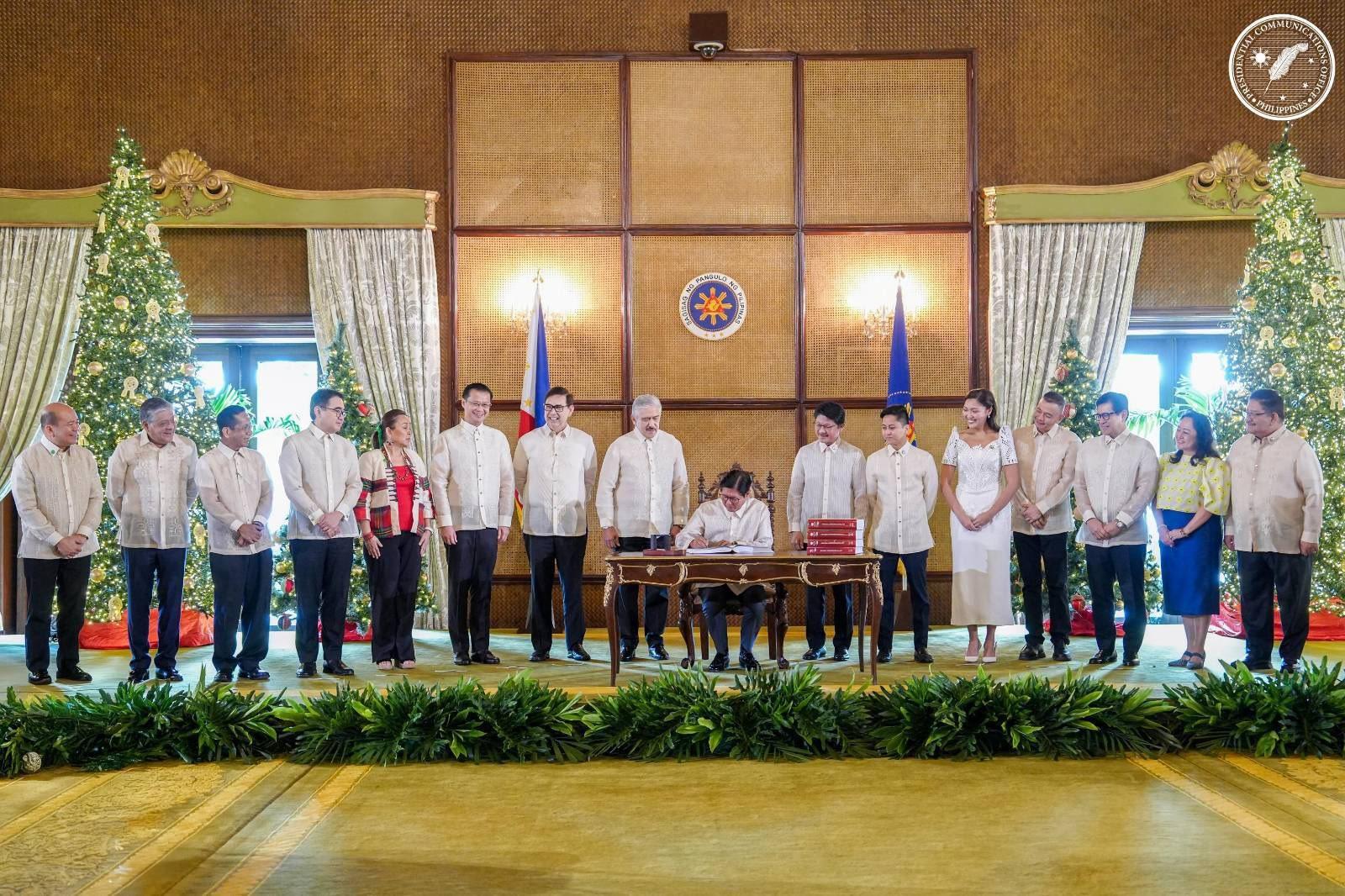
Lawmakers on Monday welcomed the P6.793-trillion budget for fiscal year 2026, with Senate President Vicente “Tito” Sotto III calling it “by far the cleanest ever,” though opposition solons said pork barrel allocations remained.
“I know the 2026 budget is by far the cleanest ever but it seems the President wants it squeaky clean. He even highlighted the Senate provision that prevents political patronage by politicians,” Sotto said in a Viber message to reporters, on the day President Ferdinand “Bongbong” Marcos Jr. signed the 2026 General Appropriations Act (GAA) into law.
Sotto also backed Marcos' move to veto nearly P92.5-billion worth of line items under unprogrammed appropriations.
“Yes, he is correct. Anyway, ‘yun ang isa sa mga contentious na issue na sometimes sa legislation kailangan magbigay ka… Kaya malinis ‘yung budget pero gusto ni PBBM mas malinis pa,” he added.
(Anyway, that is one of the contentious issues in legislation, that sometimes you have to give way...So the budget is clean, but PBBM wants it to be even cleaner.)
According to Marcos, the unprogrammed funds under the 2026 GAA were reduced to their “absolute bare minimum,” and at the level lowest since 2019.
Unprogrammed appropriations are budget items that will only be funded if there is excess government revenue collected, or if there are other sources of funding such as special laws or loans.
Executive Secretary Ralph Recto said that only three items remain under unprogrammed funds in the 2026 GAA:
- support for foreign-assisted projects worth P97.305 billion;
- the revised Armed Forces of the Philippines (AFP) Modernization Program worth P50 billion; and
- the Risk Management Program worth P3.6 billion.
He said among the items included in the vetoed items in unprogrammed funds was the P80-billion “lump sum” for the Strengthening Assistance for Government Infrastructure and Social Programs (SAGIP).
Senate President Pro Tempore Panfilo "Ping" Lacson said that the two of the items that survived the veto—the government support to foreign-assisted projects and the revised AFP Modernization Program—are needed for economic development and national security.
He also said the care non-cash items that may only be used with the following special conditions:
- if there is an excess in the government’s non tax revenue collection;
- if there is an accompanying revenue measure; and
- if there is an approved loan.
"Further, only the President is authorized to approve to use the unprogrammed appropriations to augment items under the programmed appropriations, a.k.a. regular budget," he said.
Senator Sherwin Gatchalian, chairman of the Senate Committee on Finance, also clarified that the P80-billion allocation supposedly for the SAGIP under the unprogrammed funds had already been removed by the Senate early on.
“The [unprogrammed appropriations] contains many components, and SAGIP has been identified as a source of abuse and corruption, particularly in flood control projects. In other words, lump-sum funds for projects such as flood control were often parked under SAGIP, which the Senate had long eliminated,” he said in a statement.
He also said that five of the seven items vetoed under the unprogrammed funds were originally part of the 2026 National Expenditure Program.
Senator Erwin Tulfo, vice chairman of the Senate Committee on Finance, also expressed the belief that the 2026 budget is “the most transparent budget law in the recent history.”
“This is what we need, a budget that will restore the public’s trust to the government. We are grateful that the President heeded our call to limit the use of unprogrammed appropriations and vetoed P92.5 billion worth of projects lodged under this budgetary mechanism,” he said.
Token veto, shadow pork?
But for House opposition lawmakers, the veto was more cosmetic than reform-driven.
House Deputy Minority Leader and ML party-list Representative Leila de Lima said that while P92.5 billion is a significant amount, removing the entire P243-billion unprogrammed appropriations (UAs) would have been the right thing to do, because the remaining amount is still “pork” or discretionary allocations.
“Vetoing a considerably significant amount—or any amount—in unprogrammed appropriations is not the point. It is still 'shadow pork.' As succinctly pointed out in the separate concurring and dissenting opinion of Justice Hernando in the PhilHealth case, unprogrammed appropriations are unconstitutional,” de Lima said.
“They [unprogrammed appropriations] lack definite and identifiable revenue sources, bypass constitutional safeguards, and surrender congressional power of the purse to executive discretion,” she added.
De Lima, a former senator and Justice secretary, also cited Executive Secretary and former Finance secretary Ralph Recto’s earlier statement that there is no expected excess revenue to be collected.
“Isn’t it illogical to have UAs in the first place? If we are not expecting excess revenues, how are we going to fund the UAs? Uulit-ulitin natin: Yung mga talagang kailangan ay dapat inilalagay na sa programmed appropriations. At doon naman sa mga hindi pa kayang isama due to limited fiscal space, at sakaling magkapera na dahil sa excess revenues, then special appropriations from Congress ang dapat,” de Lima said.
(We say again: funds that are truly needed must be placed in programmed appropriations. And for programs that cannot be included due to limited fiscal space, and for whom there might be funding if there are excess revenues, then special appropriations from Congress is appropriate.)
“UAs have no place in the national budget,” de Lima added.
Makabayan bloc lawmakers Antonio Tinio of ACT Teachers party-list, Sarah Jane Elago of Gabriela Women’s party-list and Renee Louise Co of Kabataan party-list agreed, saying that the signed 2026 budget still perpetuates the pork barrel system, patronage politics, and systemic corruption in government.
“The President's much-touted veto of P92.5 billion in unprogrammed appropriations is nothing but pampalubag-loob—a token gesture meant to distract from the billions in pork barrel funds that remain untouched in the signed budget,” the Makabayan legislators said.
“The veto of P92.5 billion in unprogrammed appropriations does not change the fundamental character of this budget. It remains a budget designed for the political survival of the Marcos administration, a budget that enables systemic corruption, and a budget that prioritizes the interests of the few over the needs of the many,” they added.
Makabayan also said that by refusing to veto the Department of Public Works and Highways' (DPWH) “allocables,” or the infrastructure funds per district, President Marcos has ensured the continuation of the most entrenched system of corruption in government.
“The “allocables” system allows members of Congress to identify infrastructure projects in their districts, which are then implemented by DPWH with bloated costs and questionable quality. This is the very definition of pork barrel, rebranded and legitimized through the national budget,” they pointed out.
“By signing this budget with the DPWH allocables and other pork barrel funds intact, President Marcos has made his position clear: he will protect the system of corruption that keeps him and his allies in power, regardless of the cost to the Filipino people,” they added.
Makabayan also took offense over the President’s stance of earmarking P73.2 billion for Local Government Support Fund (LGSF) which the Makabayan lawmakers tag as LGU “pork.”
“The President's refusal to touch this system reveals his true priority: maintaining Malacañang's hold on Congress through the distribution of billions in infrastructure funds,” they said.
“This is not in support of the local governments. This is a tool for political control, a mechanism to reward allies and punish critics, and a fund prone to abuse and corruption at every level of government,” they added. — BM, GMA Integrated News

