

 GMA Brandtalk
 Tracking
 Archives

Marcos to students: Use AI in your learning but never allow it to replace your drive
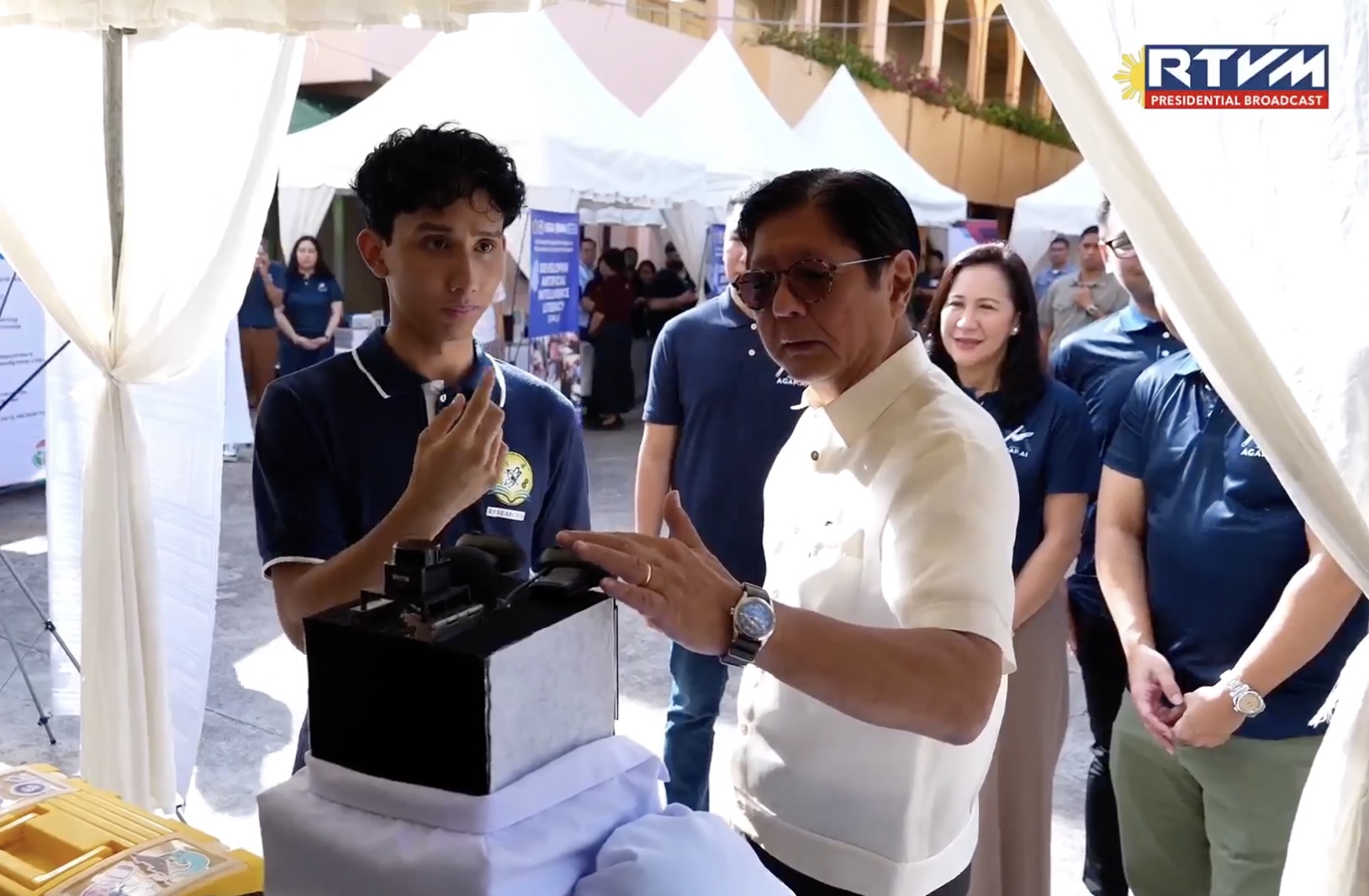
President Ferdinand “Bongbong” Marcos Jr. on Friday urged students to utilize artificial intelligence wisely, saying that it must help them with their learning process.
Marcos said this as the Department of Education (DepEd), with the support of the ASEAN Foundation, launched the Project AGAP.AI: The DepEd AI Program.
“I have to say, I am a little bit jealous because I wish – I really fervently wish we had this when the time that I was still in school because you have in your hands an extraordinary – extraordinarily powerful tool,” Marcos said in his speech.
“But you must use it to help you think and support your learning. It should never replace your drive, your creativity, and grit to learn about our world,” he added.
He expressed belief that AI would help the public tackle more complex challenges. However, he pointed out that there are still some things that technology cannot do for us.
“Technology cannot replace discipline. It cannot replace effort. It cannot replace the habit of showing up prepared and ready to learn. It cannot replace hard work,” Marcos said.
“That is how we build a Bagong Pilipinas, one that is enabled by technology and powered by Filipinos who choose to learn, to work and to aspire for a better future for all,” he added.
The program highlights DepEd’s commitment to the Quality Basic Education Development Plan (QBEDP) 2025-2035 through a multi-stakeholder collaboration, with Project AGAP.AI serving as an umbrella initiative for the integration of artificial intelligence in basic education.
This seeks to promote responsible technological advancement and deliver accessible, quality education aligned with the QBEDP and the Philippine Development Plan (PDP).
According to the President, the DepEd is working with the Massachusetts Institute of Technology, MIT Responsible AI for Social Empowerment and Education, and Day of AI to integrate AI concepts into the basic education curriculum.
“This will then strengthen learners’ AI literacy, computational thinking, and digital innovation skills,” Marcos said.
When it comes to the national level, Marcos said the government is leveraging AI as an engine for development.
“It focuses on building robust infrastructure, including high-performance computing systems and of course, once again, upskilling our workers and our educators,” he added.
He said that through investment in AI research and development, “we ensure that this technology delivers real benefits while remaining ethical and responsible.”
AGAP.AI
AGAP.AI stands for Accelerating Governance and Adaptive Pedagogy through Artificial Intelligence. Education Secretary Sonny Angara said it is fully funded through a grant from the ASEAN Foundation, with no cost to the Philippine government.
“Actually that’s free kasi donation ng ASEAN yan dahil tayo yung mag-chair ng ASEAN," he said.
(Actually, that’s free because it’s a donation from ASEAN since we are chairing ASEAN.)
He also emphasized that the program promotes responsible and ethical AI use and is not meant to replace traditional learning.
Angara added that the training will reach 1.5 million beneficiaries, including 1.05 million learners, 300,000 teachers, and 150,000 parents, under a 12-session national AI capacity-building program.
“So kasama sa P1.5M na magbe-benefit, di lang guro, di lang studyante, pati yung mga parents itetrain din," he noted.
(So included among the 1.5 million beneficiaries are not only teachers and students, but parents will also be trained.)
Angara said AI concepts will eventually be integrated into the national basic education curriculum once development is completed with partners including the Massachusetts Institute of Technology and its Responsible AI for Social Empowerment and Education initiative.
“Once natapos na natin yung curriculum… ilalabas na sa buong bansa dahil national curriculum," Angara expressed.
(Once we finish the curriculum, it will be rolled out nationwide as a national curriculum.)
However, he stressed that internet connectivity remains a major hurdle, particularly for schools in remote areas.
DepEd further said the implementation of Project AGAP.AI will continue through 2026, alongside pilot adoption of AI-powered tools to improve teaching, learning, assessment, and school operations. —with reports from Sherylin Untalan/ VAL, GMA Integrated News

