

 GMA Brandtalk
 Tracking
 Archives

PH, US launch 80th anniversary logo, vow greater alliance
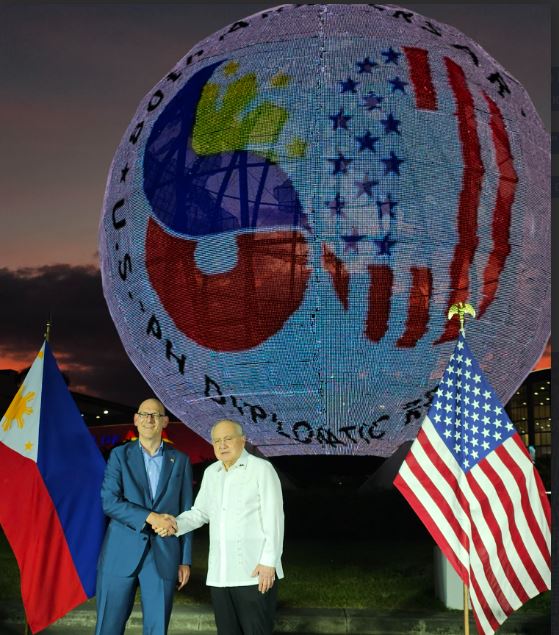
The Philippines and the United States on Thursday unveiled the logo commemorating the 80th anniversary of their diplomatic relations as both allies vowed to further bolster defense, security, economic, and people-to-people ties.
"We are not simply unveiling a design. We are unveiling a story – eight decades of shared struggles, shared values, and shared aspirations," Philippine Ambassador to Washington Jose Manuel Romualdez said during the launch in Pasay City.
The logo, according to Romualdez, symbolizes far more than the number “80," noting it "represents a living partnership that has evolved with time."
"From post-war reconstruction, to the Cold War years, to economic development, to people-to-people exchanges, to our modern strategic alliance – our relationship has never been static. It has grown, adapted, and deepened," he said.
The Philippines and the US established diplomatic relations on July 4, 1946.
"We are proud of what we have accomplished side by side - balikatan - from shoulder-to-shoulder in times of conflict, to advancing economic growth, to joining forces on health, education, and disaster-response priorities," said US Embassy Charge d'Affaires Robert Ewing.
This year also marks the 75th anniversary of the signing of their Mutual Defense Treaty, which binds the two allies to come to each other’s aid against aggression and to help defend the other party.
The Philippines is the oldest treaty ally of the US in Asia, and both have boosted defense ties under former President Joe Biden and the current Trump administration in the face of China’s increasingly aggressive actions in the disputed West Philippine Sea.
The US has helped in efforts to modernize the Armed Forces of the Philippines for years, aside from staging large-scale combat-readiness exercises every year, including the Balikatan military exercises that have increasingly focused on strengthening the Armed Forces of the Philippines’ capability to defend the country’s territorial interests in the disputed waters.
Manila refers to the waters as the West Philippine Sea, that part of the South China Sea that is nearest to the Philippines' archipelago.
Washington’s assistance is crucial to Manila’s efforts to modernize its armed forces – one of Asia’s most underfunded – as it seeks to strengthen its maritime capability amid an increasingly aggressive China, which has repeatedly harassed and threatened Philippine vessels and aircraft in the West Philippine Sea.
While it has no territorial claims in the resource-rich waters, the US has patrolled the area for decades and has repeatedly warned China it’s obligated to defend its ally if Filipino forces come under an armed attack, including in the South China Sea.
"The next chapters will be written by the innovative young people who are already building on our shared legacy. We are confident that - as friends, partners in prosperity, and ironclad Allies - we will rise to even greater heights together for generations to come," Ewing said.
US and Philippines forces, he stressed, are committed to working together to address shared challenges in the region, including in the South China Sea, through large-scale military drills, saying freedom of navigation and overflight, unfettered access, and freedoms of economic opportunity in the waters are crucial to the two countries' interests.
Both diplomats also highlighted the people-to-people ties of their two countries' relationship, with the presence of around 375,000 Americans in the Philippines, while more than 4.6 million Filipino-Americans live, work, and study across the US.
On the economic front, they said US investments and assistance to its ally continued to grow while Manila and Washington have intensified cooperation on energy security and critical supply chains.
Both countries, they said, are committed to the Luzon Economic Corridor - a US-envisioned growth region in Asia, that intends to increase trade and establish an economic hub in the northern Philippines through major infrastructure and other key projects.
"The next 80 years will be defined not by nostalgia, but by innovation, resilience, and shared leadership in the Indo-Pacific," said Romualdez. "As we unveil this logo tonight, let us see it not merely as a graphic – but as a symbol of continuity, trust, and shared destiny."
"From 1946 to 2026 and beyond, the Philippines and the United States remain bound not only by history, but by choice – a choice to stand together, work together, and move forward together," he added.—LDF, GMA Integrated News

