

 GMA Brandtalk
 Tracking
 Archives

POINTS OF VIEW: Is it time for the Philippines to return to ICC?
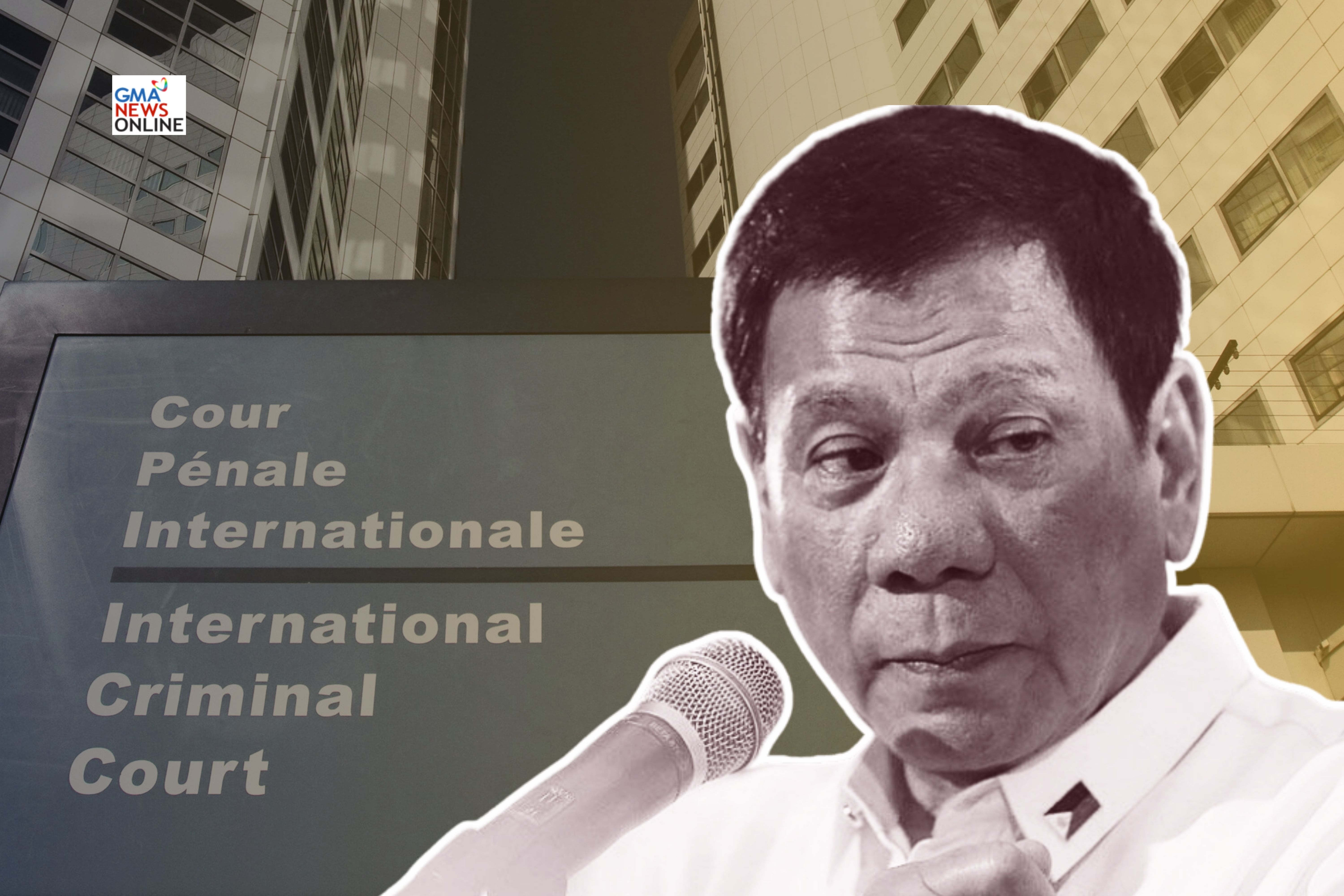
Former President Rodrigo Duterte announced that the Philippines was pulling out of The Hague-based International Criminal Court (ICC) in 2018, after the tribunal began a preliminary probe into his administration's drug war.
The ICC Appeals Chamber's denial of Duterte's appeal for interim release, and the ICC Pre-Trial Chamber I's rejection of his lawyers' legal challenge, reinforce the principle that the Philippines' withdrawal from the Rome Statute does not exempt him from the court's jurisdiction over the alleged crimes against humanity when the Philippines was still a member.
With the latest developments in the case of the former president, how urgent is it for the Philippines to return to the ICC?
For Michael Tiu Jr., assistant professor at the University of the Philippines (UP) College of Law, the Philippines should rejoin the ICC, adding that he believes the government should never have left in the first place.
"'Yung punto naman talaga ng ICC ay mayroong dapat managot, right, sa international crimes. 'Yung idea ng international crimes, katulad ng crimes against humanity ay napaka-shocking niya sa conscience," he said when asked if he believes the government should rejoin.
(The real point of the ICC is that someone must be held accountable, right, for international crimes. The idea of international crimes, such as crimes against humanity, is very shocking to the conscience.)
"Halimbawa 'yung nangyari sa Holocaust o 'yung nangyari dito sa Pilipinas. Na kahit hindi ka taga-Pilipinas, kapag tinitignan mo 'yung nangyari, parang maapektuhan ka bilang tao. So dapat may napapanagot," he added.
(For example, what happened in the Holocaust or what happened here in the Philippines. That even if you are not from the Philippines, when you look at what happened, you will somehow be affected as a human being. So there must be accountability.)
Tiu raised that in situations where the perpetrators or the accused are high-ranking government officials that cannot be prosecuted by their countries, the victims should have a venue that they can approach.
"Walang makaka-escape kasi mayroong ICC na pupuntahan 'yung mga biktima. So I think importante 'yan kung gusto natin 'yung rule of law, gusto natin 'yung hustisya sa international and domestic sphere," he said.
(No one can escape because there is the ICC where the victims can go. So I think that is important if we want the rule of law, if we want justice in the international and domestic sphere.)
'Separated from the rest'
Meanwhile, Ateneo Policy Center senior research fellow Michael Henry Yusingco said the country's withdrawal from the Rome Statute, which is technically a global treaty, means that the Philippines is no longer interested to take part in the global effort to hold certain individuals accountable for their crimes.
"Therefore, the withdrawal from the Rome Statute fundamentally means that the Philippines is no longer part of this global effort. That we have separated from the rest of the international community in its desire to provide a court of last resort, i.e., the ICC, to the victims of crimes against humanity," he said.
On the urgency of the Philippines to rejoin the ICC, Yusingco said that it would help the country to be in good standing with the international community.
"Correspondingly, the question of rejoining the Rome Statute is essentially about the Philippines expressing once again a commitment to ensure that perpetrators of crimes against humanity have their day of reckoning in a court of law. So clearly, the answer to this question should be a resounding Yes. Most especially given the current global climate where we see victims of crimes against humanity online and on television every single day," he said.
"In sum, the decision to rejoin the ICC is really about whether the Philippines would still want to adhere to the principles and objectives of the Rome Statute," he added.
"It is a matter of our country aiming to be a member in good standing of the international community. A decision not to rejoin simply means a rejection of both."
'Measure of justice'
For her part, ML party-list Representative Leila De Lima, one of Duterte's staunchest critics, said the country's withdrawal was a "self-serving act" by the former Philippine leader.
"Rejoining the ICC is a crucial step towards upholding human rights, justice, and accountability. In cases of serious international concern—such as crimes against humanity, war crimes, genocide and aggression—and when our domestic legal system is unable or unwilling to investigate, prosecute and try those atrocities, ICC can serve as a 'safety valve' and back-up plan," she said.
"It is a measure of justice, an assurance to the Filipino people that there will be available remedies, both domestic and international, that can effectively confront the most egregious crimes," De Lima added.
'Necessary move'
Akbayan party-list Representative Chel Diokno believes that rejoining the ICC will give hope to the families of the victims of extrajudicial killings during Duterte's reign.
"Rejoining the International Criminal Court is a necessary move as it can serve as the final avenue to reclaim justice and uphold accountability," he said.
"Now, with former Pres. Rodrigo Duterte facing possible long-term detention under the jurisdiction of the ICC, the families of the victims are finally seeing a glimmer of hope that justice will be served—not just for them, but for the nation."
Despite Duterte's pullout, with the withdrawal taking effect in 2019, a Supreme Court ruling in 2021 said the Philippines has the obligation to cooperate with the ICC despite its withdrawal from the Rome Statute, noting that the exit does not affect criminal proceedings pertaining to acts that occurred when a country was still a state party.
The ICC judges said in their October 23 decision, the Philippine government continued its engagement with the court despite the country's withdrawal.
Further, the Pre-Trial Chamber I judges argued that Article 127(2) of the Statute provides that "the Court may exercise its jurisdiction over any matter which was already under consideration by the Court prior to the date on which the withdrawal became effective."
'Absolutely no urgency'
For his part, Israelito Torreon, who serves as a legal counsel to some members of the Duterte family, said the Philippines does not need to rejoin the ICC.
"There is absolutely no urgency, nor any valid reason, for the Republic of the Philippines to return to the International Criminal Court. In fact, any move to rejoin the ICC at this time would constitute a grave betrayal of Philippine sovereignty and a direct assault on our Constitution," he said.
He also noted that the Philippines has "a functioning, independent, and capable judicial system."
"Our courts are more than able to investigate, prosecute, and try any alleged wrongdoing, including any offense committed during the anti-illegal drugs campaign. The Department of Justice, the Office of the Ombudsman, and the regular courts remain open to any legitimate complainant. No victim has ever been denied access to justice in our country," Torreon added.
The Duterte family's counsel added that rejoining the ICC would lead to "unacceptable"consequences like "surrender of the sovereign right of every Filipino, including future presidents and law enforcers, to be tried only by Philippine courts," and "exposure of our police and military to endless foreign prosecution for doing their constitutional duty."
PH justice system 'quite capable'
On the other hand, University of Asia and the Pacific Law School dean Jeremy Gatdula echoed that the Philippines's justice system is capable of handling such cases.
"I will still maintain that the Philippines is better off not being a part of the ICC and we prosecute our own, that we learn how to prosecute with regard to our own issues. As I have said, I have emphasized this, this is setting aside, or apart from the case of President Duterte which is a special case, and I think that has its own merit," he said.
"For me, our justice system is quite capable of handling cases like this. We have to remember that our justice system is solid enough to have been able to look at, for example, the cases of two presidents and even one chief justice."
Government records showed that there are over 6,000 drug suspects killed in police operations. Human rights organizations, however, estimate the death toll may have reached 30,000 due to unreported incidents.
Duterte entered the Hague Penitentiary Institution or the Scheveningen Prison on March 13, 2025, where he is being held while awaiting trial. — VDV/RSJ, GMA Integrated News

