

 GMA Brandtalk
 Tracking
 Archives

DFA's Lazaro on WPS debate: 'Noise in democracy'
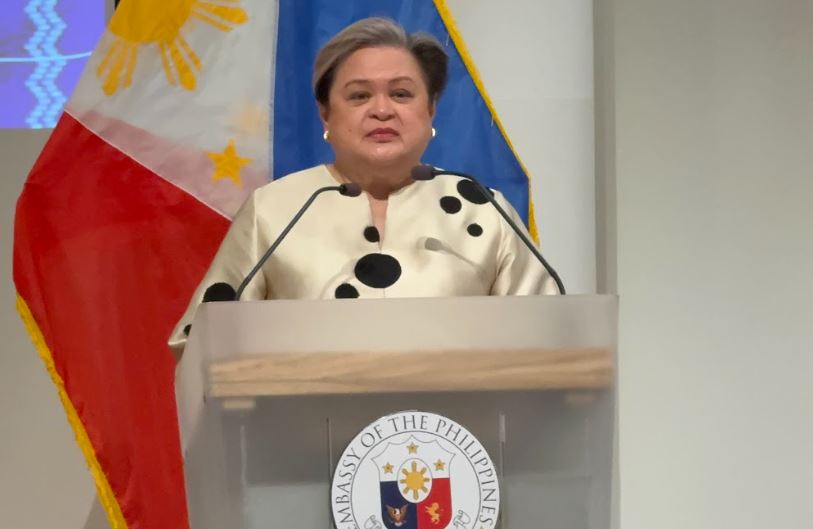
VIENNA —Department of Foreign Affairs (DFA) Secretary Ma. Theresa Lazaro said the remarks made by some Filipino legislators on the West Philippine Sea issues are “part of the noise in democracy."
“These discussions are being done by our legislators, and I will not comment on that,” Lazaro told GMA Integrated News on Wednesday, on the sidelines of her lecture in Vienna on the Philippines’ chairmanship of the Association of Southeast Asian Nations (ASEAN) for 2026.
Lazaro delivered similar lectures in Oman and Singapore last week.
“What we're dealing with here is brass tacks foreign affairs issues. We’re talking about foreign policy. But I will not comment on the discussion they’re having. That’s part of the noise of democracy and democratic institutions. We are a democracy. Everybody has an opinion on everything.”
During recent legislative discussions, Filipino officials have made various statements on the West Philippine Sea issue, with Senator Rodante Marcoleta allegedly stating it would be easier to let go of the Kalayaan Island Group (KIG) amid territorial disputes with China. Marcoleta has maintained that his remarks were “misinterpreted."
Meanwhile, Senator Erwin Tulfo has called for a “ceasefire” in the ongoing “word war” between Filipino and Chinese officials, following a meeting with Secretary Lazaro, who he said had requested them to tone their statements down.
The DFA has told Chinese diplomats to act in a “professional manner” when issuing statements on its position in the South China Sea.
ASEAN’s 'endeavor' in SCS
In her speech, Lazaro reiterated ASEAN’s “endeavor” to craft and finish a document on the Code of Conduct (CoC) with China in the South China Sea before the end of 2026.
This includes a document on defining self-restraint, which she said the Philippines has been advancing, as well as dealing with the other “milestone issues” of discussing the CoC’s geographical scope and its connection to the Declaration on the Conduct of Parties in the South China Sea adopted in 2022
When asked by GMA Integrated News whether it is realistic to finish the CoC this year, Lazaro said ASEAN member states have expressed interest in hosting face-to-face meetings, on top of their technical working group’s monthly meetings.
“In the past, it used to be every three months. And I also said that in [my recent lecture in] Singapore, there are many ASEAN member states that have now been proposing certain viable suggestions. Like us, the Philippines came up with a document on self-restraint, because we really want to push this and have to put everything that we are able to do so that it will move. So, I guess that's how realistic we are. But again, I’m saying that we ‘endeavor’ to finish this. I’m speaking as an optimist, but also a pragmatist.”
Europe’s vital interest
One of the session speakers, Prof. Mag. Dr. Alfred Gerstl, who is the President of Central European Institute of Asian Studies, emphasized Europe’s “vital interest” in keeping maritime security and seamless navigation of trade in the South China Sea.
“Almost 40% of the European trade passes through the South China Sea. Tensions have increased in the last years, and even though they have not escalated into a war, a military crisis is quite a realistic risk," Gerstl said.
The professor, who also teaches Philippine studies courses at Palacky University in the Czech Republic, also called the European Union and ASEAN “emerging great world powers” where lie opportunities in geopolitics, geoeconomy, and expanded “thinking in the spheres of influence”.
“Of course, in Europe and Southeast Asia, there are certain issues, but that’s why we have diplomats to resolve these issues. The EU and ASEAN are really challenged by these new developments, because first of all, they are not military alliances, and moreover, we refuse to use the threat of force. We are really looking at straightening the rules-based order, multilateralism, and cooperation in our region, but also with different leadership.”
Beyond SCS talk
Lazaro told the audience of ASEAN and European diplomats, academics, and postgraduate students, her hopes that the ASEAN-China Code of Conduct would be finalized this year, and that other economic concerns in the region would be discussed and prioritized.
“For the first time, a document on digitalization [in ASEAN] will be coming up within this year, and we have to finish that. Timor-Leste became our 11th member, and [their membership] was a very politically strong statement over there.”
Lazaro also highlighted the “silver economy”.
“People have been talking about women and children, the vulnerable groups, but they forgot the elderly. We are all going in that direction. When you look at aging societies, even some ASEAN members are already in the aging process. We think some aspects of the elderly should also be given so much attention," she said.
“Politically, there is not much of a difference. But the other economic aspects and the social culture in ASEAN, there might be certain changes,” she added.
Lazaro is scheduled to hold a press briefing with the Austrian Ministry of Foreign Affairs on Thursday. She will go to Munich to continue her lecture series.—LDF, GMA Integrated News

