

 GMA Brandtalk
 Tracking
 Archives

What to do with last year’s blessed palms
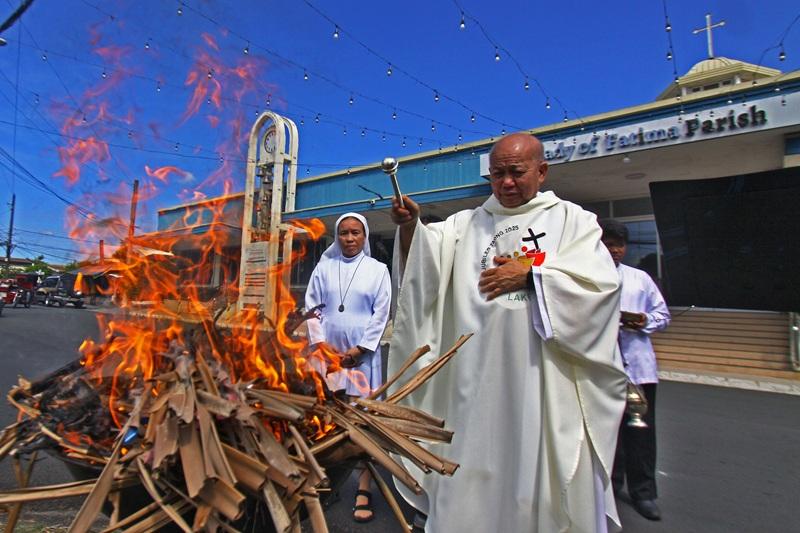
Ash Wednesday marks the beginning of Lent, a season in which Catholics are called to renew their faith and prepare for the resurrection of Jesus Christ through prayer, fasting and almsgiving.
During this 40-day period, the faithful receive ash as a sign of mortality and repentance, which is prepared from palm fronds blessed from the previous year's Palm Sunday celebration.
Speaking to GMA News Online, Fr. Earl Gabriel S. Tan, Imus diocese's Diocesan Lay Formation Office priest collaborator, said the faithful may bring their blessed palm fronds to their churches to be burned and its ashes used for Ash Wednesday.
“Sunday before Ash Wednesday, that's more practical. But others would burn it on Tuesday before Ash Wednesday,” said Tan, who is currently taking up Dogmatic Sacramental Theology Licentiate program in Rome, Italy.
He explained that the palm symbolizes the Catholic faith: vibrant, yet requiring constant renewal.
“Theologically, it also symbolizes our faith na napaka-fresh, pero natutuyo. Yung pagpasok natin sa mysteries ng Holy Week, ng Lent, it reminds us of renewing our faith,” said Tan.
(Theologically, it also symbolizes our faith that begins fresh, yet eventually withers if not cared for. As we enter into the mysteries of Holy Week, of Lent, we are reminded of the need to renew our faith.)
“And our faith, which is given to us, begins with looking at our humanity and God’s work in our lives,” he added.
A form of humility
The blessed ashes are placed in the form of a cross on the forehead, as is done in the Philippines.
Ashes could also be sprinkled on the head, a custom followed in Rome and practiced in the country during the COVID-19 pandemic, Tan said.
Citing the book of Job in the Old Testament, Tan said receiving the ashes is a “form of humility.”
“You humble yourself before God. So, very symbolic yung paglalagay ng ashes [So, the imposition of ashes is very symbolic.],” Tan said.
He reminded Catholics that in observing Lent, it is important to reflect on one’s actions and relationship with God and to anticipate Easter.
“Actually, hindi ka na-require na lagyan ng abo. Ang required sa'yo, magbago ka. Tingnan mo yung relationship mo sa Diyos,” he added.
(Actually, you are not required to have ashes placed on you. What is required of you is not receiving ashes, but changing yourself and looking at your relationship with God.)
Actions over religious objects
Tan described the blessed palm fronds as an 'external reminder' of the Catholic faith, and while they may remain in homes, the proper way to keep them is by placing them on the altar. The blessed palm fronds are not to be used as talisman to ward off evil.
“We relate with our senses. Lalo na tayo mga Catholics. Gusto natin nakahawakan, nakikita, naririnig, naaamoy. So it reminds us of our faith. Sometimes it dries up and needs to be renewed. It's not to ward off evil spirits,” Tan said.
(We relate to our faith through our senses, especially us Catholics. We like to touch, see, hear, and even smell. That’s why it reminds us of our faith. Sometimes it dries up and needs to be renewed. It’s not meant to ward off evil spirits.)
More than keeping religious objects, it is more important to maintain a good relationship with the Lord.
“No matter how many crucifixes, rosaries, or holy water you have in your house, but you don't have this relationship, this prayer life, walang kwenta yan (it's useless),” Tan said.
“Kung nagsisimba ka at tanggap mo si Jesus sa kanyang katawan at dugo, nangungumpisal ka, nagdadasal ng rosary, nagiging mabuti sa kapwa, that brings you to who you really are as a Christian,” Tan said.
(If you attend Mass and receive Communion, go to confession, pray the rosary, and do good to others, it brings you closer to who you truly are as a Christian.)
This year, Ash Wednesday will be on February 18. — BAP, GMA Integrated News

