

 GMA Brandtalk
 Tracking
 Archives

Senate panel eyes passing anti-political dynasty bill before March ends
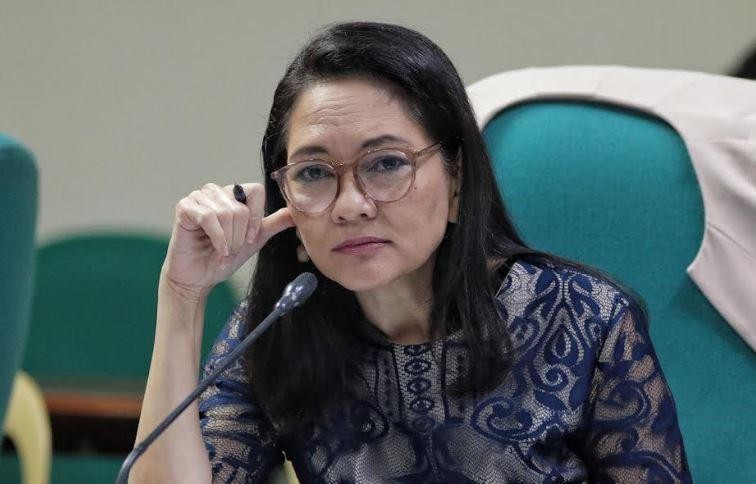
Senator Risa Hontiveros said Friday that the Senate Committee on Electoral Reforms is planning to pass the bill seeking to prohibit political dynasties before March ends.
“It will be passed. Intensyon namin maipasa ito this session so bago matapos ang buwan ng Marso,” Hontiveros said during a joint committee meeting.
(It will be passed. It is our intention to pass it this session, so before March ends.)
Hontiveros, who chairs the electoral reforms panel, said she wants the anti-political dynasty law to cover up to the 4th degree of consanguinity.
“Para sa akin ‘yun ang dapat, ‘yun ang ideal. Bilang isa sa mga authors sa Senate, ‘yun ang ipu-push ko. At the same time… I'm working with six bills na iba-iba ang prescription. Fourth degree, third degree, second degree,” she said.
(For me, that is what should be done, that is the ideal. As one of the authors in the Senate, that is what I will push. At the same time… I’m working on six bills with different prescriptions: fourth degree, third degree, second degree.)
She said they will undergo a consensus building to reach a compromise.
“Ang sa akin lang, whatever will be our final form, ‘yung tingin kong dapat or ideal na 4th degree or maaring sa mas marami sa colleagues ko, mas practical or mas reasonable at this point in time, 3rd degree or 2nd degree, basta ang importante sa akin, magkaroon kami ng batas na impactful, may kwenta,” she said.
(For me, whatever will be our final form, what I think should be the ideal—4th degree—or for many of my colleagues, maybe more practical or more reasonable at this point in time, 3rd degree or 2nd degree, what’s important to me is that we have a law that is impactful and meaningful.)
Hontiveros also said that the damage brought by a dynasty is known to the public.
“Kung saan nangingibabaw ang konsentrasyon ng kapangyarihan sa ilang pamilya, madalas matatagpuan rin ang korapsyon, kahirapan, at kakulangan ng pananagutan o accountability,” she said.
(Where the concentration of power in a few families prevails, corruption, poverty, and a lack of accountability are often also found.)
“Sa halip ng serbisyong publiko sa ordinaryong Pilipino, personal na interes at pakinabang ang madalas na nagiging sentro. Nandito tayo ngayon para baguhin ito,” she added.
(Instead of public service for ordinary Filipinos, personal interest and gain often become the focus. We are here now to change this.)
Meanwhile, Bacolod City Mayor Greg Gasataya said he is in favor of starting the discussion and coming up with a clear framework on the prohibition of dynasties.
Lawyer Jose Max Ortiz, former mayor of Don Salvador Benedicto, Negros Occidental, said the preference of some to choose candidates who would give limang daan or P500 rather than voting based on merit is one of the solid hurdles in passing an anti-political dynasty law.
“Because of the dynasty, there is monopoly of power already. The others who are also capable are denied opportunity because they don’t stand against a political dynasty. But the problem is also with the Filipino people. Money talks,” he said.
“That's why, when I was running, I asked, ano ang gusto ninyo, ang dating daan o ang bagong daan? Ang sabi, limang daan (what do you want, the old path or the new path. They replied, five hundred). That is the environment we have, not only here in Negros Occidental,” he added.
Ortiz, however, said not all hope is lost because in the case of Silay City, Negros Occidental, its mayor Joedith Gallego won his post even if he was not a member of a political family.
“Without money, he was able to win that election. That should be an eye opener already,” he said.
The flood control controversy that implicated political families, Ortiz said, also provided a very good impetus to finally pass the anti-political dynasty measure.
“We are happy that because of this flood control issue, public officials are on board the anti-dynasty bill. Even (Rep.) Sandro Marcos and the Speaker of the House agreed. This is a catalyst we need,” Ortiz said.
Sandro is the Ilocos Norte representative, and son of President Ferdinand Marcos, Jr.
The President is the sibling of Senator Imee Marcos, whose son Matthew Marcos Manotoc is the incumbent Vice Governor of their hometown Ilocos Norte.
The Speaker of the House, Isabela Sixth District Rep. Faustino “Bojie” Dy III, has also many relatives currently occupying elective post. His nephews Ian and Mike also currently serve as the representatives of Isabela's 3rd and 5th Districts, respectively.
Dy's son, Inno, now sits as the mayor of Echague, Isabela.
Hontiveros agreed with Ortiz that a cultural reset is also needed to pass the anti-political dynasty bill into law.
“Political dynasties do not only concern political power. It is also about economic power, and changing the culture. Maybe we can learn from Silay’s best practices on how they were able to change the culture of limang daan,” Hontiveros added.
Former provincial election officer Jessie Suarez also agreed, saying monopoly of power has no place in a democratic society.
“When leadership positions circulate within family networks, citizens will perceive governance as self-serving rather than public-oriented. This reduces electoral competitiveness, weakens check and balances, and diminishes citizen confidence in institutions,” he said.
“Anti-corruption frameworks emphasize transparency, accountability, and equal access as regards elite capture or monopoly of the people,” he added.
There are currently six bills on political dynasties filed in the Senate.
In December 2025, President Ferdinand Marcos Jr. urged Congress to prioritize the passage of the Anti-Dynasty Bill.
His son, House Majority Leader Ferdinand Alexander "Sandro" Marcos, and Speaker Faustino “Bojie” Dy III have filed an Anti-Political Dynasty Bill, which bans relatives of incumbent public officials from holding the same level of an elective position at the same time.
The House committee on suffrage and electoral reforms will conduct public consultations in Luzon, the Visayas, and Mindanao regarding proposed measures banning political dynasties. — RSJ, GMA Integrated News

