

 GMA Brandtalk
 Tracking
 Archives

Philippine maritime rights 'arise from territory,' not EEZ lines — DFA
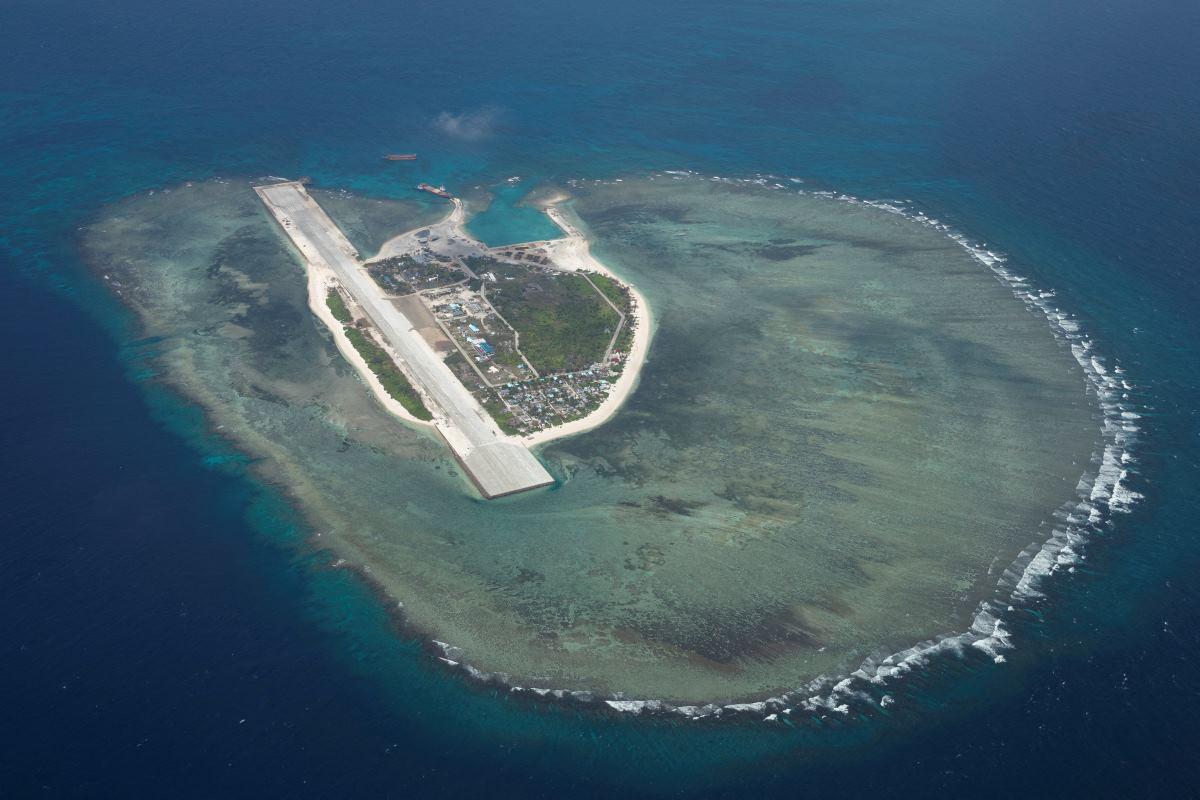
The Department of Foreign Affairs (DFA) said Friday the Philippines' territorial claim over islands and rock features in the West Philippine Sea do not depend on whether or not they are within the country's exclusive economic zone.
"In connection with certain misconceptions in the public sphere, the DFA clarifies that maritime entitlements arise from territory, and that sovereignty over high-tide features is not contingent on whether or not they fall within the maritime zones of other landmasses," DFA Deputy Assistant Secretary and Spokesperson on Maritime Issues Rogelio Villanueva said a press briefing.
Villanueva stressed that Philippine sovereignty over the Kalayaan Island Group (KIG) in Palawan and the territorial sea of its high-tide features has been settled and not dependent on EEZ placement.
"The extent of what constitutes the West Philippine Sea, as well as our sovereignty over the Kalayaan Island Group and the territorial sea of its high-tide features, are already explicitly established and are not contingent on whether or not they fall within the country's exclusive economic zone," the DFA official said.
The DFA's statements come amid the exchange of Philippine leaders regarding sovereignty over the (KIG), including Pag-asa Island.
Senator Rodante Marcoleta had suggested that the Philippines should let go of the KIG as it is not within the country's 200-km EEZ—a statement which earned flak from experts, other lawmakers, and local leaders of Kalayaan town. The senator later said his words were "abbreviated."
Citing the country's maritime zones law, Villanueva said the Philippines has already explicitly defined the extent of the West Philippine Sea.
"We should keep in mind that the Philippine maritime zones under RA (Republic Act) 12064—which is consistent with UNCLOS—set forth that the maritime zones of the Philippines on the western side of the Philippine archipelago, including the Luzon Sea, the territorial sea of Bajo de Masinloc, and the maritime features of the Kalayaan Island Group, shall be collectively called the West Philippine Sea," Villanueva said, referring to the United Nations Convention on the Law of the Sea.
Villanueva noted that high-tide features around Pag-asa include Sandy Cay 1, Sandy Cay 2, and Sandy Cay 3—features that China has claimed as part of its territory.
The DFA official also reiterated the Philippines' legal position under the UNCLOS and the 2016 Arbitral Award that invalidated China's nine-dash line claim.
"I would also like to take this opportunity to emphasize that our sovereignty over the Philippine archipelago and other territories, including Bajo de Masinloc and the high-tide features of the Kalayaan Island Group, remains absolute," he said.

Leaked letter?
In the same briefing, the DFA also rejected claims circulating online that a letter from Foreign Affairs Secretary Maria Teresa Lazaro to Senator Risa Hontiveros had been "leaked," saying the release was authorized.
"There were those who wrongly thought that the letter of Foreign Affairs Secretary Maria Teresa Lazaro to Senator Risa Hontiveros was 'leaked,' when in fact the Secretary gave the permission to the good senator to release it to the public," Villanueva said.
The letter referred to by the DFA was Lazaro's response to Hontiveros amid concerns over continued and strongly worded statements by the Chinese Embassy in Manila against Philippine officials, including Philippine Coast Guard spokesperson on the West Philippine Sea Commodore Jay Tarriela.
'Performative rhetoric'
Villanueva also took aim at what he described as "performative rhetoric" in modern public discourse, saying government statements should not be driven by virality or engagement.
"While performative rhetoric is a reality in modern public discourse, the DFA has long resolved to conduct our work with the national interest as the sole consideration—not for fanfare, not for followers, and certainly not for likes—but solely for the national interest and the welfare of the Filipino people," he said.
Meanwhile, Villanueva said the Philippines will continue filing diplomatic protests when necessary in the coming days, while keeping communication lines open with China.
This effort includes cooperation toward a Code of Conduct (COC) in the South China Sea that Philippine officials target to complete within the year.
"Our lines of communication with each other are open and will remain collaborative, especially in crucial times. We have also made it clear that all our efforts must be viewed in the greater lens of achieving the Philippines' strategic objectives," Villanueva said.
China insists ownership of almost 90% of the South China Sea, including areas that overlap with the Philippines' and other Asian nations' territorial waters.
Manila has renamed parts of the South China Sea nearest to the Philippine archipelago as West Philippine Sea.
The Philippines, Vietnam, Malaysia, Brunei, China and Taiwan all have overlapping claims over the waters—a major trade route teeming with rich marine life and said to be harboring vast oil and mineral deposits.
The Philippines challenged the validity of China's sprawling territorial claims in the South China Sea and sought to clarify the territorial entitlements of certain Chinese-occupied features under the United Nations Convention on the Law of the Seas, or UNCLOS. Manila won the case against China, which refused to recognize the ruling. — VDV, GMA Integrated News

