

 GMA Brandtalk
 Tracking
 Archives

Australia warship showcases naval strength, gives feel of life at sea
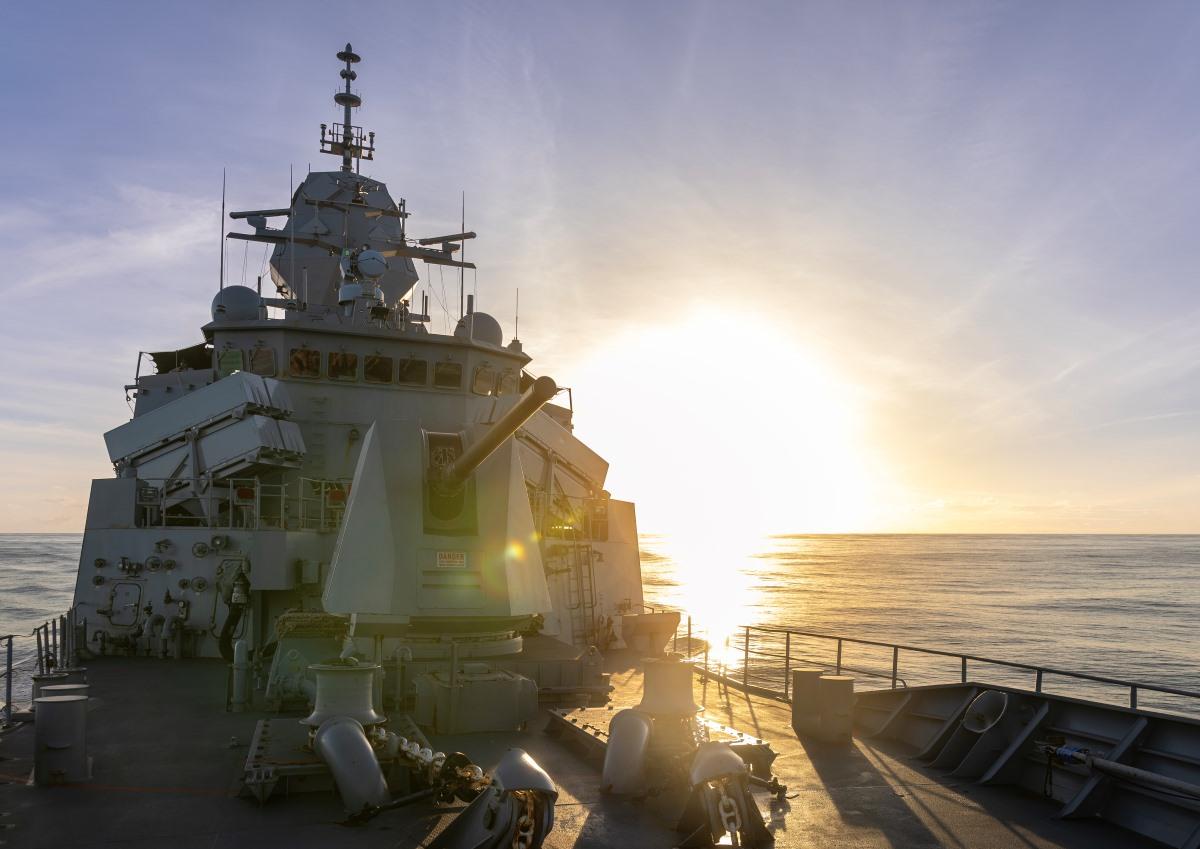
ABOARD HMAS TOOWOOMBA, Subic Bay — Fresh from its voyage in the South China Sea to promote freedom of navigation, an Australian Navy frigate welcomed on board a group of Southeast Asian journalists while docked in the Subic Bay freeport to show the warship's capabilities.
It was more than just a naval ship tour.
The selected journalists from Southeast Asia, including from GMA News Online, were allowed to try the HMAS Toowoomba's high-pressure fire hose—one of its many safety features—and put on body armor vests complete with Kevlar helmets for a real, albeit brief, feel of life at sea.
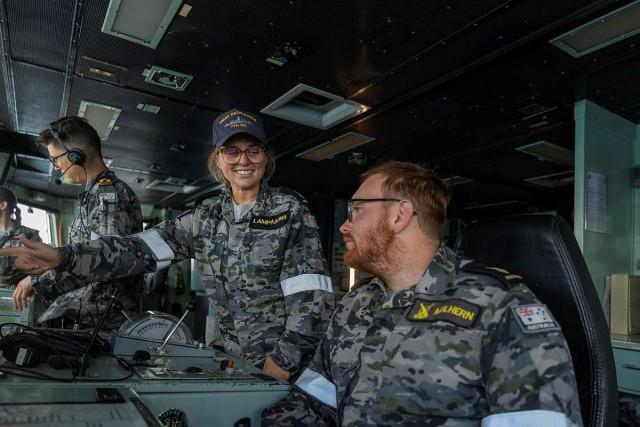
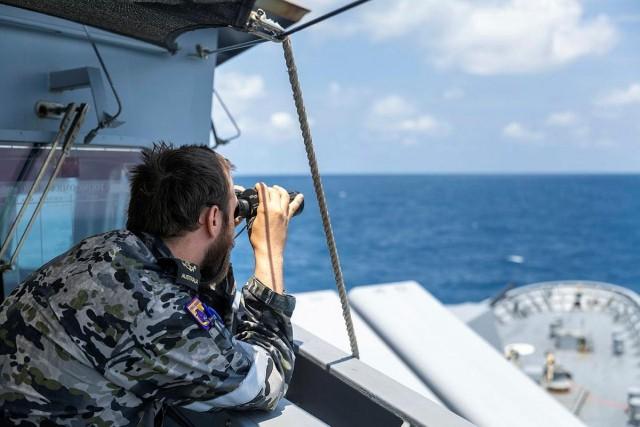
The journalists were shown the combat capabilities of the long-range frigate, which carries the mantra—"fearless"—but actually aims to foster regional peace through deterrence. The bridge, the command-and-control hub of the frigate, becomes a beehive of activities when Toowoomba journeys in the high seas with its captain and crew members constantly scanning a wide stretch of the sea and sky as well as what's underneath the sea surface, day and night, to ensure a smooth and safe mission.
The 118-meter Anzac-class ship can accommodate up to 200 crew members and can be deployed for air defense, surface and undersea warfare, surveillance reconnaissance and interdiction.
Indonesian journalist Arya Dwiangga said it was a rare chance for him to board a warship and added that Australia's friendly outreach and peacetime mission to promote the rule of law and regional stability was reassuring.
"The vessel has been upgraded both the electronic system and also the weaponry. I could see that the vessel is ready for any scenario," Dwiangga said.
Another journalist, Noor Bakhtiar from Malaysia, said the tour provided a "first-hand closer look" at how the crew operate and how the ship supports regional maritime cooperation.
"It's always different when you see things firsthand and understand better the scale, the discipline, and the professionalism involved," he said.
For Hanoi-based Vietnamese journalist Trong Kien, "the warm welcome and the fun demonstrations" extended to the journalists and the Australian military's "evident excitement to further the ties—both professional and personal—with regional partners" demonstrates its commitment in pursuing "a peaceful and cooperative region."
"I'm impressed with their energy and the professionalism," he said.
Regional security
Commander Alicia Harrison of the Royal Australian Navy, Toowoomba's commanding officer, said the ship was fully prepared for the deployment, a vital part of Australia's longstanding commitment to regional security and stability.
"This deployment underscores Australia's presence in the Indo-Pacific and our commitment to upholding international law and supporting a stable, open and rules-based maritime environment," Harrison said.
Commissioned on December 12, 1998, HMAS Toowoomba is the second Royal Australian Navy ship to bear the name of Queensland's inland city.
It has awesome firepower. The ship is fitted with air and surface surveillance radars and can counter simultaneous threats from aircraft, surface vessels and submarines. Its main armament comprises one Mark 45 capable of firing 20 rounds per minute, ship-launched Mark 46 torpedoes and a Mark 41 vertical launch system for the Evolved Sea Sparrow missile.
The Navy's multi-role MH-60R Seahawk helicopter can also be launched from the ship, providing enhanced anti-submarine and anti-surface warfare and search and rescue capabilities. Embarkation of a helicopter also provides the ship with the capability to deliver air-launched missiles and torpedoes.
Sailing through South China Sea
Toowomba's transit through the South China Sea from Jakarta, Indonesia, to Subic Bay this week was peaceful and was carried out in accordance with international law, Harrison said.
It passed through the Spratlys, the most hotly disputed chain of islands, islets, reefs and atolls in the strategic passage, where China has turned seven disputed reefs into what are now missile-protected island bases, including three with military-grade runways.
The island bases have allowed China to boost its patrols further away from its mainland and fortify its claims to virtually the entire South China Sea despite protests from other claimant states including the Philippines, Vietnam, Malaysia Brunei. Taiwan is also involved in the long-running territorial stand-offs.
Australian officials said Twoowoomba's deployment serves Australia's interests and also helps preserve an international rules-based order, enhances cooperation and relationships with regional partners and allies, and develops capability and interoperability.
Shared security challenges
The Australian Navy has also participated several times in joint missions with the Philippine military and other security allies like the United States and Japan, called Maritime Cooperative Activities or MCA, in the West Philippines Sea—that part of the South China Sea that lies closer to the Philippine archipelago.
Australian Ambassador to the Philippines Marc Innes-Brown, who spoke to the journalists in a separate interview, said Australia is stepping up its defense and maritime security cooperation with the Philippines to deal with shared security challenges in the region.
Australia, he added, will continue to call out "concerning behavior" in the South China Sea when necessary in support of the Philippine position.
The Philippines and Australia signed in 2007 a Status of Visiting Forces Agreement allowing Australian forces to participate in combat exercises with Filipino forces in the Philippines, including in Balikatan exercises—a large-scale annual drill between the Philippines and its treaty ally, the US, that has lately expanded to include other like-minded states.
Manila and Canberra are also working towards a new defense pact to be signed this year, which will increase the frequency of joint military drills to boost their operational capability and strengthen deterrence against threats.
Harrison said Toowoomba's presence in the region, including in the Philippines, sends a message that by working side by side with regional allies and partners, Australia is helping strengthen collective security and adherence to international law. It also braces Australian forces to any contingency.
"Regional presence deployments also provide vital experience for our people, ensuring we can respond to maritime challenges," Harrison said. — VDV, GMA Integrated News

