

 GMA Brandtalk
 Tracking
 Archives

Bribery is the most common form of corruption –OCTA
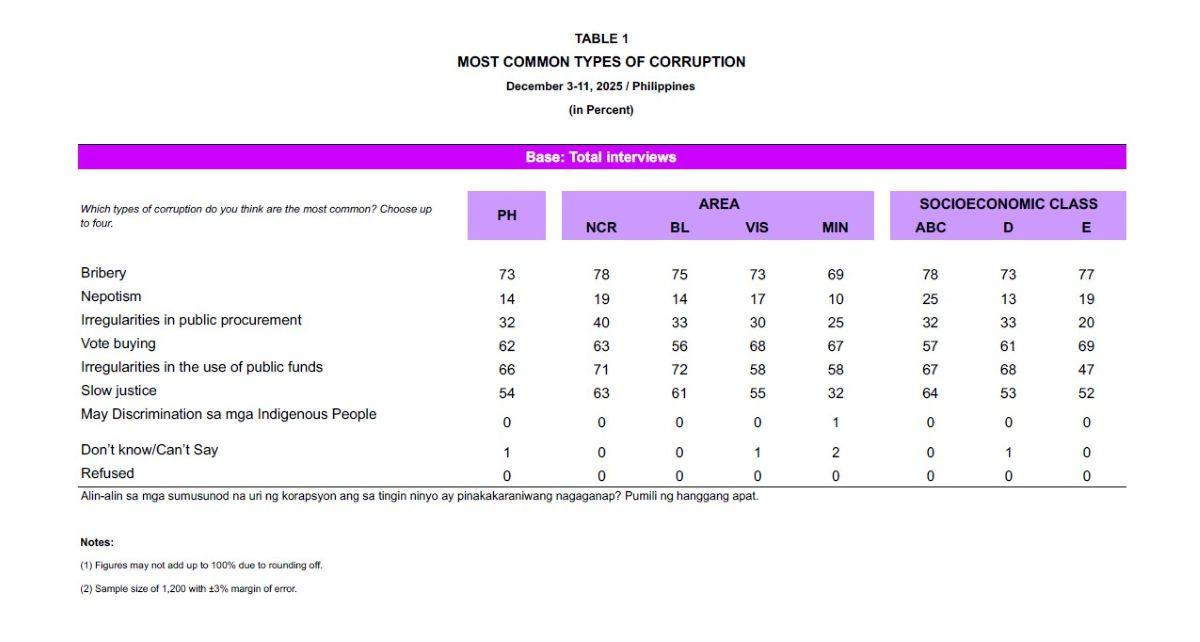
Most Filipinos believe bribery is the most visible form of corruption in the country, based on a survey conducted by OCTA Research which is part of a broader study commissioned by the Office of the Ombudsman.
According to the most recent Tugon ng Masa survey conducted in December 2025, 73% of adult Filipinos across regions and socioeconomic groups responded as such.
Following bribery, 66% of the respondents said that irregularities in using public funds were the most common form of corruption, followed by vote buying with 62% and slow justice at 54%.
The other respondents meanwhile chose the following as the most common form of corruption: nepotism (14%), and irregularities in public procurement (32%). One percent of respondents said they didn't know or can't say what is the most common form of corruption.
"The consistency of reported corruption types across regions and demographic groups suggests that corruption is not confined to specific sectors or locations, but is widely experienced or observed in everyday governance and public service interactions," OCTA Research said.
As for bribery being the top perceived most common form of corruption, OCTA Research said this “may reflect its visibility in routine transactions with government offices. Many Filipinos may have directly encountered or observed informal payments in frontline services, making it the most immediate and recognizable form of corruption."
In Visayas and Mindanao, vote buying was the second most commonly cited form of corruption, OCTA Research said, "indicating persistent concerns about electoral integrity in these areas."
Sixty-eight percent of respondents in Visayas chose vote buying as the most common type of corruption, while 67% of respondents in Mindanao did so. It was 63% in the National Capital Region, and 56% in Balance Luzon (the rest of Luzon outside Metro Manila).
OCTA Research noted that the survey results emphasized the need for increased anti-corruption efforts by the government through stronger institutional checks, clearer procedural rules, improved monitoring systems, and greater transparency.
“Overall, the results underscore that effective anti-corruption strategies must address both institutional structures and lived public experiences, ensuring reforms are responsive to the everyday realities identified by respondents,” it added.
Data used in the survey were gathered through face-to-face interviews, conducted from December 3 to 11, 2025.
There were 1,200 respondents aged 18 and above nationwide.
The survey has a ±3% margin of error at a 95% confidence level, while subnational estimates of margin of error were at ±6% at the same confidence level. —KG, GMA Integrated News

