

 GMA Brandtalk
 Tracking
 Archives

Chinese warships sighted near Bajo de Masinloc during PH-US-Australia activities
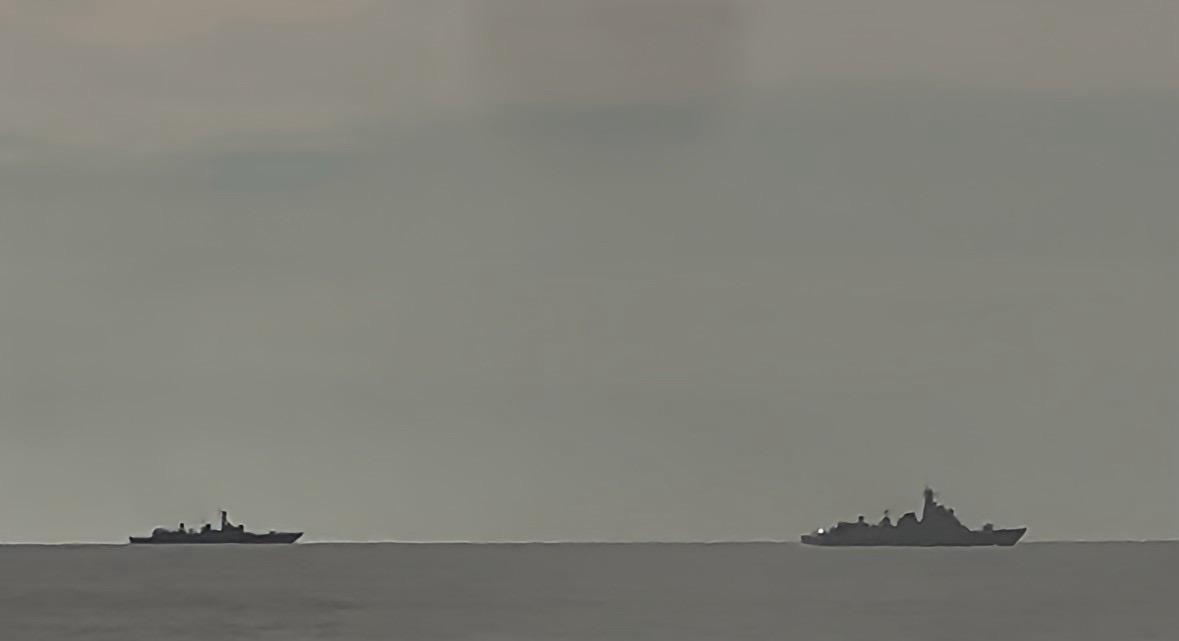
While the 14th Multilateral Maritime Cooperative Activity (MMCA) of the Philippines, Australia, and the United States was underway near the southeastern portion of Bajo de Masinloc in the West Philippine Sea, two People’s Liberation Army Navy (PLA Navy) warships of China were sighted in the area.
The Chinese vessels did not assume formation and did not approach the participating naval ships. They remained at what observers described as a safe distance.
GMA Integrated News was among the journalists on board the Philippine Navy’s newest guided missile frigate, the BRP Diego Silang, whose crew directly observed the two PLA Navy warships during the latter part of the maritime activities.
The sighting was confirmed by the ship's commanding officer, Captain John Percie Alcos. “These were People’s Liberation Army Navy warships,” he said.
Alcos added that the Philippine Navy vessel communicated with the Chinese ships. “They did not challenge us,” he added.
Although the passage of foreign vessels is not unusual at sea, Armed Forces of the Philippines (AFP) spokesperson Colonel Francel Margareth Padilla, who was also on board the Diego Silang and observed the movement of the PLA Navy ships, described the incident as illegal.
"Basically, these are illegal presences in the area so as this was observed this is going to be submitted to the proper agency accordingly," she said.
Interoperability operations
Prior to the sighting, the Diego Silang sailed from Naval Operating Base Subic to participate in the MMCA, a joint exercise among allied nations aimed at strengthening maritime and defense cooperation.
The exercises focused on interoperability drills designed to enhance the operational readiness of the Philippine Navy, including missions in the West Philippine Sea.
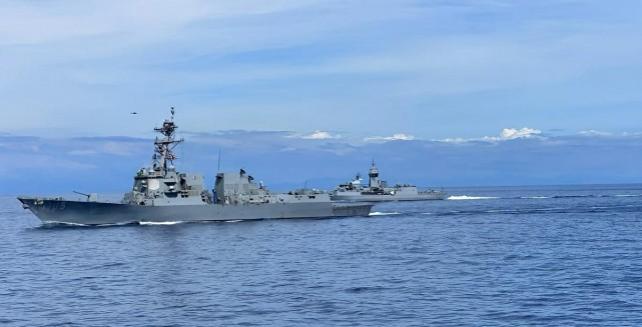
Among the activities conducted was the landing of a Philippine Navy AW109 helicopter on the flight deck of the Diego Silang, a maneuver requiring precision and careful calculation, particularly while the ship was underway.
As the Diego Silang approached the activity area, participating vessels formed up, including Australia’s HMAS Toowoomba, the US Navy’s USS Dewey, and Philippine Coast Guard vessel BRP Teresa Magbanua.
One of the key drills involved Australian and US Navy ships maneuvering alongside the Diego Silang in a simulated protective scenario.
According to Alcos, “It translates to kinetic and non-kinetic action. Ibig sabihin, in times of war we maneuver to address a specific threat during HADR [humanitarian assistance and disaster relief], we also need that for search and rescue specifically, and maraming application ang division tactics.”
He also emphasized the Philippine Navy’s capability to keep pace with partner forces.
“Ang pinaka importanteng takeaway ko dito is in terms of division tactics, specifically maneuvers, hindi tayo nahuhuli, actually, we are abreast sa ating mga partners. Kundi man tayo nahuhuli kasabay na natin siya.”
(The most important takeaway I got from this is that in terms of division tactics, specifically maneuvers, we are not lagging. Actually we are keeping abreast of our partners. We are not lagging behind them, we are alongside them.)
_2026_02_17_00_12_16.jpeg)
Traditional naval communication
The exercises also highlighted traditional naval communication methods, including the use of signal flags conveying tactical and strategic messages at sea.
A large Philippine flag was raised aboard the Diego Silang while sailing in the West Philippine Sea.
Alcos explained: “They correspond to different strategic tactical signals that we send out to our allies. This is on top of the the different communication protocols that we conduct over the radio and this is anchored on Naval history.”
The conduct of the Multilateral Maritime Cooperative Activity at Bajo de Masinloc coincided with recent clarifications by the Department of Foreign Affairs (DFA), reiterating that Bajo de Masinloc and the Kalayaan Island Group form part of the West Philippine Sea.
According to the AFP and the Philippine Navy, similar maritime cooperative activities will continue in the West Philippine Sea with allied nations. — BM, GMA Integrated News

