

 GMA Brandtalk
 Tracking
 Archives

PH, US to ramp up deterrence vs aggression in South China Sea
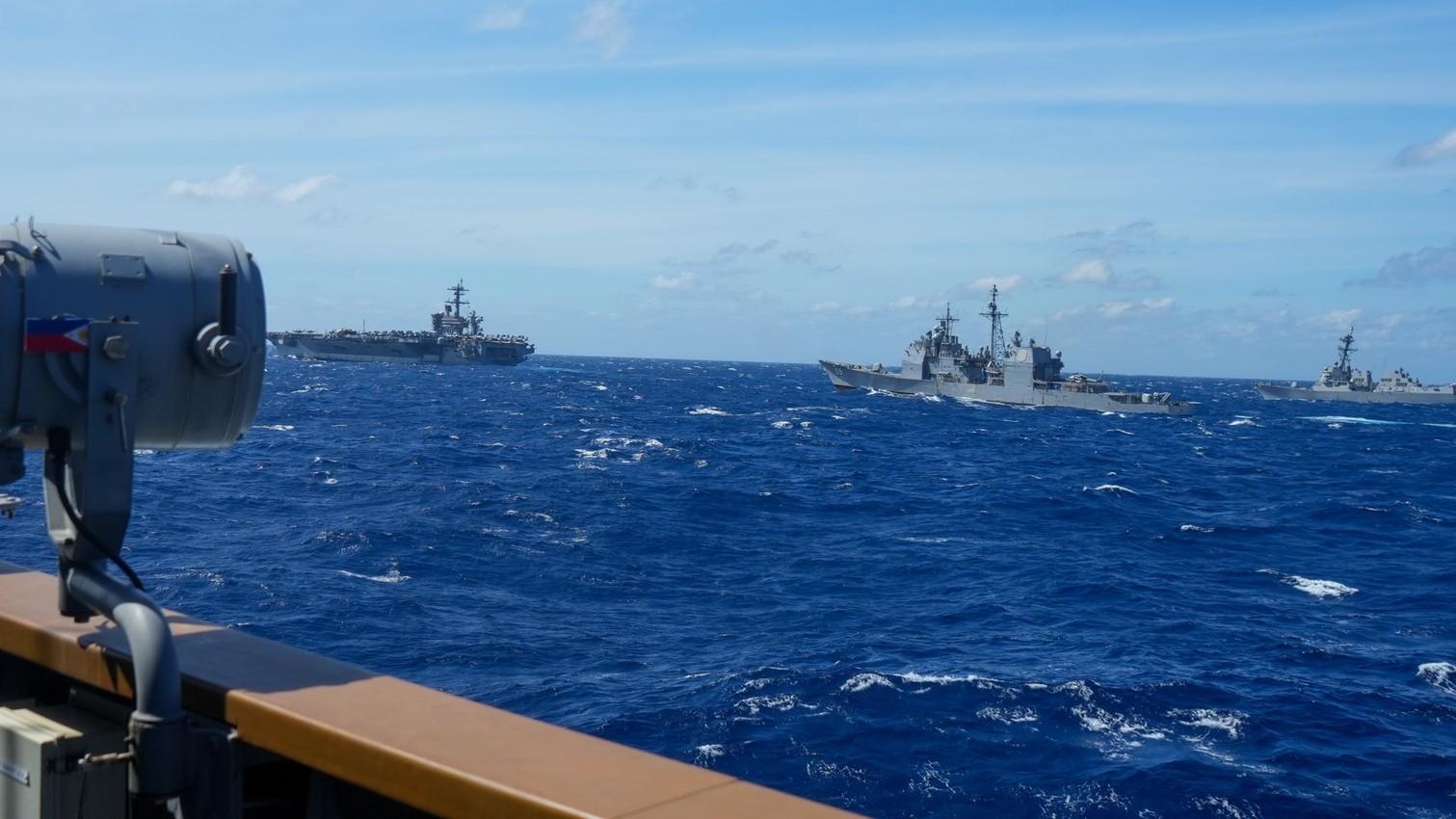
The Philippines and the United States on Tuesday said they will work together to bolster deterrence against threats to rule of law in the region, including China's "illegal, coercive, aggressive, and deceptive activities" in the South China Sea.
They also said they will continue and work to increase deployments of US cutting-edge missile and unmanned systems to the Philippines, while an additional $144 million from the US Department of War will fund infrastructure development in existing Philippine military sites that will be utilized by American troops under their Enhanced Defense Cooperation Agreement (EDCA).
Senior diplomats and defense officials from the Philippines and the US issued a joint statement detailing the direction of their security cooperation after meeting in Manila on Monday for the 12th Bilateral Strategic Dialogue (BSD).
Both sides said "collective defense is critical to denying and deterring aggression anywhere in the First Island Chain" as they denounced China's increasingly assertive actions in the South China Sea.
China's behavior, they said, have "adverse effects on regional peace and stability and the economies of the Indo-Pacific and beyond."
"Both sides condemned China’s illegal, coercive, aggressive, and deceptive activities in the South China Sea," according to their joint statement.
They reiterated that their Mutual Defense Treaty extends to armed attacks against either country’s armed forces, aircraft, and public vessels – including those of their coast guards – anywhere in the Pacific, including the South China Sea.
The 1951 defense pact signed between Manila and Washington, binds the two allies to come to each other’s aid from aggression and help defend the other party.
Philippine and US also said they are committed to "preserving freedom of navigation and overflight, unimpeded lawful commerce, and other lawful uses of the sea for all nations."
GMA News Online contacted the Chinese Embassy for comment but it has yet to receive a reply as of posting time.
'Increase the tempo of multilateral cooperation'
Over the next five years, Washington is allocating $2.5 billion worth of security assistance to the Philippines, its biggest defense assistance so far to its oldest treaty ally in Asia.
"Both sides underscored their unwavering commitment to uphold a free, open, prosperous, and secure Indo-Pacific, grounded in mutual respect for sovereignty, territorial integrity, international law, and the peaceful resolution of disputes," their statement said.
"They committed to maintaining a vigilant posture in the Indo-Pacific to prevent conflict and to developing strong measures along with the deterrence to keep sea lanes open and not subject to arbitrary control by one country."
Territorial disputes in the busy and resource-rich waterway have sparked occasional violence and has been regarded as a potential regional flashpoint for armed conflict. It has also been at the center of a strategic rivalry between China and the US.
China, which considers the sea disputes a purely Asian issue, is opposed to any foreign intervention, particularly from the US.
Defying China, Manila and Washington agreed in the meeting to "increase the tempo of multilateral cooperation with like-minded countries," including through maritime cooperative activities in the West Philippine Sea, bilateral and multilateral military drills, and security cooperation coordination.
The Philippines and the US also welcomed improved multilateral cooperation with allied partners, including Australia and Japan, as their forces train together to brace for any contingency.
Free, safe, prosperous, and secure Indo-Pacific
The US added that it will boost the Philippines’ capacity to monitor and respond to maritime challenges and illegal maritime activity, such as illegal, unreported, and unregulated fishing.
China's assertive behavior in the resource-rich waters also prompted serious concerns and condemnations from several countries after its coast guard vessels have repeatedly blasted water cannons, used military-grade lasers and blocked Philippine government ships from conducting patrols in the West Philippine Sea, that part of the South China Sea that is nearest to the Philippine archipelago.
The years-long disputes also involve Vietnam, Malaysia, Brunei and Taiwan.
The Philippines largely won a landmark case against China's massive claim in the South China Sea before an arbitration tribunal in The Hague, Netherlands in 2016, but Beijing refused to recognize the ruling.
While it has no territorial claims in the South China Sea, the US has patrolled the area for decades and has repeatedly warned China that it’s obligated to defend its ally if Filipino forces come under an armed attack, including in the contested waters.
Manila and Washington also reaffirmed the importance of peace and stability across the Taiwan Strait. Beijing considers Taiwan, a self-ruling democratic island, a part of its territory to one day be reclaimed by force if necessary.
First convened in 2011, the BSD serves as the annual platform between Manila and Washington where they discuss the full range of their political, security, and economic cooperation. The one-day meeting allows them to assess and exchange views on current challenges and identify strategic bilateral priorities and new collaborative initiatives.
The Philippines, under President Ferdinand Marcos Jr. has sought to upgrade its defense capabilities and expanded its security partnerships with other countries as it confronts Chinese aggression in its waters.
Philippine and US officials said they are committed "to a free, safe, prosperous, and secure Indo-Pacific that upholds shared principles including territorial integrity, sovereignty, sovereign rights and jurisdiction, and the peaceful resolution of disputes."
They also declared that they oppose "any threat or use of force against the territorial integrity or political independence of any state."
Economic cooperation
On the economic front, the Philippines and the US underscored the need to advance cooperation on energy security, including the peaceful use of nuclear power, and critical supply chains.
These areas, they said, "support regional deterrence by reducing strategic vulnerabilities, demonstrating long-term commitment to Philippine sovereignty, and supporting long-term economic growth."
Both sides agreed to strengthen "defense industrial base resiliencies," including defense co-production capabilities, and to strengthen the Luzon Economic Corridor - a US-envisioned growth region in Asia, that intends to increase trade and establish an economic hub in the northern Philippines through major infrastructure and other key projects.
A Luzon Economic Corridor (LEC) Investment Forum will be held in Manila this year to drive new investments and unleash additional private sector opportunities, in coordination with Japan and other likeminded partners, the joint statement said.
Both sides also announced a plan to help the Philippines build its capacity to construct and operate state-of-the-art nuclear reactors.
Through the Department of State’s Foundational Infrastructure for Responsible Use of Small Modular Reactor Technology (FIRST) program, the US will provide $1.5 million to build a control room simulator in the Philippines, ensuring nuclear development in the region is consistent with the highest standards of nuclear safety, security, and nonproliferation.
Expanding bilateral collaboration to establish secure and standards-based critical minerals supply chains is also a priority for the two allies, according to their statement. — KG/RSJ, GMA Integrated News

