

 GMA Brandtalk
 Tracking
 Archives

De Lima seeks House inquiry into anti-terror law implementation
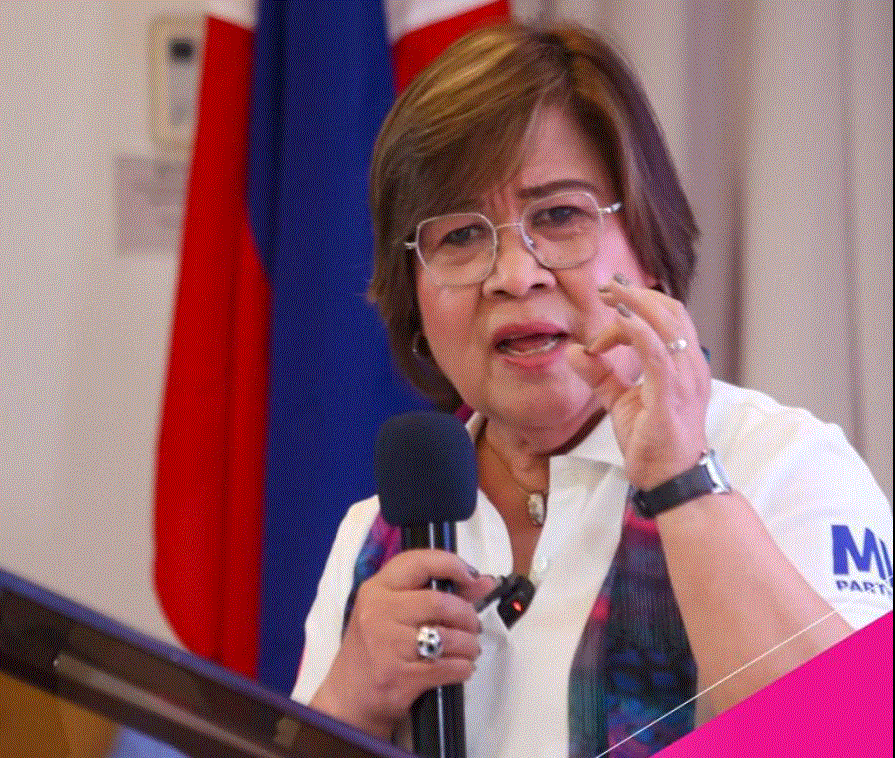
Mamamayang Liberal Party-list Rep. Leila de Lima has filed resolutions seeking inquiry into the implementation of anti-terror laws amid allegations that these were being misused against democratic dissent and lawful civic engagement.
De Lima, a former Justice secretary, also condemned the continued detention of Frenchie Mae Cumpio and lay worker Marielle Domequil, saying there is a need for a congressional inquiry to ensure laws on anti-terrorism and terrorist financing will not be used to quash legitimate dissent.
Cumpio and Domequil were convicted of terrorist financing by a Tacloban court last month, sentencing them to 12 to 18 years in prison as provided under the Terrorism Financing Prevention and Suppression Act of 2012. They supposedly supplied P100,000 in cash as well as ammunition to members of the Community Party of the Philippines-New People’s Army (CPP-NPA) in Catbalogan City in March 2019.
Former President Rodrigo Duterte issued a 2017 proclamation declaring CPP-NPA as a terrorist group. The Justice Department then asked the Manila court to make the same declaration in 2018. But in a September 2022 decision, a Manila court ruled that the CPP-NPA is not a terrorist group because its purpose was not terrorism.
“We strongly condemn Cumpio and Domequil's continued unjust detention and the relentless weaponization of counterterrorism and counter-terrorism financing laws to silence dissent. The denial of bail of community journalist Frenchie Mae Cumpio and of lay worker Marielle Domequil is a serious setback in the fight for press freedom, a major blow to civil liberties in our country,” De Lima said.
“In light of the highly questionable charges against them, and the many reported cases of human rights defenders, political activists, and other dissenters being unjustly accused, indicted, or charged under the Anti-Terrorism Act and the Terrorism Financing Prevention and Suppression Act, we have filed House Resolution Nos. 786 and 787 calling for a congressional inquiry into the implementation of these laws,” she added.
De Lima cited the Supreme Court decision declaring two parts of the Anti-Terrorism law as unconstitutional which include:
- qualifying dissent as not considered terrorism, “provided that it is not intended to cause death or serious physical harm to a person, to endanger a person's life, or to create a serious risk to public safety” and
- the Anti-Terrorism Council's automatic adoption of the United Nations Security Council Consolidated List of designated individuals or groups designated as a terrorist, one who finances terrorism, or a terrorist organization.
De Lima also said that United Nations Special Rapporteur on the promotion and protection of the right to freedom of opinion and expression Irene Khan (Special Rapporteur) rendered a report expressing continuing concern regarding several provisions of the ATA.
“A comprehensive inquiry in aid of legislation would enable the House of Representatives, through its appropriate committee, to determine whether statutory refinements, clarifications, additional safeguards, or institutional reforms are necessary to ensure that counterterrorism measures remain narrowly tailored, proportionate, and aligned with constitutional and democratic principles,” she said under House Resolution 786.
The lawmaker said the inquiry will cover the following topics:
- the extent of the implementation of the Anti-Terrorism Act of 2020 insofar as it complies with the constitutional guarantees of due process, freedom of speech, freedom of expression, freedom of association, peaceful assembly, and the right to privacy;
- the exercise of powers by the Anti-Terrorism Council, including designation processes, coordination with law enforcement agencies, and mechanisms for judicial review and redress;
- the use of surveillance authorities under the Act and the adequacy of oversight mechanisms to guard against abuse and to ensure proportionality and necessity;
- the impact of the law on journalists, human rights defenders, civil society organizations, indigenous peoples, labor leaders, youth activists, humanitarian workers, and other sectors engaged in lawful advocacy and civic participation; and
- the sufficiency of existing institutional safeguards to prevent misuse, overreach, or unconstitutional application of the law.
“Such inquiry would likewise reinforce public confidence in both the state's commitment to national security and its unwavering adherence to the rule of law and human rights protections,” she added.
Further, De Lima said that the deluge of terrorist financing cases like that of Cumpio and Domequil are also alarming, with the Department of Justice filing terrorism financing charges against approximately 24 community activists in Cebu in May 2024 alone.
In October 2024, the police charged three officials of a humanitarian group that has worked with farmers and fisherfolks in northern Philippines for over 40 years.
De Lima also flagged the Anti-Money Laundering Council (AMLC)’s decision to issue ex parte freeze orders against the bank accounts and properties of the Leyte Center for Development, Inc. (LCDe), a non-governmental organization (NGO) engaged in post-disaster relief and community development work in Eastern Visayas, as well as against its executive director, her son, and several staff members, on allegations of terrorism financing.
These instances, De Lima said, are on top of similar measures taken against other civil society organizations, including the Cordillera People's Alliance (CPA); Community Empowerment Resource Network (CERNET) Inc., a Cebu-based development organization; and the Paghida-et sa Kauswagan Development Group (PDG), a land rights group in the central island of Negros, following their alleged association with designated organizations.
“The abrupt freezing of the foregoing accounts led to the immobilization of organizational funds and, in certain instances, even the personal bank accounts of officers and staff, effectively suspending ongoing humanitarian and development initiatives, restricting access to essential financial resources, and giving rise to serious issues regarding the sufficiency of the evidentiary basis for such measures, the issuance of ex parte freeze orders without prior notice or hearing, and the broader implications of these actions on lawful civic and humanitarian activities,” De Lima said in House Resolution 787.
“The overextension or aggressive application of terrorism-financing measures against lawful dissenters, development workers, indigenous rights defenders, and members of the press risks diverting institutional resources away from high-risk money-laundering and corruption cases. It is therefore incumbent upon Congress to ensure that efforts to combat money laundering and terrorism financing are directed at genuine illicit financial threats, while avoiding the misuse or weaponization of counter-terrorism financing laws against lawful civic engagement, humanitarian action, and democratic dissent,” she added.—AOL, GMA Integrated News

