

 GMA Brandtalk
 Tracking
 Archives

Why ICC? No accountability vs. those at highest levels in PH, says De Lima
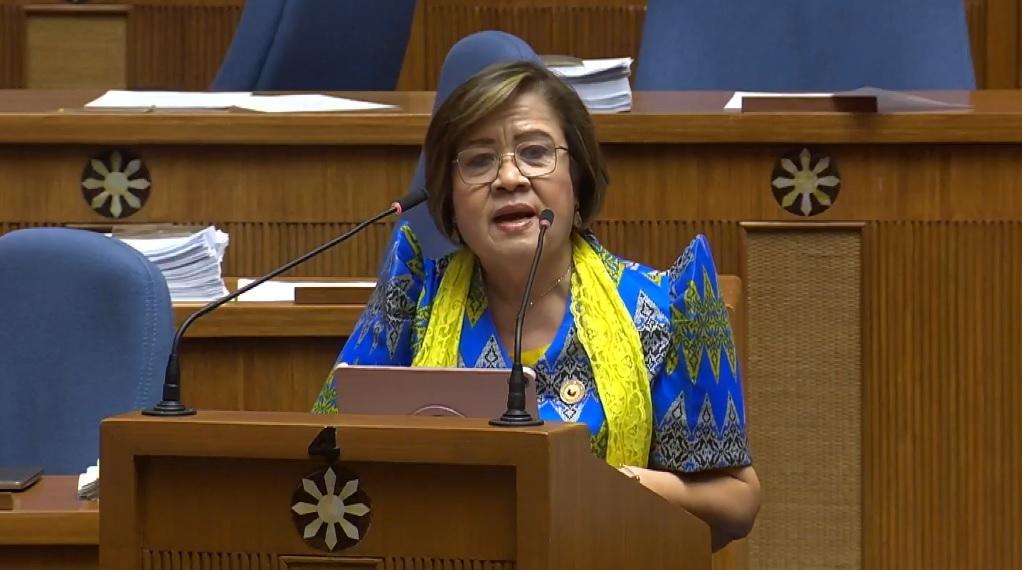
The confirmation of charges hearing in the case against Rodrigo Duterte at the International Criminal Court shows that not even a president can escape accountability, House Deputy Minority Leader Leila de Lima said Monday.
“This is not a moment for triumphalism. It is not a moment for vengeance. It is a watershed moment for reckoning. Bakit kailangang sa ICC pa maganap ang paglilitis [ni Duterte]? Meron po kasing tinatawag na prinsipyo o principle of complementarity. Ibig sabihin: kapag hindi ginagawa ng isang bansa o hindi kaya ng isang bansa na magsagawa ng tapat at makatotohanang imbestigasyon at paghahatol, saka papasok ang ICC,” the ML party-list Representative said in a privileged speech.
(Why was it necessary for the trial against Duterte to be held at the ICC? Because of the principle of complementarity. If a country fails to conduct an honest and genuine investigation and trial, the ICC will take over.)
De Lima was referring to the provision in Republic Act 9851—the Philippine Act on Crimes Against International Humanitarian Law, Genocide, and Other Crimes Against Humanity—which states: “In the interest of justice, the relevant Philippine authorities may dispense with the investigation or prosecution of a crime punishable under this Act if another court or international tribunal is already conducting the investigation or undertaking the prosecution of such crime.”
The same law further provides that, “Instead, the authorities may surrender or extradite suspected or accused persons in the Philippines to the appropriate international court, if any, or to another State pursuant to the applicable extradition laws and treaties.”
“Ngayon, magderetsahan po tayo: Noong panahon ng drug war, may nakita ba tayong kapani-paniwalang imbestigasyon sa mga matataas na opisyal? Nasampahan ba ng kaso ang mga naglatag ng polisiya?...The few domestic cases that moved forward focused narrowly on specific incidents, often involving only low-level officers,” de Lima said.
(Let's be straight with each other. When the drug war was happening, did we ever see a genuine and believable probe into a high-ranking official? Were those who made the policies charged?)
"To insist now that everything must be tried domestically, when years have passed without genuine accountability at the highest levels, is to ignore the very safeguards embedded in international law. If we believe that no one is above the law, then we must accept that even a former President may stand before an international tribunal. If we believe in sovereignty, we must also believe in the rule of law commitments we freely undertook," she added.
If the Philippine justice system were indeed equipped to handle Duterte and those involved in the drug war killings, de Lima said, then cases against him should have been filed long ago.
That, however, has not been the case. Duterte and top-level police and government officials named in the ICC case, such as Senator Ronald dela Rosa, have no pending criminal case before any Philippine court.
“If we truly believed that the Philippines is capable of handling these cases domestically, we would see vigorous, transparent prosecutions—not only of those at the top, but also of those who pulled the trigger and those who falsified reports,” de Lima, a former Justice Secretary, said.
"The tragedy is this: while international prosecutors prepare to argue that crimes against humanity were committed, many families of victims here at home are still waiting for accountability in the killing of their loved ones. As far as we know, there have been only few investigations and prosecutions here, and only five convictions involving only low-level perpetrators. Hindi pa nga natin alam ano nang nangyayari sa mga kaunting imbestigasyon sa mga drug war killings,” de Lima added.
(We do not even know the results of the probe on low-level perpetrators.)
Having said that, de Lima underscored that Duterte facing crimes against humanity charges before the ICC is a quest for justice and should be not reduced to mere politicking.
“If we believe in justice for the poor, we must ensure that their deaths are not reduced to statistics, nor their families silenced by fear. The confirmation of charges hearing at the International Criminal Court is the beginning of a formal process where evidence will be tested and rights will be protected. [And] today, we must choose. I stand for accountability. I stand for the rule of law. And above all, I stand for the Filipino people—especially the voiceless, the powerless, and the grieving—who deserve nothing less than justice,” de Lima added.
Duterte is detained at the ICC in The Hague, Netherlands, suspected of the crimes against humanity of murder and attempted murder in his "war on drugs." The hearing to confirm the charges began on Monday.
But for PPP party-list Representative Harold Duterte—the former President’s nephew—the ICC case is just politics.
“Today is not about accountability. Today is not about victims or justice. Today is about politics, plain and simple,” the congressman said in a statement.
Congressman Duterte, however, conceded that there is no stopping the ICC proceedings on Duterte at this point.
“As the ICC proceeds with the case, we have no choice but to continue hoping and praying that the former President will still be able to come home to the Philippines,” he added. — BM, GMA Integrated News

