

 GMA Brandtalk
 Tracking
 Archives

Health advocates push early prevention, full liver care coverage
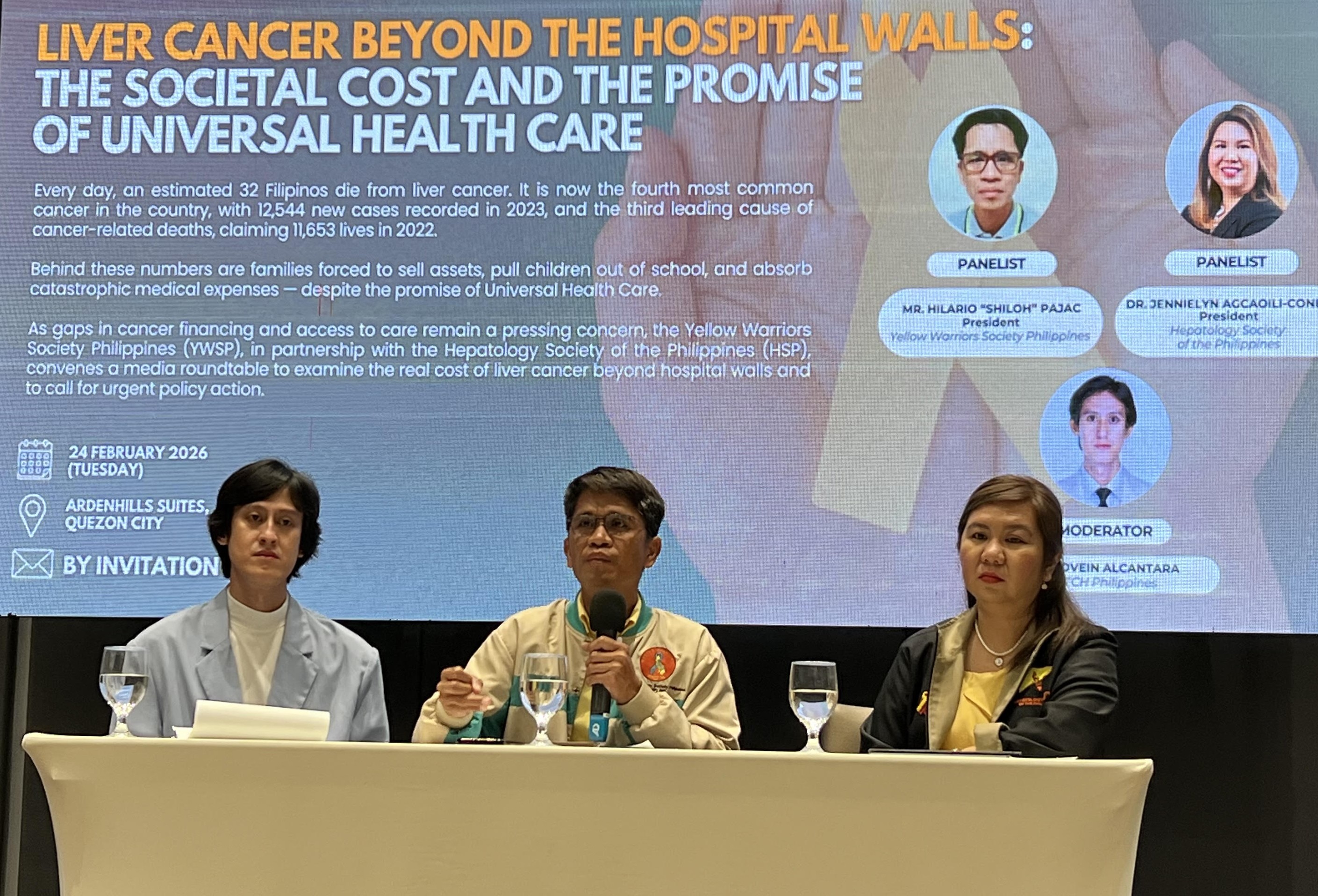
Health advocates and patient groups are urging the government to expand benefits covering all levels of liver care, including early prevention through regular screening tests.
At a media roundtable in Quezon City on Tuesday, Hepatology Society of the Philippines (HSP) President Dr. Jennielyn Agcaoli-Conde said that 32 Filipinos die from liver cancer every day.
Data from the Global Cancer Observatory in 2022 shows liver cancer as the third leading cause of cancer deaths globally.
“This is happening despite universal healthcare. The truth is simple—we do not lack science… What we lack is full system implementation and financial protection,” she said.
Liver cancer is often asymptomatic in its early stages, meaning most patients are diagnosed late and face costly treatment.
While some can access available care, many Filipinos living paycheck to paycheck must choose between medical treatment and putting food on the table.
“Several immunotherapies now exist that are very promising for liver cancer patients. Ngayon din actually, we're really pushing for liver transplant. Mas maganda na mas maagap na lalaman kung may liver cancer para na-offer namin itong mga treatment options nito,” Agcaoli-Conde said.
(As of now, several immunotherapies show promise in treating liver cancer. We are also pushing for liver transplants. The earlier we detect liver cancer, the sooner we can offer these treatment options.)
HSP is working with the Yellow Warrior Society of the Philippines to push for concrete reforms and expanded PhilHealth benefits to ease the burden on liver patients.
While PhilHealth currently covers some hepatitis treatments, Agcaoli-Conde said the benefits are insufficient.
“In a one whole year yun, parang kulang siya… P23,000 to P24,000, to tell you honestly, I think it's still not enough,” she shared.
“Lagi ang iisipin ng mga Pinoy, gastos lagi… So that's why, isa rin yun yung gusto naming i-address. Sana, dahil na may universal healthcare, katulad ng binanggit ko, is ma-cover natin yung screening, yung pagpapatest ng mga pasyente may hepatitis B sa kanilang regular na follow-up,” she added.
(Filipinos will always think about costs… So that’s one of the issues we aim to address. Hopefully, with universal healthcare, we can cover hepatitis B screenings during regular patient follow-ups.)
According to her, prevention must begin with universal screenings and full coverage of anti-hepatitis vaccinations.
Early detection should be guaranteed through broader insurance coverage for high-risk patients, while comprehensive care from diagnosis to treatment must be financially protected, Agcaoili-Conde said.
“Universal healthcare cannot just be a law. It should be implemented… Kung hindi fully covered ang surveillance at treatment ng isang Pilipino may liver cancer, we are paying for terminal cancer instead of preventing it,” she said.
(Universal healthcare cannot just be a law. It must be implemented. If surveillance and treatment for a Filipino with liver cancer are not fully covered, we end up paying for terminal cancer rather than preventing it.)
“Kung seryoso tayo sa (If we are serious about) universal healthcare, liver cancer must be funded as a national priority. Legislation without sufficient funding is just symbolism. It is not a reform. The economic cost of inaction is far greater than the cost of prevention," she said.
"Liver cancer is not just a hospital issue but affects workforce productivity, economic stability, and national development. If we delay, 32 more Filipinos will die tomorrow,” Agcaoili-Conde added.
Discrimination, forced lifestyle changes
Hilario Pajac, president of the Yellow Warrior Society of the Philippines, said liver cancer patients and their families often face drastic life changes and financial burdens after diagnosis.
“Napakalaki ng gastusan pagdating sa ganitong pangangailangan. Unang magbabago sa buhay mo, yan pwedeng mawalang ka ng hanap buhay, yan trabaho. Bakit? Kasi pag nawalan ka ng hanap buhay dahil sa sakit mo, matik lahat damay… Nasasakripisyo lahat, lahat nagsasakripisyo,” he said.
(Treatment costs are enormous. One of the first life changes is that you might lose your livelihood or job. Why? Because losing your job due to illness affects everything… Everyone sacrifices, everything is affected.)
Pajac added that patients often face discrimination and difficulty finding employment, as companies may reject them after a positive diagnosis.
“Hirap maghanap ng trabaho sa totoo lang. Bakit? Nakakaranas ako ng discriminations eh. Isa yan sa pagbabago na aming tinatanggap… Lalong-lalo na sa gamutan, mahirap din po talaga yan,” he said.
(It’s hard to find a job, to be honest. Why? I experience discrimination. This is one of the changes we have to accept… Especially regarding treatment, it’s really difficult.)
As a representative for liver patients nationwide, he echoed HSP’s call for comprehensive PhilHealth coverage for liver screening, diagnosis, and treatment.
“Kapag kulang yan, malaki ang possible na ang out-of-pocket ng isang pasyente… Wala na talagang matitira sa kanya. Sabi ko nga kanina, darating sya punto na kailangan niyang mamili.
(If benefits are lacking, patients’ out-of-pocket expenses can be overwhelming… Nothing is left for them. There comes a point when they have to choose.)
"Kailangan dapat talaga sa PhilHealth kumpleto ang package, may sapat na halaga,” he said.
(PhilHealth needs a complete package with sufficient funding.)—MCG, GMA Integrated News

