

 GMA Brandtalk
 Tracking
 Archives

ICC told of Dela Rosa, Lapeña, Danao, Aguirre roles in Duterte's war on drugs
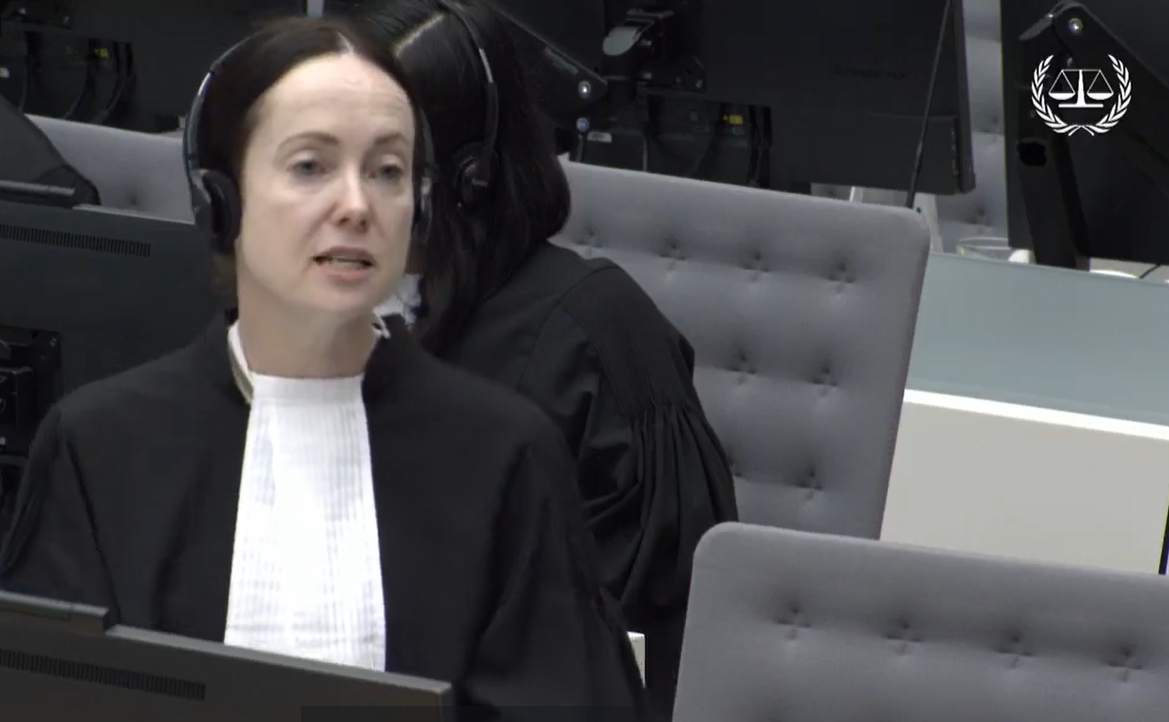
International Criminal Court (ICC) prosecutor Robynne Croft on Tuesday told the Pre-Trial Chamber I that during his term, former President Rodrigo Duterte’s alleged co-perpetrators in the war on illegal drugs “controlled the executive.”
On the second day of Duterte’s confirmation of charges hearing, Croft named the co-perpetrators as former Philippine National Police (PNP) chief and now Senator Ronald “Bato” Dela Rosa, former PNP chief of counterintelligence Vicente Danao, former PNP operations chief Camilo Casclolan, former National Capital Region Police Office (NCRPO) regional director Oscar Albayalde, then Special Assistant to the President (SAP) and now Senator Christopher Lawrence “Bong” Go, former National Bureau of Investigation (NBI) Director Dante Gieran, lawyer and ex-Justice Secretary Vitaliano Aguirre II, and former Philippine Drug Enforcement Agency (PDEA) chief Isidro Lapeña.
“The co-perpetrators controlled the executive, they controlled the police, they controlled the [Philippine] Drug Enforcement Agency (PDEA), the National Bureau of Investigation (NBI) and the Department of Justice (DOJ),” Croft said.
“And they used this control to ensure that their subordinates carried out the plan to neutralize alleged criminals through violent crimes,” she added.
Prior to their national positions, Dela Rosa, Go, Danao, Gierran, and Aguirre were also named as Duterte’s co-perpetrators in his anti-narcotics campaign during his term as Davao City mayor.
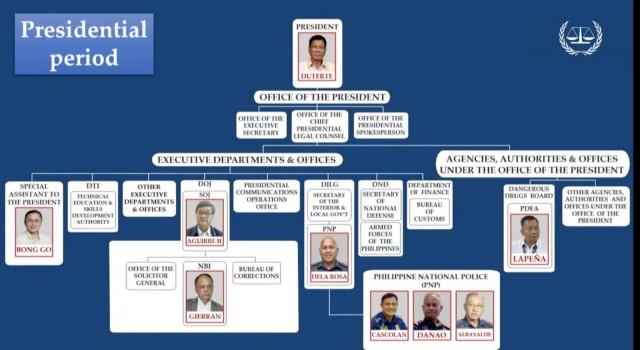
Croft claimed that when Duterte was mayor, Duterte and his co-perpetrators controlled the Davao Death Squad (DDS).
“They controlled the will of the DDS perpetrators through a range of mechanisms… Include threats to kill and actual killing,” she said.
Croft alleged that when Duterte became President in 2016, his co-perpetrators continued to control a structure of power.
On Monday, Duterte’s lawyer Nicholas Kaufman said the allegations against his client were “grievously misplaced and politically motivated” as he urged the ICC Pre-Trial Chamber I to send back the former President to his family and country.
He said the prosecution’s evidence against the 80-year-old Duterte was “wholly insufficient” and claimed that the prosecution “cherry-picked” Duterte’s speeches to suit its narrative.
The defense lawyer maintained that Duterte’s “hyperbole, bluster, and rhetoric” did not have lethal intent and was calculated to instill fear, obedience, and a respect for the law in the minds of drug suspects.
On Tuesday, Croft pointed out that one of the first things that “Mr. Duterte did with his presidential powers was to appoint his co-perpetrators from Davao to national positions in government and law enforcement, which were key in the common plan.”
“And after he appointed Mr. Dela Rosa as chief of the PNP, Mr. Dela Rosa used his new powers to move other police co-perpetrators into key policing roles,” she added.
Dela Rosa
According to Croft, Dela Rosa, as PNP chief, controlled around 180,000 police officers. She also cited an interview where Dela Rosa was “wholeheartedly agreeing” to the plan.
In the video shown to the ICC, Dela Rosa said, “Patayan sa drugs. Patayan talaga ito sa drugs. So kayong mga drug lords diyan, humanda na kayo at talagang sasagasaan ko kayo.”
(There will be killings over drugs. There will be killings. So to the drug lords out there, be prepared because I will crush you.)
Croft also referred to a speech made by Dela Rosa in August 2016.
“Kilala siguro niyo kung sino ang mga drug lord dito. Ano, gusto niyo patayin? Gusto niyo patayin? Patayin niyo. Pwede naman kayo pumatay dahil wala naman kayo… Puntahan niyo, buhusan niyo ng gasolina, ‘yung bahay sindihan ninyo,” Dela Rosa said in the video.
(You probably know who the drug lords are. What, do you want to kill them? You want to kill them? Kill them. You can kill because you have nothing… Go there, douse the house with gasoline, burn it down.)
Dela Rosa has not attended any plenary session at the Senate since November 2025 amid allegations of an ICC warrant issued against him.
As Dela Rosa marked his 64th birthday in January, he broke his silence and released a statement saying he is still “waiting” for “justice to emerge and take over.”
Lapeña
According to Croft, Lapeña was appointed as director general of the PDEA and served from 2017 to 2017. Due to this, she said Lapena controlled 1,800 PDEA personnel.
“They used these subordinates as physical perpetrators to commit the crimes,” she said.
Before this, he was Davao City police chief from 1996 to 1998. She cited Lapeña’s speech, in which he claimed that Duterte’s term as Davao City mayor, they implemented “strict law enforcement against illegal drug enforcement activities.”
“‘The President wants to replicate and expand what is being done in Davao, and that is precisely what I intend to do,’” Croft said, further quoting Lapeña.
Danao
Meanwhile, Danao served as chief of the Davao City police from 2013 to 2016. He later served as director of the Manila Police District (MPD) from 2018 to 2019.
She cited Danao’s statement, in which he said he will “go after” and “kill” those who he discover are involved in drugs.
Aguirre
A lawyer, Aguirre served as Justice Secretary of the Duterte administration from 2016 to 2018.
“Mr. Aguirre, as Secretary of Justice, now had control of the National Prosecution Service (NPS). He used this control to ensure that except for a handful of low-level perpetrators in notorious cases, the crimes were not prosecuted and the climate of impunity prevailed,” she said
According to Croft, Aguirre also publicly acknowledged the plan and his agreement to it as a member of Duterte’s Cabinet.
She played an interview where Aguirre said “[they] will choose to kill the drug lords” in the Philippines.
“Your Honor, these speeches of co-perpetrators showed both the scope of the common plan and those co-perpetrators agreement to it,” Croft said.
Croft also mentioned the terms “tokhang” and “nanlaban,” terms which she said were widely used to legitimize the police operations.
In the Document Containing the Charges (DCC) and in court on Monday, Dela Rosa was named as one of Duterte’s co-perpetrators, along with Go, Aguirre, Danao, and former police officials Camilo Cascolan and Oscar Albayalde, among others.
Following the ICC’s release of the DCC submitted by the prosecution, Go said the allegations against him are “unfounded, one-sided, and unfair.”
Aguirre also denied participating in the alleged extrajudicial killings related to the drug war and maintained his innocence.
Amid the ongoing ICC confirmation of charges hearings, Go refused to comment and said he will wait for the week to be over.
Meanwhile, Croft said data showed that there were 274 extrajudicial killings in Davao City during Duterte’s term as mayor from 2012 to 2015. She said this is corroborated by insider witnesses.
“Several DDS witnesses say that they each killed hundreds of criminals while with the DDS,” she said, adding that one witness estimated that between 1,500 to 2,000 people were buried at the Laud Quarry.
Croft said Duterte himself admitted that he killed 1,700 people in Davao City.
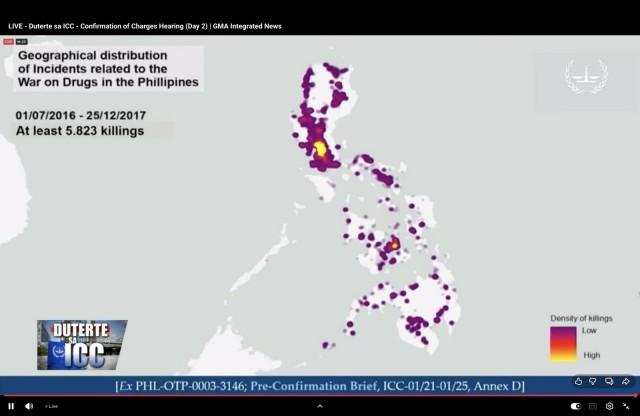
“The attack continued to be widespread after Mr. Duterte became President when it expanded across the country. The victimization expanded with the hundreds killed during the mayoral period becoming thousands in the presidential period,” she said.
She added that the Duterte administration’s 2017 year-end report stated that 3,967 drug personalities died in anti-drug operations from July 2016 to November 2017.
Meanwhile, the PDEA reported that 5,281 drug personalities died in anti-drug operations in the first two and a half years of Duterte’s presidency.
“These admissions corroborate the widespread nature of the attack. They show that thousands of individuals were killed,” she said.
Aside from this, Croft said an expert witness specializing in political violence analyzed data on armed encounters between the PNP and armed suspects.
She said the expert found that in the first 25 months of Duterte’s presidency, the number of suspects killed by the police officers increased by 590% nationwide.
Croft noted that the expert also learned that police killings rose by 1,600% in Bulacan when Duterte became president.
The expert further compared data on the Bulacan police’s use of deadly force to other countries or cities. She said he used the metric of police killings per 100,000 population.
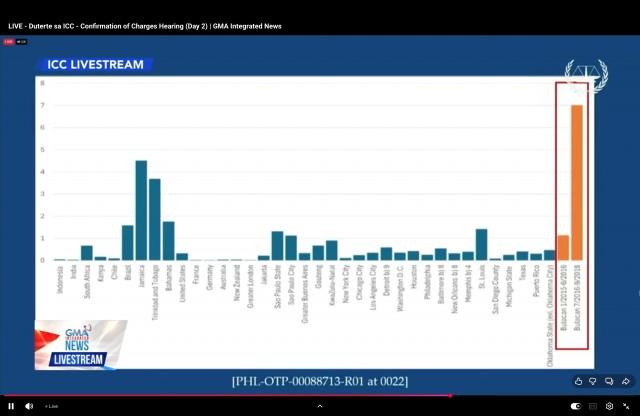
“The orange bar on the left shows police use of deadly force in Bulacan before Mr. Duterte became President. You can see that with a fatality rate of over one, it was already comparatively high,” Croft said.
“The orange bar on the right shows the dramatic increase in killings in Bulacan by the police after Duterte became President,” she added.
Citing the expert, Croft said this may only be explained by a “widespread facility of extrajudicial executions.”
On Monday, the ICC read the charges against Duterte.
The confirmation of charges hearings will be continued on February 26 and February 27.
READ: DAY IN COURT: ICC Hearings on the Charges vs. Duterte
According to the ICC, the Pre-Trial Chamber I may decide to do the following at the close of the confirmation of charges hearing:
- Decline to confirm the charges. Such a decision does not prevent the Prosecution from presenting a subsequent request for confirmation of the charges on the basis of additional evidence
- Adjourn the hearing and request the Prosecution to consider providing further evidence or conducting further investigation, or amending the charges, or
- Confirm the charges and commit the case for trial. Upon confirmation, the Presidency of the Court constitutes a Trial Chamber responsible for the subsequent phase of the proceedings: the trial.
— JMA, GMA Integrated News

