

 GMA Brandtalk
 Tracking
 Archives

Chinese Navy ships seen as PH, US, Japan drills reach north Batanes waters
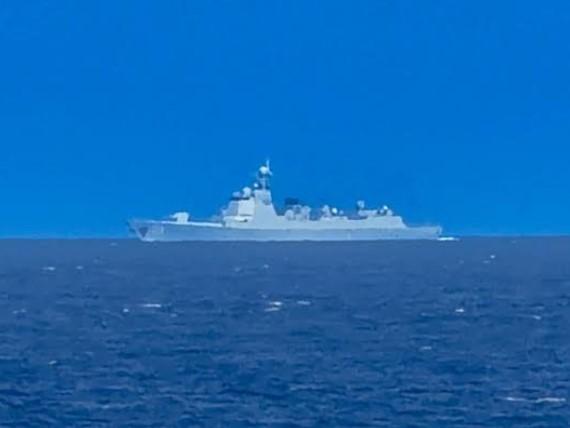
Chinese Navy warships were spotted multiple times this week near patrolling naval assets of the Philippines and the United States in the West Philippine Sea during the 15th Multilateral Maritime Cooperative Activity (MMCA) with Japan.
Vessels of the People's Liberation Army (PLA) Navy of China were consistently spotted near Philippine and American Navy ships throughout the four-day MMCA, which was conducted from Monday, February 23, to Thursday, February 26.
GMA Integrated News was the only local media organization aboard the Philippine Navy's BRP Antonio Luna to witness the conduct of the 15th MMCA—the first-ever edition of the three countries' joint exercises to reach the waters of northern Batanes.
Aircraft from the allied nations took part in a friendly flight near the Bashi Channel—a waterway separating the Philippines from Taiwan.
The BRP Antonio Luna, Philippine Coast Guard's BRP Gabriela Silang, and the US Navy's USS Dewey, meanwhile, sailed towards the northern tip of Batanes for joint maritime drills.
Warships
On Monday, Februrary 23, the Philippine Navy monitored the presence of China's Jiangkai II-class missile frigate Liuzhou 573.
Meanwhile, the guided-missile destroyer Hefei 174 of the PLA Navy was seen a few nautical miles away from the Philippine and US vessels traversing northern Batanes waters, and even near Bajo de Masinloc, from the second up to the last day of the MMCA.
"Hindi naman nila tayo binigyan ng radio challenge. Gayunpaman, 'yung presence nila is illegal kasi nasa loob sila ng [exclusive economic zone] ng Philippines at sumunod sila hanggang Batanes," said BRP Antonio Luna commanding officer Capt. Jennifer Monforte.
(They didn't issue a radio challenge to us. Nevertheless, their presence is illegal because they're inside the EEZ of the Philippines and they followed us to Batanes.)
'Not normal'
He noted that the presence of any PLA Navy ship in the Batanes area is "not normal."
"Madalas dito lang sila sa Bajo de Masinloc area… Kapag ganiyan na nag-e-exercise at sumunod sila, para sa akin, hindi na 'yan normal."
(They're usually just in the Bajo de Masinloc area… When we hold our exercises and they follow us, for me, that's not normal.)
Monforte also clarified that the MMCA reaching near the Bashi Channel—the waterway separating the Philippines from Taiwan—should not be seen as a provocation of other countries.
"Scheduled exercise ito at nasa loob naman tayo ng EEZ ng Pilipinas. Hindi naman maritime domain ng ibang bansa so hindi ito provocation," he said.
(This is a scheduled exercise and we're within the EEZ of the Philippines. This is not the maritime domain of any other country so this is not a provocation.)
China claims self-governing Taiwan as part of its territory.
According to a Reuters report, China's military said Friday it conducted a routine patrol in the South China Sea from February 23 to 26, and accused the Philippines of "disrupting" peace and stability by organizing joint patrols with countries outside the region.
The Chinese military's Southern Theatre Command will "resolutely safeguard China's territorial sovereignty and maritime rights and interests, and firmly uphold regional peace and stability," spokesperson Zhai Shichen said in a statement.
Signal jamming
Meanwhile, the Chinese Embassy in Manila on Friday denied allegations that China interfered with the military communication and navigation systems of Philippine vessels and aircraft in the West Philippine Sea (WPS).
“These accusations are groundless,” Chinese Embassy in Manila deputy spokesperson Guo Wei said in a statement.
Guo reiterated China’s claim of sovereignty over the concerned waters and criticized the presence of Philippine military and coast guard vessels and aircraft into "sensitive maritime areas."
"The repeated intruding of Philippine military and coast guard vessels and aircraft to sensitive maritime areas, including flying a legislator by a PCG aircraft to Zhongye Dao and its surrounding waters, constitutes a deliberate and provocative escalation," Guo said.
"Such actions are entirely unacceptable and are firmly opposed by China," Guo added.
On February 23, the Philippine Coast Guard (PCG) accused China of jamming signals while Filipino vessels were conducting maritime patrol near Bajo de Masinloc.
"The Starlink connection ng ating barko ng Bureau of Fisheries and Aquatic Resources and even the Philippine Coast Guard vessel MRRV 4409 ay nawawalan ng signal," PCG spokesperson for WPS Commodore Jay Tarriela earlier said.
(The Starlink connection of Bureau of Fisheries and Aquatic Resources vessels and even the Philippine Coast Guard vessel MRRV 4409 lost their signals.)
"I'd like to believe that there is signal jamming that the People's Republic of China is doing because we monitor that for our vessels, every time that we go near or go inside a radius of 24 nautical miles and closer sa Bajo de Masinloc, ito 'yung mga pagkakataon na nawawala yung starlink signal natin (this was the time when we lose our Starlink signals)," he added.
The disruption could delay information transmission and compromise communication between vessels and monitoring units.
According to Tarriela, this was the first time such an incident happened.
Tensions continue as Beijing claims almost all of the South China Sea, a conduit for more than $3 trillion of annual shipborne commerce, including parts claimed by the Philippines, Vietnam, Indonesia, Malaysia, and Brunei.
Parts of the South China Sea that fall within Philippine territory have been renamed by the government as West Philippine Sea to reinforce the country’s claim.
The West Philippine Sea refers to the maritime areas on the western side of the Philippine archipelago including Luzon Sea and the waters around, within and adjacent to the Kalayaan Island Group and Bajo de Masinloc.
In 2016, the Permanent Court of Arbitration in the Hague ruled in favor of the Philippines over China's claims in the South China Sea, saying that it had "no legal basis."
China has refused to recognize the decision. — with a report from Joviland Rita/ VDV, GMA Integrated News

