

 GMA Brandtalk
 Tracking
 Archives

ICC prosecution: Duterte defense shows why case must proceed to trial
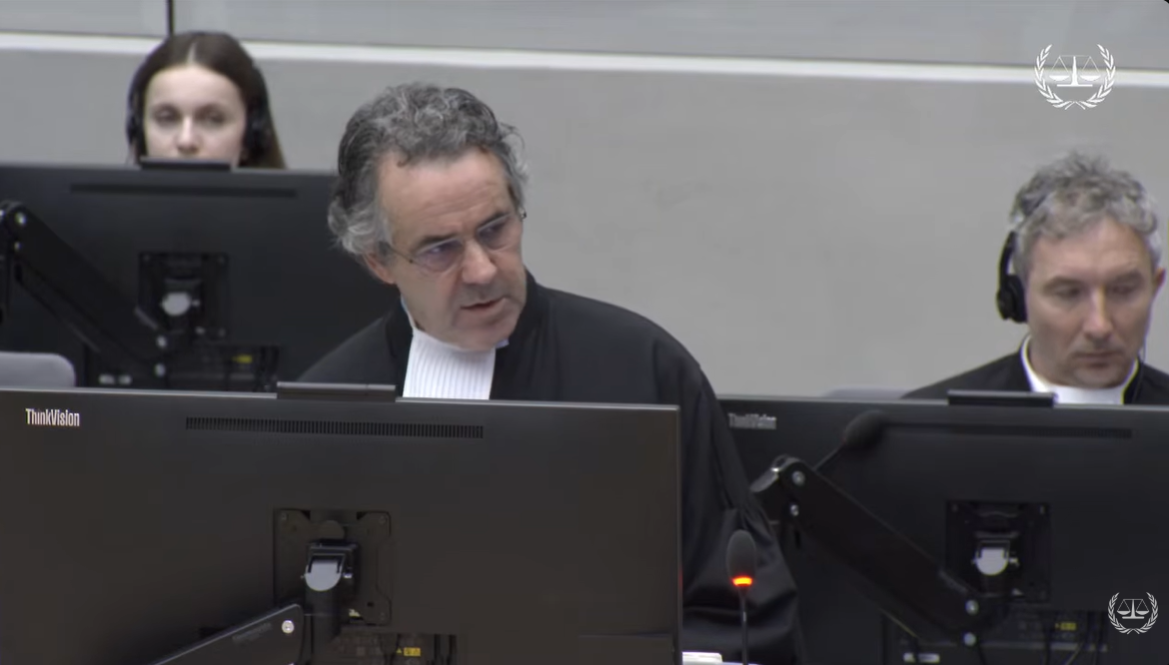
For the International Criminal Court (ICC) Prosecution, every argument given by former President Rodrigo Duterte’s legal team was proof that his crimes against humanity case must proceed to trial.
In his closing remarks, ICC Prosecutor and Senior Trial Lawyer Julian Nicholls thanked Duterte’s lawyer, Nicholas Kaufman, for their submissions on the case's merits.
“Everything he said, literally this morning, showed why this case should go to trial and that we have met the standard of substantial grounds for confirmation,” Nicholls said.
Earlier, Kaufman argued that there was no evidence linking Duterte to the killings. He also questioned the credibility of the prosecution’s witnesses and argued that police reports have the presumption of regularity.
Nicholls said his arguments sounded like a closing argument after a trial.
“The types of issues he raised today and yesterday, well, in these incidents, the first witness says x, the second witness says y. That’s what gets sorted out at trial,” he said.
“The witness that supports our charge is enough for the confirmation of charges,” he added.
Nicholls said the prosecution would prove during the trial how the police reports were often falsified through witness testimony.
“Look at this police report. It says the victim had a gun. We say the gun was planted. That is what the judges at trial will sort out by hearing the witnesses,” he said.
Nicholls also reiterated their allegation that Duterte moved his co-perpetrators from Davao to national positions.
“When he appoints the chief of police, and part of the chief of police’s job is to kill thousands of people, it’s not a surprise that the police reports don’t reflect that,” he said.
In response to Kaufman’s argument on documentation, Nicholls argued that in crimes against humanity trials, top leadership often does not put their orders to commit crimes into writing.
Nicholls cited other cases where orders directed personnel to respect the Geneva Conventions and prisoners of war.
“That was in virtually every order and it didn’t mean anything. It was boilerplate as part of their coverup,” he said.
Meanwhile, Nicholls addressed Kaufman’s argument that the word “neutralize” meant to arrest, not to kill.
“We set out in our brief, multiple witnesses for the mayoral period and for the presidential period who will testify that to neutralize means to kill,” he said.
When asked what the terms “eliminate” and “neutralize” mean, he said witnesses answered, “Kill. You have to kill, whether it is a legitimate operation or not a police operation.”
Nicholls also recalled the prosecution’s theory that Duterte tried to build a “veneer of plausible deniability” and to “give his lawyers something to say” when he made his remarks on self-defense.
“And that is exactly what happened. Mr. Kaufman has gone through, repeated this, repeated this, repeated this when he came as some kind of mantra that supposedly exculpates his client,” he said.
“It does not. As I said, this is a lawyer of Duterte who is trying to build a defense in case he is ever held to account for his crimes,” he added.
Meanwhile, Nicholls said it is up to the trial judges to rule on the credibility of witnesses. He also denied Kaufman’s claims that the witnesses have been granted “virtual immunity” from ICC proceedings.
READ: DAY IN COURT: ICC Hearings on the Charges vs. Duterte
The ICC Office of the Prosecutor has charged Duterte with 3 counts of crimes against humanity for alleged murder and attempted murder during his time as mayor and president.
In arguing that the evidence against Duterte was insufficient, the defense said that the 80-year-old did not issue specific orders to kill drug suspects in the course of his campaign to dismantle the illegal drug trade
He also cited speeches where the former President told cops to kill only in self-defense.
Nicholls criticized Kaufman for arguing as though the case were already at the trial stage and for relying heavily on police records. He said those records could not be taken at face value, noting that police reports linked to the anti-drug campaign were often falsified.The prosecution also pointed to Duterte’s authority over state institutions, arguing that violence linked to the anti-drug campaign was a foreseeable consequence of his leadership.
Nicholls argued that Duterte’s power to appoint the national police chief and the head of the Department of Justice created an environment where abuses could occur with impunity.
A central focus of the prosecution’s argument was the use of the term “neutralize.”
Nicholls said that, in the context of the case, “neutralize” was widely understood as to “kill”. He said that in crimes against humanity, it was common for there to be no written or explicit orders to kill.
Multiple witnesses, he said, consistently testified that “neutralize” meant to kill, adding that attempts to “dance around” the term were ultimately irrelevant.
Nicholls further argued that the alleged attacks were directed against a civilian population, which under international law may include not only suspected drug dealers but also users, pushers, and even individuals accused of minor crimes such as theft.
“The facts cannot be denied,” Nicholls said. “He ran a death squad. He promised to kill thousands, and he did.”
Responding to defense claims that Duterte’s public statements should not be relied upon, the prosecution said the former president’s own testimony undermined that position.
Nicholls said Duterte had, on three occasions under oath, admitted to having a death squad, demonstrating, in the prosecution’s view, a willingness to lie under oath when it suited him.
The prosecution also drew the judges’ attention to Duterte’s public remarks shortly before his transfer to The Hague, in which he told Filipinos that the killings were not done for himself or his family but for the nation.
Nicholls said Duterte even urged supporters to contribute money for a monument depicting him holding a gun rather than a book, a gesture the prosecution described as showing contempt for the court and open justification of murder as a “necessary evil.”
“He wants to be remembered as the man with the gun,” Nicholls said. “It is time for him to take responsibility for the crimes he brags about.”
Nicholls told the judges that the prosecution had met its burden at the pre-trial stage and urged them to confirm the charges and allow the case to proceed. “We have proven it,” he said. “We ask you to do it.” –NB, GMA Integrated News

