

 GMA Brandtalk
 Tracking
 Archives

When Rodrigo Duterte was arrested for crimes against humanity
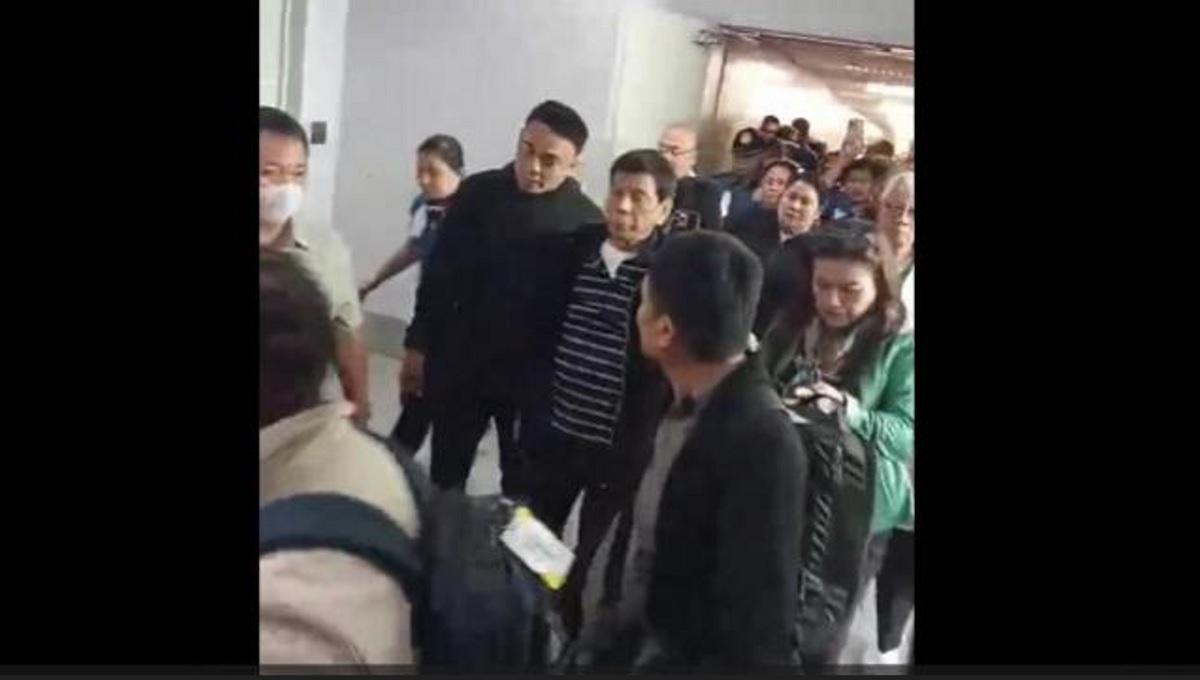
March 11, 2025, began with anticipation of what would happen in the next several hours as talk grew louder about a warrant of arrest issued by the International Criminal Court, set to be served on former President Rodrigo Duterte.
He had traveled with loved ones to Hong Kong a few days before for a thanksgiving event with overseas Filipino workers and even told his audience about the news he received.
“Nakita ninyo na patong-patong ang kaso ko... Ang balita ko may warrant daw ako... Hindi, totoo. 'Yung sa ICC or something. Matagal na akong hinahabol ng mga p–g ina,” Duterte said in his speech in Wan Chai.
(You have seen that cases have been filed against me one after the other. I heard that I supposedly have a warrant. No, it's true. From the ICC or something. They’ve been after me for a long time.)
Duterte's information, as events would show, was accurate. The Office of the Prosecutor of the ICC applied for a warrant of arrest on Duterte on Feb. 10, 2025.
Weeks later on March 7, the ICC Pre-Trial Chamber I issued the warrant, finding reasonable grounds to believe that he was individually responsible for the crime against humanity of murder as an indirect co-perpetrator.
The warrant was initially classified as secret but was made public on this day a year ago, when he was taken into custody.
I
n an exclusive interview with GMA Integrated News’ Marisol Abdurahman in the morning before his arrest, Duterte allayed concerns that he went to Hong Kong over the weekend to evade the service of the ICC warrant. He was scheduled to return to the Philippines that fateful Tuesday.
“Susmaryosep. Mas lalo akong mahuli dito (sa Hong Kong). I am here as a visitor. We do not enjoy any privileges here. Saka kung magtago ako, hindi ako magtago sa ibang lugar. Diyan ako sa Pilipinas. Diyan mo ako hindi makita,” Duterte said.
(The possibility of me getting caught is bigger here in Hong Kong. I am here as a visitor. We do not enjoy any privileges here. Besides, if ever I hide, I won't hide anywhere else. I will hide in the Philippines. You won't see me there.)
Duterte also indicated that how he would deal with the warrant. “I would say that not really appear or non-appearance, but I will deal with the problem directly as a lawyer," the former Philippine leader said.
Duterte said that he regretted nothing about what he did when he was President.
Before dawn, according to the Presidential Communications Office, the Interpol in Manila received the ICC warrant.
At 9:20 a.m., at the Ninoy Aquino International Airport, Duterte and his party arrived onboard Cathay Pacific Flight CX 907. He was met by the authorities upon his arrival.
"Kaninang madaling araw, natanggap ng Interpol Manila ang official copy ng warrant of arrest mula sa International Criminal Court (ICC),” the PCO said.
(Early this morning, Interpol Manila received the official copy of the warrant of arrest from the International Criminal Court.)
“Sa kanyang pagdating, inihain ng Prosecutor General ang ICC notification para sa isang arrest warrant sa dating Pangulo para sa krimen laban sa sangkatauhan,” it added.
(Upon his arrival, the Prosecutor General served the ICC notification for an arrest warrant on the former President for crimes against humanity.)
Tension at Villamor Airbase
Former presidential legal counsel Atty. Salvador Panelo branded the arrest as unlawful, saying that the Philippine National Police did not even allow one of Duterte's lawyers to meet him at the airport and question the legal basis for his arrest.
Duterte was then brought to Villamor Airbase, where former officials from his administration tried to stop his arrest by questioning its legal basis.
At 4:27 p.m., the Supreme Court received a petition for certiorari and prohibition from petitioners Duterte and Senator Ronald dela Rosa, asking the High Tribunal to keep Philippine authorities from cooperating in any way with the ICC.
Tensions arose as Duterte's partner, Honeylet Avanceña, and daughter Veronica ''Kitty'' Duterte tried to keep the police from taking the family patriarch.
"Anong kasalanan ko?" Duterte was heard as saying, as the police insisted on taking him.
(What sin have I committed?)
Vice President Sara Duterte, the former President's daughter, was kept from the premises of Villamor Airbase to speak to her father. She described the incident as ''state kidnapping.''
Around 8 p.m., Sara Duterte obtained from the Office of the President authority to travel to Germany, France, Belgium, and The Netherlands for the period March 11 to April 30.
At 11:03 p.m., a Gulfstream G550 aircraft with tail number RP-C5219, carrying Duterte left the Villamor Air Base in Pasay and headed for The Hague, The Netherlands.
A few minutes after the plane carrying him took off, President Ferdinand ''Bongbong'' Marcos Jr. announced in a news conference that his predecessor was en route to the Netherlands to face charges in connection with the killings during the past administration's war on drugs.
'The plane carrying former President Rodrigo Roa Duterte took off at 11:03 p.m. this evening and exited Philippine air space," Marcos said in a news conference.
"The plane is en route to The Hague in the Netherlands allowing the former president to face charges of crimes against humanity in relation to his bloody war on drugs,'' he added.
On March 12, Duterte was surrendered to the custody of the ICC.
On March 13, he was was brought to The Hague Penitentiary Institution or the Scheveningen Prison aboard a black vehicle.
Supporters who have gathered outside the prison chanted "We love Duterte" and "Bring him back" as the convoy entered the facility.
The plane bringing Duterte to the Netherlands landed at the Rotterdam The Hague airport at 4:54 p.m. (11:54 p.m. Philippine time).
The 79-year-old former Philippine leader was handed over to the ICC on Wednesday after it issued a warrant for his arrest over his deadly crackdown on drugs.
The ICC arrest warrant said that as president, Duterte created, funded, and armed the death squads that carried out murders of purported drug users and dealers.
"Mr Rodrigo Roa Duterte... was surrendered to the custody of the International Criminal Court," the ICC said in a statement.
On March 14, a seemingly frail Duterte, wearing a blue suit and tie, faced the ICC via a video link.
Despite being in detention, Duterte even won as Davao City mayor in the May 2025 elections, but his son, Davao City Vice Mayor Sebastian Duterte, was directed by the Department of the Interior and Local Government to assume the role of acting mayor.
E
xactly a year after his arrest on crimes against humanity charges, the 79-year-old Duterte remains behind bars in a foreign land, regularly visited by his family members, particularly his children.
The ICC's Appeals Chamber recently affirmed the Pre-Trial Chamber I's ruling to detain Duterte while awaiting trial in connection with the alleged killings and abuses in his bloody campaign against illegal drugs during his stint as Davao City mayor and president of the Philippines.
This decision came after the Pre-Trial Chamber I had held hearings to decide whether to confirm the charges and proceed with a full trial as regards Duterte's case.
The hearing on the confirmation of charges took place in the absence of Duterte after the Chamber had granted his request to waive his right to attend the proceedings. Like when he was still president, Duterte refused to recognize ICC's jurisdiction over him.
In line with Regulation 53 of the Regulations of the Court, the Pre-Trial Chamber shall deliver its written decision on the matter within 60 days of the date on which the confirmation hearing ends.
'Accepted his fate'
Through his lawyer Nicholas Kaufman, Duterte has said that he has “accepted his fate” and the possibility that he could die while in prison.
To recall, the ICC Office of the Prosecutor has charged Duterte with three counts of crimes against humanity for alleged murder and attempted murder due to the extrajudicial killings in relation to his war on drugs.
Judge Iulia Antoanella Motoc (presiding judge), as well as Judges Reine Adélaïde Sophie Alapini-Gansou and María del Socorro Flores Liera are deliberating whether there is sufficient evidence to establish substantial grounds to believe that the former Philippine leader indeed committed crimes against humanity of murder and attempted murder.
The Pre-Trial Chamber may then:
- confirm those charges for which the Chamber has determined that there is sufficient evidence, and commit the suspect to trial before a Trial Chamber;
- decline to confirm those charges for which it has determined that there is insufficient evidence and stop the proceedings against Duterte;
- adjourn the hearing and request the Prosecutor to provide further evidence, to conduct further investigations or to amend any charge for which the evidence submitted appears to establish a crime other than the one charged was committed.
According to the ICC, the defense and the prosecution cannot directly appeal the decision. However, they can request authorization from the Pre-Trial Chamber to appeal it.
Meanwhile, coinciding with the first year since Duterte's arrest, Senator Imee Marcos, the President's sister, filed a resolution calling on the Executive department to fully disclose all communications and directives in its cooperation with the international body regarding the former president's arrest.
The senator had already led a prior investigation of the arrest, stating she found glaring violations of due process and the rule of law.
The Marcos administration has since maintained that the government only honored its commitments with the Interpol as regards the controversial arrest, noting that due process was observed at that time amid criticisms that what happened was a circumvention of the Philippine justice system. —NB/LDF, GMA Integrated News

