

 GMA Brandtalk
 Tracking
 Archives

CHED, Landbank partner to provide ATM cards to 2M scholars

CLARK, Pampanga — The Commission on Higher Education (CHED) and Land Bank of the Philippines (Landbank) have signed a partnership to streamline the distribution of government scholarships and subsidies by providing Automated Teller Machine (ATM) cards to student beneficiaries.
Under the agreement, financial assistance for programs such as the Tertiary Education Subsidy (TES) and other scholarships will be deposited directly into students’ bank accounts, instead of being distributed manually through schools, regional offices, or at events in the presence of politicians or local government units.
CHED chairperson Dr. Shirley Agrupis explained that under the Universal Access to Quality Tertiary Education Act (R.A. 10931), tuition for students in state and local universities is paid directly to schools, but many still need financial support for daily expenses.
“Students alone cannot survive on free tuition,” she said, noting that the government also implements the TES for students from low-income households, particularly those listed under the Pantawid Pamilyang Pilipino Program (4Ps) of the Department of Social Welfare and Development.
She said around 357,000 incoming freshmen currently qualify for TES based on DSWD data.
Aside from TES, CHED also administers other scholarship programs, including the Tulong Dunong Program, the Merit Scholarship Program for students in fields such as medicine and allied health sciences, and the Presidential Merit Scholarship, which provides about 20,000 slots for top-performing senior high school graduates pursuing priority programs identified by education planners.
Agrupis said the initiative aims to address long-standing delays in releasing student allowances.

“Ang pain points dito kasi because sa dami nila [scholar], we [prepare their payouts manually], so, medyo nagtatagal,” she said. She noted that the process currently passes through several bureaucratic steps before reaching students.
With the new system, scholars will receive ATM cards where their financial assistance will be directly credited.
“One-time big time na ang issuance ng ATM… then maybe we will wait three months to validate and everything at makukuha na nila,” she said.
The program is expected to cover as many as two million students nationwide who benefit from government scholarship and subsidy programs.
Agrupis said the rollout is targeted for the first semester of academic year 2026–2027.
Direct and digital distribution
The ATM system will allow scholars to access funds through digital banking services instead of receiving checks or cash payouts through universities or LGUs.
Previously, funds were often processed through regional offices and schools before reaching students.
“Before, it’s either voucher check or i-de-distribute sa regional offices, then the university will distribute the allowances,” Agrupis said.
CHED said the shift to digital banking is also expected to reduce delays caused by manual validation and limited staffing in some regional offices.
Addressing audit concerns
Agrupis said the shift to digital payouts could also help address past audit concerns about unliquidated scholarship funds.
A 2024 audit report by the Commission on Audit (COA) found that about P647 million in CHED Merit Scholarship Program funds remained unliquidated as of December 31, 2024. State auditors said the amount involved transfers to higher education institutions under CHED Regional Offices 4B (Mimaropa) and 12 (Soccsksargen) covering academic years 2019–2020 to 2023–2024.
Agrupis said delays in liquidation were partly due to the lack of a unified digital system and limited manpower in some CHED offices. She noted that some CHED regional offices have faced staffing constraints while processing scholarship validation and documentation.
“Sana maintindihan nila na kung meron man unliquidated sa CHED, it's not because there is something wrong, but it is because [we are understaffed] and then the [digitalized] system talaga ay hindi pa in place,” she said.
Agrupis said strengthening digital systems is now part of CHED’s reform agenda, describing digitalization as one of the key enablers under the Commission’s ACHIEVE agenda.
“This is one of the offshoots of the non-digitalized system. Kaya po in-a-[address] po namin ito,” she said.
Support for agriculture students
Another agreement signed during the event expands financial support for students taking agriculture and fisheries programs.
The CHEd official said this aligns with the government’s priority to strengthen the agriculture sector and fill workforce gaps in key industries.
The agreement includes additional scholarships and institutional support for universities offering agriculture-related programs.
“Unang-una po is to give scholarship to our students who want to enroll in agri-related programs. Number two is the capacity building of our higher education institutions in order to modernize their programs,” Agrupis said.
“Kasi mahirap naman na ituro mo lang mga theories and principles in agriculture kung wala talaga silang pag-practice-an in and out of the laboratory,” she added.
Long-term partnership
For Landbank, the partnership is expected to bring more students into the formal banking system while ensuring faster distribution of government assistance.
Landbank president and CEO Lynette Ortiz said the bank will provide deposit accounts and ATM cards with access to digital banking services.
“We offer basic deposit accounts with an ATM that allows them mobile banking access,” Ortiz said.
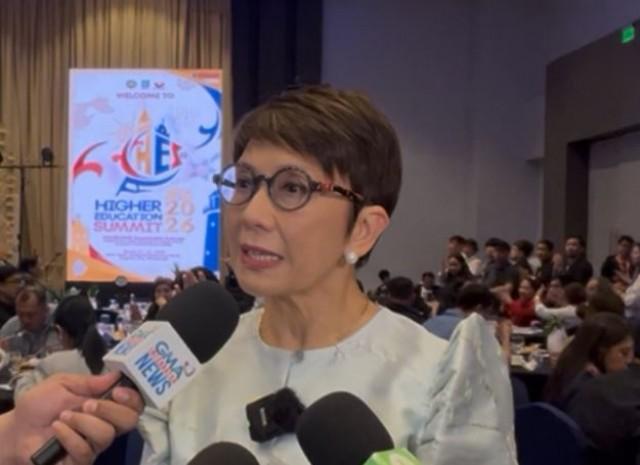
She described the agreement as part of a broader and long-term collaboration between Landbank and CHED.
“This becomes more enduring, it becomes deeper and broader in scale,” she said.
The partnership was inked on the final day of the Higher Education Summit: Achieving Sustainable Futures: Transformative Higher Education for Human Capital, Innovation, and Global Responsibility, held March 10–12 at the SMX Convention Center Clark and National University Clark, which gathered leaders from state universities and colleges, local universities and colleges, and private higher education institutions. —LDF, GMA Integrated News

