

 GMA Brandtalk
 Tracking
 Archives

Urban advantage falls short: NCR cities show high rates of struggling readers
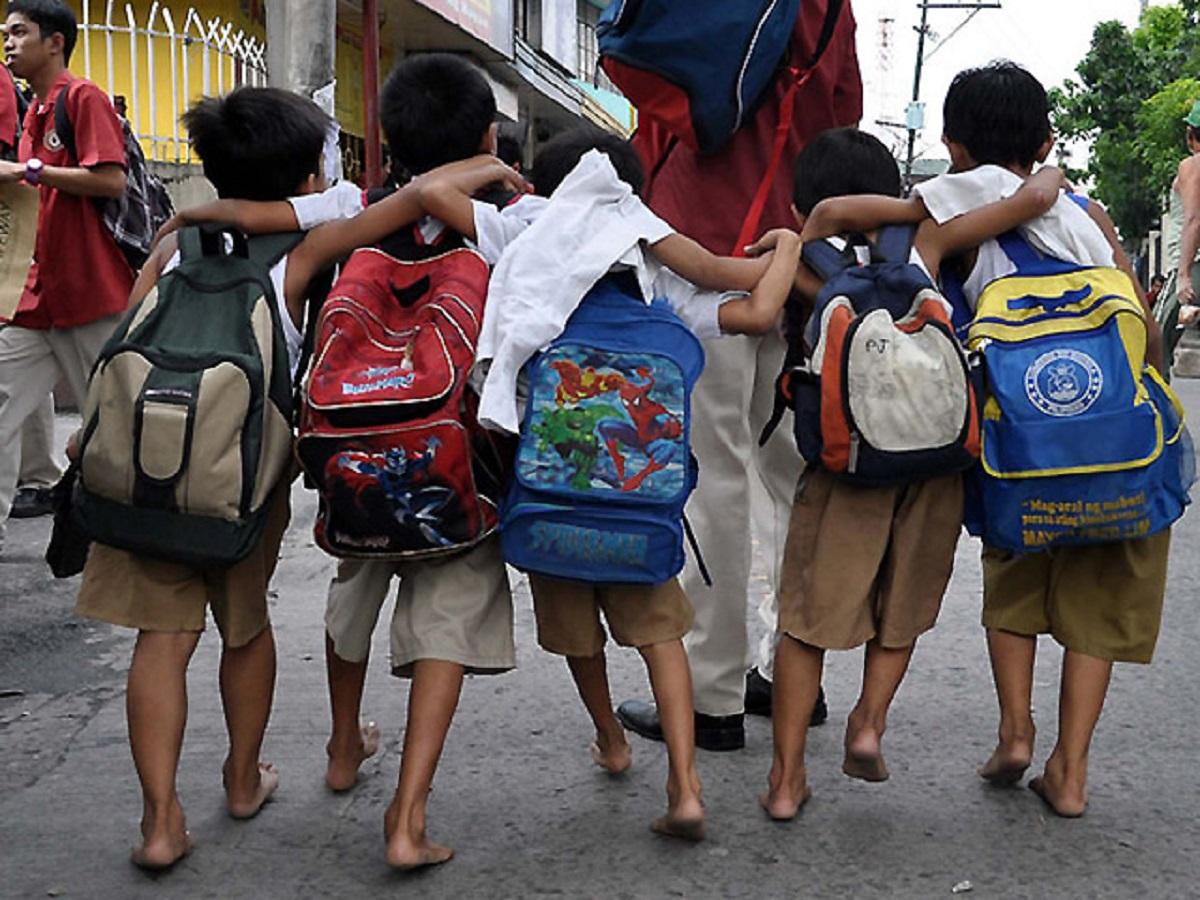
Cities across Metro Manila and other highly urbanized areas show significant levels of struggling readers among early-grade learners, according to data from the Second Congressional Commission on Education (EDCOM II), highlighting uneven literacy outcomes even in the country’s most developed urban centers.
Based on the Comprehensive Rapid Literacy Assessment (CRLA) for School Year 2025–2026, the proportion of learners classified as struggling readers varies significantly across cities in the National Capital Region (NCR).
Pasay City posted one of the highest shares at 47.50%, followed by Muntinlupa City (45.29%), City of Manila (44.43%), Las Piñas (44.22%), and Parañaque City (43.87%).
Other NCR cities recorded the following levels of struggling readers:
- Caloocan City – 33.07%
- Makati City – 32.19%
- Malabon City – 43.18%
- Mandaluyong City – 41.43%
- Marikina City – 38.10%
- Navotas City – 43.20%
- Pasig City – 39.36%
- Pateros – 41.19%
- Quezon City – 39.71%
- San Juan City – 36.63%
- Taguig City – 38.03%
- Valenzuela City – 27.44%
Valenzuela City recorded the lowest share among NCR cities at 27.44%, while most others clustered between 38% and 47%.
Challenges for Metro Manila schools
Luigi Conti, EDCOM II Communications and Advocacy Head, said that despite their "urban advantage," big cities like those in Metro Manila "face significant literacy challenges."
He points to three factors:
- Severe school congestion. "Classrooms in Metro Manila frequently exceed standard class sizes, making it nearly impossible for teachers to provide the individualized reading interventions that struggling learners desperately need," Conti said.
- Double or even triple shifts due to a lack of classrooms. "EDCOM 2 findings point out that this shifting system drastically reduces the actual instructional time each student receives. When students are only in school for a compressed half-day schedule, there is less time dedicated to foundational skills like reading, and teachers are prone to rapid burnout, heavily impacting the quality of instruction," he said.
- High rates of migration from the provinces for economic opportunities. "Many families relocate to cities like Manila or Quezon City mid-school year or bring children who may have already been left behind by the education system in their home provinces. This continuous influx means urban schools are constantly absorbing transferring students who may already have significant literacy gaps, compounding the difficulty of raising the overall reading readiness of the city's student population," Conti said.
"In short, the presumed 'urban advantage' is canceled out by the sheer volume of students, reduced learning hours per child, and socioeconomic challenges in urban centers," he added.
Conti said that this data is from the beginning of the school year, so progress should again be measured at the end of the school year.
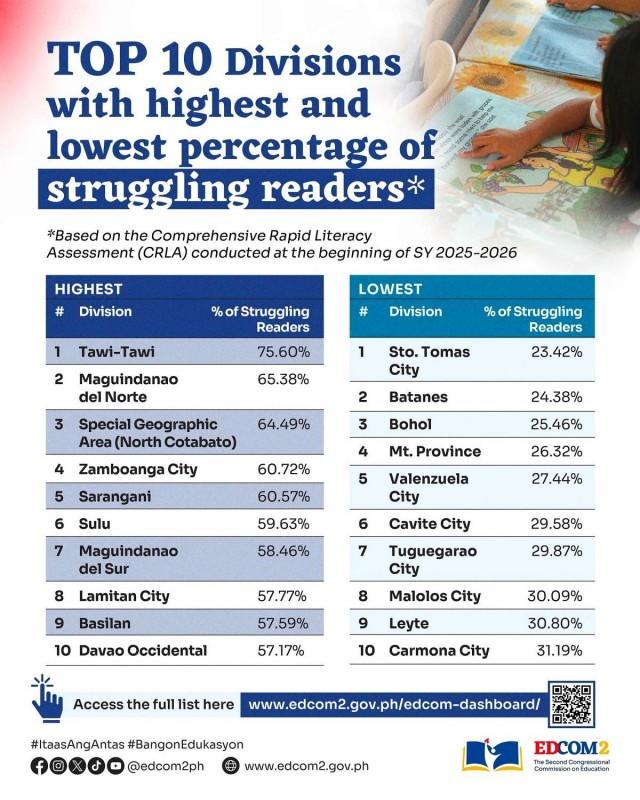
Other highly urbanized cities
Outside Metro Manila, highly urbanized cities also showed a wide range of results, with several areas reporting that nearly half, or more—of early-grade learners are struggling readers.
Zamboanga City posted the highest share among listed cities at 60.74%, followed by Iloilo City (51.93%), Cagayan de Oro City (50.50%), and Tacloban City (49.95%).
Other cities recorded:
- General Santos City – 48.66%
- Angeles City – 47.78%
- Olongapo City – 47.24%
- Cebu City – 46.85%
- Lapu-Lapu City – 45.64%
- Puerto Princesa City – 45.24%
- Davao City – 44.82%
- Bacolod City – 43.91%
- Iligan City – 43.24%
- Baguio City – 41.79%
- Lucena City – 40.18%
- Mandaue City – 39.70%
- Butuan City – 35.38%
CRLA
The CRLA was conducted nationwide to quickly assess the reading ability of early-grade learners and identify students needing urgent literacy interventions.
The city-level variation comes amid broader concerns raised by EDCOM II over what it described as a “learning crisis,” noting that around 85% of Grade 1 to Grade 3 learners nationwide are considered struggling readers.
EDCOM II clarified with GMA News Online that differences in reported figures may arise due to changes in methodology and how data is organized.
Earlier versions of its dashboard included “Developing Readers” in the count of struggling readers, alongside “Low Emerging Readers” and “High Emerging Readers.” This has since been revised, with the definition now limited to the latter two categories.
The commission also noted that its dashboard presents data by local government unit (LGU), while figures released in its social media materials are organized by DepEd division, which do not have a one-to-one correspondence.
Despite these differences, EDCOM II said the data is consistent with figures from the Department of Education’s CRLA National Dashboard and is intended to guide targeted interventions to address early literacy gaps across the country. — BM, GMA Integrated News

